
Table of Contents
- Mattress Sagging Causes: Why Your Bed Sinks in the Middle
- How to Identify Sagging vs. Normal Softness
- Mattress Support and Bed Frame: The Foundation That Prevents Sag
- How Often to Rotate a Mattress (And Why It Matters)
- How to Fix a Sagging Mattress: Temporary Repairs vs. Real Fixes
- Flippable vs. One-Sided Mattresses: Care That Matches the Design
- Measuring Sag and Checking Warranty Coverage
- Frequently Asked Questions
Last Updated: October 18, 2026
Mattress Sagging Causes: Why Your Bed Sinks in the Middle
Mattress sagging is the permanent compression of the comfort layers in the spot where you sleep, and it usually starts long before you notice it. At Durable Mattress, we see the same pattern again and again: the dip forms where body weight concentrates, not where the bed gets the most use.
The causes stack up fast:
- Body weight in one spot. Hips and shoulders press into the same few inches of foam every night.
- Weak support underneath. Slats that bow, a box spring past its prime, or no center rail on a queen or king.
- Heat and moisture. Trapped sweat and warmth break down foam faster. A cool, dry bed lasts longer.
Here's what most guides miss: sagging is rarely a mattress problem alone. It's a support system problem. Fix the foundation and you slow the wear.
A mattress only sags as much as the support beneath it allows. Check the frame before you blame the bed.
How to Identify Sagging vs. Normal Softness
Normal softness feels even across the whole sleep surface. Sagging is localized and stays put after you get up.
Try this simple test. Lay a straight edge, like a broom handle or a ruler, across the dip and measure the gap underneath. A dip of 1 inch or more is the point where most warranties consider it a real problem, so measure before you call anyone.
Watch for these signs:
- A visible body impression that doesn't bounce back within a few minutes
- Rolling toward the middle when you lie near the edge
- Waking with hip or lower back pain that eases once you're up
Softness you can press through and recover from is comfort. A crater that stays is wear.
Mattress Support and Bed Frame: The Foundation That Prevents Sag
The single best way to prevent mattress sagging is a rigid, well-ventilated foundation. A firm base spreads weight across the whole mattress instead of letting it pool in the middle.
Foundation Compatibility by Mattress Type
| Mattress Type | Best Foundation | Slat Spacing | Center Support | Adjustable Base |
|---|---|---|---|---|
| Foam and memory foam | Solid platform or closely spaced slats | 2-3 inches or less | Required on queen and king | Check manufacturer approval; some foam beds flex poorly on adjustable bases |
| Innerspring | Box spring or slatted base that flexes with the coils | 3 inches or less | Required on queen and king | Usually compatible if the base has a solid deck or close slats |
| Hybrid | Firm platform or slats with a center rail | 3 inches or less | Required on queen and king | Often compatible; confirm the coil core is rated for articulation |
| Latex | Solid platform or closely spaced slats | 2-3 inches or less | Required on queen and king | Check manufacturer guidance; latex is heavy and may need a reinforced deck |
Slat spacing matters because a mattress bridges the gaps between slats. Wider gaps let the comfort layers dip between them, and the dip becomes permanent over time. Gaps under about 3 inches are the common standard; foam and latex do best at 2-3 inches or less.
Checking Slats, Center Support, and Box Springs
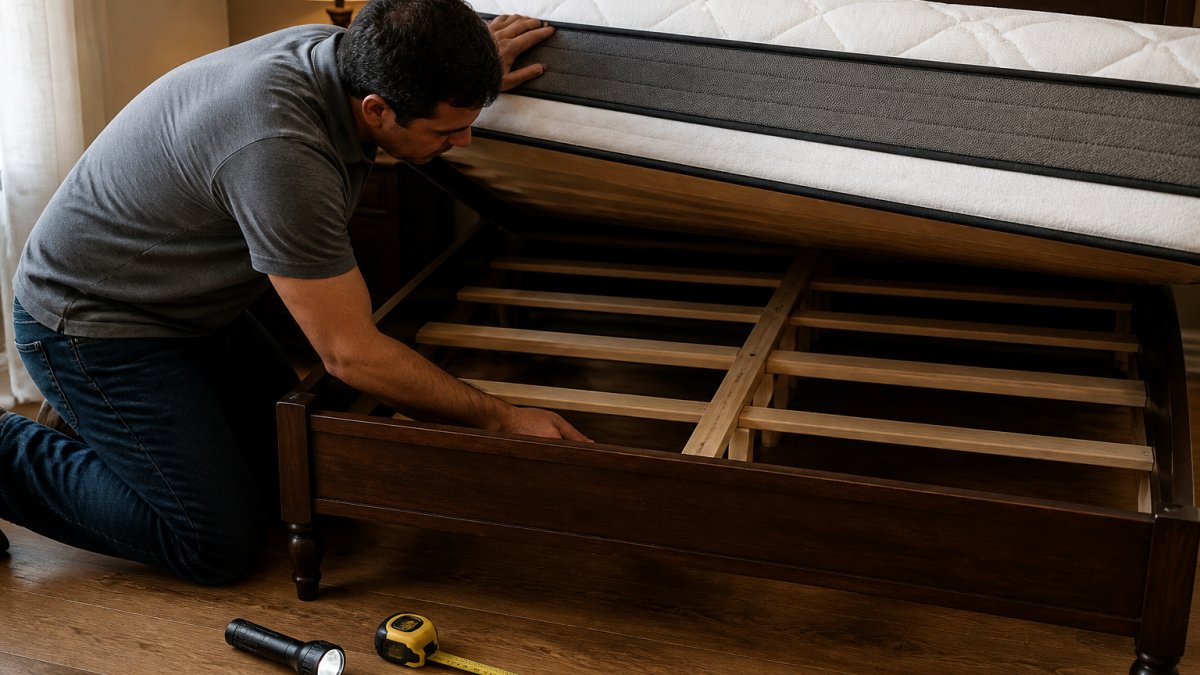
On a queen or king, a center support rail with a leg to the floor is not optional. It carries the middle, which is exactly where sagging starts. Without it, the mattress bridges a gap and caves in the center within a couple of years.
Press down on each slat. If one bows or cracks, replace it. Look for slats that have slipped out of their brackets or bowed under the mattress weight.
Adjustable Bases: What to Check Before You Buy
An adjustable base can be a good foundation, but not every mattress is built for it. Before pairing a mattress with an adjustable base:
- Confirm the mattress is rated for articulation. Foam and hybrid beds usually are; some innerspring and latex beds are not.
- Check that the base has a solid deck or slats close enough to support the mattress in the flat position.
- Make sure the base has a center support or a reinforced deck for queen and king sizes.
Skipping the center support on a queen or king is the most common cause of middle sag. Without it, the mattress bridges a gap and caves in the center within a couple of years.
Ventilation and Moisture
A foundation that traps heat and moisture accelerates foam breakdown. Slatted bases ventilate better than solid platforms, and a breathable mattress protector helps keep sweat away from the comfort layers. If you live in a humid climate or sleep hot, prioritize airflow under the mattress, a solid platform with no ventilation can trap moisture and soften foam faster.
Match the foundation to the mattress type, keep slat gaps under 3 inches, and never skip the center support on a queen or king. The foundation is the cheapest part of the sleep system to fix and the most common cause of preventable sag.
How Often to Rotate a Mattress (And Why It Matters)
Rotation is the cheapest prevention tool you own, but "rotate every few months" is too vague to act on. The right interval depends on your mattress construction, your body weight, and how many sleepers share the bed. Use the schedule below as a starting point, then tighten it if you notice early softening.
A Practical Rotation and Inspection Schedule
| Task | How Often | What to Look For |
|---|---|---|
| Head-to-foot rotation (180 degrees) | Every 3 months for foam and hybrid; every 6 months for innerspring | Fresh pressure points under hips and shoulders |
| Flip (flippable beds only) | Every 3-6 months, paired with rotation | Even wear across both sleep faces |
| Slat and frame check | Every 6 months | Bowed slats, cracked rails, missing center leg |
| Full inspection and sag measurement | Once a year | A dip of 1 inch or more under a straight edge |
| Mattress tag date check | At every rotation | Confirm the flip or rotation date is written down |
A 180-degree rotation moves your body's pressure points to a fresh section of the sleep surface. That spreads wear and delays the dip. Mark the date on the mattress tag with a marker so the schedule stays honest, a calendar reminder works too, but the tag travels with the bed.
Why the Interval Changes by Mattress Type
- Memory foam and polyurethane foam: These soften fastest under concentrated load. A 3-month rotation is a reasonable default, especially for sleepers over 200 pounds or couples who sleep close to the center.
- Innerspring: Steel coils hold their shape longer, but the comfort layers above them still compress. A 6-month rotation is usually enough unless the mattress has a pillow-top or euro-top, which behaves more like foam.
- Hybrid: Treat it like foam for the top layers and like innerspring for the coil core. A 3-6 month rotation covers both.
One-Sided vs. Flippable: Different Rules
A one-sided mattress only rotates. The support core sits on the bottom and is not built to sleep on, so flipping it can damage the foundation layers and may void the warranty.
A flippable mattress gives you two sleep surfaces. Flip and rotate on the same schedule to redistribute wear across both faces. If one side starts to soften, flip to the fresh surface instead of shopping for a replacement.
Pair Rotation With a Quick Inspection
Ten minutes twice a year is cheaper than a new mattress. At each rotation:
- Vacuum the sleep surface and the foundation to remove dust and allergens.
- Press down on each slat and the center rail; replace any that bow or crack.
- Run a straight edge across the sleep surface and note any dip.
- Check the box spring or foundation for broken springs, a sagging top, or new squeaks.
- Photograph the tag date and any visible impression for your records.
Set a phone reminder for the first weekend of January, April, July, and October. Quarterly reminders match the 3-month foam schedule and are easy to remember.
If you share the bed, rotate more often, two sleepers concentrate weight in the same zones and accelerate compression. Couples over 200 pounds each may benefit from a 2-3 month rotation on a foam mattress.
How to Fix a Sagging Mattress: Temporary Repairs vs. Real Fixes
A quick fix buys time. A real fix stops the sag from coming back.
Temporary repairs:
- Add a mattress topper to level the dip
- Slide a plywood board or a support insert under the sagging zone
- Tighten or add slats and a center leg
Real fixes:
- Replace a worn box spring or bowed slats
- Add proper center support to the frame
- Rotate or flip the mattress to a fresh side
The difference matters. A topper hides the problem; fixing the foundation solves it. Start with the support system, then decide if the mattress itself needs replacing.
Flippable vs. One-Sided Mattresses: Care That Matches the Design
One-sided mattresses only rotate. Flippable mattresses rotate and flip, which doubles the usable sleep surface and spreads wear across both sides.
For a one-sided bed, rotate head-to-foot every three to six months and never flip it. The support core sits on the bottom and isn't built to sleep on.
For a flippable design, you get two sleep sides. Flip and rotate on the same schedule to redistribute wear across both faces.
Write the flip date on the mattress tag with a marker. It's the easiest way to keep the schedule honest.
Measuring Sag and Checking Warranty Coverage
Measure the dip before you file a claim, because warranty coverage usually has a threshold. Lay a straight edge across the sag, measure the gap, and photograph it with a ruler in frame.
Then check the fine print:
- Foundation requirement. Many warranties are void if you used an unsupportive base.
- Proper support. Missing center support can disqualify a claim.
- Normal softening. Body impressions under the threshold usually aren't covered.
If the sag is real and the support was right, warranty replacement may apply. For guidance on mattress care and materials, the Consumer Product Safety Commission and sleep health guidance from the National Institutes of Health are useful starting points.
Frequently Asked Questions
Why is my mattress sagging after only 3 months?
Early sagging usually points to a support problem, not a defective mattress. Check the bed frame first: slats spaced more than 2 to 3 inches apart, a missing center rail, or a worn box spring can let the mattress sink within weeks. Memory foam also softens slightly in the first month as it adjusts to room temperature, which is normal. If the dip is deeper than about 1 inch and the foundation checks out, document it with photos and a straight edge and contact the retailer about warranty coverage.
How often should you rotate a mattress to prevent sagging?
Rotate a mattress head to foot every 3 to 6 months during the first year, then every 6 to 12 months after that. A 180-degree rotation spreads body weight across a fresh section of the sleep surface and reduces localized sagging where hips and shoulders press hardest. Set a calendar reminder so you do not forget. If you sleep alone, rotate more often, since one side takes all the wear. Flippable mattresses can also be turned over, which doubles the usable surface.
Can a bed frame cause a mattress to sag?
Yes. Mattress support and bed frame quality decide how evenly weight distributes across the sleep surface. Slats spaced wider than 3 inches, weak or bowed slats, and frames without a center support rail let the middle of the mattress drop. Box springs older than 8 to 10 years also lose their structure. For foam and hybrid mattresses, a solid platform or closely spaced slats work best. Add a center rail on queen and king sizes and check the frame annually for cracks or loose hardware.
Does flipping a mattress help prevent sagging?
Flipping helps only if the mattress is designed for it. Two-sided flippable mattresses can be turned over to use a fresh sleep surface, which spreads wear and extends mattress lifespan. One-sided mattresses should never be flipped, only rotated head to foot, because the support core sits on the bottom. Check the care label before you flip. If you own a flippable model, flip it every 6 months alongside your rotation schedule for the most even wear distribution.
Preventing mattress sagging comes down to three habits: support the bed properly, rotate on schedule, and catch dips early. Durable Mattress builds 2-sided flippable hybrid mattresses in Medium, Firm, and Soft so you can flip to a fresh surface and get more years from your investment. Our dual-sided design is made to be flipped for longer life, with the support and comfort to match your sleep style. Ready to stop replacing sagging beds? Shop Mattresses and find your fit.

Double the life of your mattress today
Our mattresses will help you get the sleep you need. Not sure which one’s right for you? Check out our firmness guide below.