
Table of Contents
- Mattress Sagging Causes: Why Your Bed Sinks in the Middle
- How to Identify Sagging vs. Normal Softness
- Mattress Support and Bed Frame: The Foundation That Prevents Sag
- How Often to Rotate a Mattress (And Why It Matters)
- How to Fix a Sagging Mattress: Temporary Repairs vs. Real Fixes
- Flippable vs. One-Sided Mattresses: Care That Matches the Design
- Measuring Sag and Checking Warranty Coverage
- Frequently Asked Questions
Last Updated: October 18, 2026
Mattress Sagging Causes: Why Your Bed Sinks in the Middle
Mattress sagging is the permanent compression of the comfort layers in the spot where you sleep, and it usually starts long before you notice it. At Durable Mattress, we see the same pattern again and again: the dip forms where body weight concentrates, not where the bed gets the most use.
The causes stack up fast:
- Body weight in one spot. Hips and shoulders press into the same few inches of foam every night.
- Weak support underneath. Slats that bow, a box spring past its prime, or no center rail on a queen or king.
- Heat and moisture. Trapped sweat and warmth break down foam faster. A cool, dry bed lasts longer.
Here's what most guides miss: sagging is rarely a mattress problem alone. It's a support system problem. Fix the foundation and you slow the wear.
A mattress only sags as much as the support beneath it allows. Check the frame before you blame the bed.
How to Identify Sagging vs. Normal Softness
Normal softness feels even across the whole sleep surface. Sagging is localized and stays put after you get up.
Try this simple test. Lay a straight edge, like a broom handle or a ruler, across the dip and measure the gap underneath. A dip of 1 inch or more is the point where most warranties consider it a real problem, so measure before you call anyone.
Watch for these signs:
- A visible body impression that doesn't bounce back within a few minutes
- Rolling toward the middle when you lie near the edge
- Waking with hip or lower back pain that eases once you're up
Softness you can press through and recover from is comfort. A crater that stays is wear.
Mattress Support and Bed Frame: The Foundation That Prevents Sag
The single best way to prevent mattress sagging is a rigid, well-ventilated foundation. A firm base spreads weight across the whole mattress instead of letting it pool in the middle.
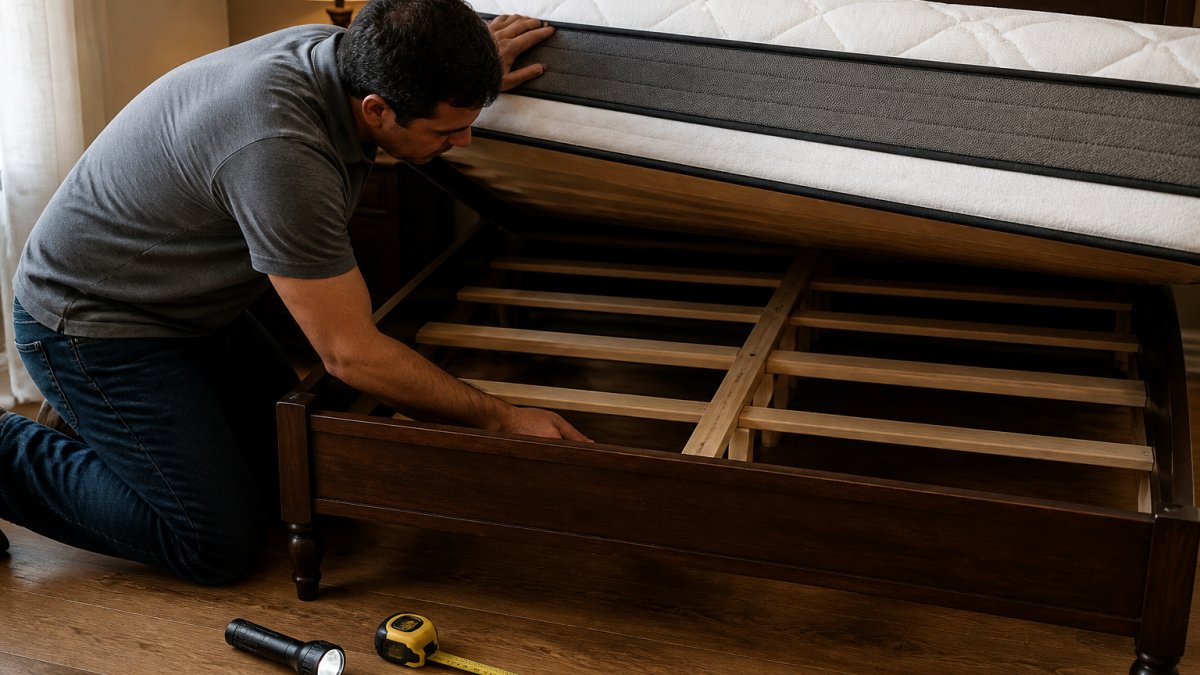
Foundation Compatibility by Mattress Type
| Mattress Type | Best Foundation | Slat Spacing | Center Support | Adjustable Base |
|---|---|---|---|---|
| Foam and memory foam | Solid platform or closely spaced slats | 2-3 inches or less | Required on queen and king | Check manufacturer approval; some foam beds flex poorly on adjustable bases |
| Innerspring | Box spring or slatted base that flexes with the coils | 3 inches or less | Required on queen and king | Usually compatible if the base has a solid deck or close slats |
| Hybrid | Firm platform or slats with a center rail | 3 inches or less | Required on queen and king | Often compatible; confirm the coil core is rated for articulation |
| Latex | Solid platform or closely spaced slats | 2-3 inches or less | Required on queen and king | Check manufacturer guidance; latex is heavy and may need a reinforced deck |
Slat spacing matters because a mattress bridges the gaps between slats. Wider gaps let the comfort layers dip between them, and the dip becomes permanent over time. Gaps under about 3 inches are the common standard; foam and latex do best at 2-3 inches or less.
Checking Slats, Center Support, and Box Springs
On a queen or king, a center support rail with a leg to the floor is not optional. It carries the middle, which is exactly where sagging starts. Without it, the mattress bridges a gap and caves in the center within a couple of years.
Press down on each slat. If one bows or cracks, replace it. Look for slats that have slipped out of their brackets or bowed under the mattress weight.
Adjustable Bases: What to Check Before You Buy
An adjustable base can be a good foundation, but not every mattress is built for it. Before pairing a mattress with an adjustable base:
- Confirm the mattress is rated for articulation. Foam and hybrid beds usually are; some innerspring and latex beds are not.
- Check that the base has a solid deck or slats close enough to support the mattress in the flat position.
- Make sure the base has a center support or a reinforced deck for queen and king sizes.
Skipping the center support on a queen or king is the most common cause of middle sag. Without it, the mattress bridges a gap and caves in the center within a couple of years.
Ventilation and Moisture
A foundation that traps heat and moisture accelerates foam breakdown. Slatted bases ventilate better than solid platforms, and a breathable mattress protector helps keep sweat away from the comfort layers. If you live in a humid climate or sleep hot, prioritize airflow under the mattress, a solid platform with no ventilation can trap moisture and soften foam faster.
Match the foundation to the mattress type, keep slat gaps under 3 inches, and never skip the center support on a queen or king. The foundation is the cheapest part of the sleep system to fix and the most common cause of preventable sag.
How Often to Rotate a Mattress (And Why It Matters)
Rotation is the cheapest prevention tool you own, but "rotate every few months" is too vague to act on. The right interval depends on your mattress construction, your body weight, and how many sleepers share the bed. Use the schedule below as a starting point, then tighten it if you notice early softening.
A Practical Rotation and Inspection Schedule
| Task | How Often | What to Look For |
|---|---|---|
| Head-to-foot rotation (180 degrees) | Every 3 months for foam and hybrid; every 6 months for innerspring | Fresh pressure points under hips and shoulders |
| Flip (flippable beds only) | Every 3-6 months, paired with rotation | Even wear across both sleep faces |
| Slat and frame check | Every 6 months | Bowed slats, cracked rails, missing center leg |
| Full inspection and sag measurement | Once a year | A dip of 1 inch or more under a straight edge |
| Mattress tag date check | At every rotation | Confirm the flip or rotation date is written down |
A 180-degree rotation moves your body's pressure points to a fresh section of the sleep surface. That spreads wear and delays the dip. Mark the date on the mattress tag with a marker so the schedule stays honest, a calendar reminder works too, but the tag travels with the bed.
Why the Interval Changes by Mattress Type
- Memory foam and polyurethane foam: These soften fastest under concentrated load. A 3-month rotation is a reasonable default, especially for sleepers over 200 pounds or couples who sleep close to the center.
- Innerspring: Steel coils hold their shape longer, but the comfort layers above them still compress. A 6-month rotation is usually enough unless the mattress has a pillow-top or euro-top, which behaves more like foam.
- Hybrid: Treat it like foam for the top layers and like innerspring for the coil core. A 3-6 month rotation covers both.
One-Sided vs. Flippable: Different Rules
A one-sided mattress only rotates. The support core sits on the bottom and is not built to sleep on, so flipping it can damage the foundation layers and may void the warranty.
A flippable mattress gives you two sleep surfaces. Flip and rotate on the same schedule to redistribute wear across both faces. If one side starts to soften, flip to the fresh surface instead of shopping for a replacement.
Pair Rotation With a Quick Inspection
Ten minutes twice a year is cheaper than a new mattress. At each rotation:
- Vacuum the sleep surface and the foundation to remove dust and allergens.
- Press down on each slat and the center rail; replace any that bow or crack.
- Run a straight edge across the sleep surface and note any dip.
- Check the box spring or foundation for broken springs, a sagging top, or new squeaks.
- Photograph the tag date and any visible impression for your records.
Set a phone reminder for the first weekend of January, April, July, and October. Quarterly reminders match the 3-month foam schedule and are easy to remember.
If you share the bed, rotate more often, two sleepers concentrate weight in the same zones and accelerate compression. Couples over 200 pounds each may benefit from a 2-3 month rotation on a foam mattress.
How to Fix a Sagging Mattress: Temporary Repairs vs. Real Fixes
A quick fix buys time. A real fix stops the sag from coming back.
Temporary repairs:
- Add a mattress topper to level the dip
- Slide a plywood board or a support insert under the sagging zone
- Tighten or add slats and a center leg
Real fixes:
- Replace a worn box spring or bowed slats
- Add proper center support to the frame
- Rotate or flip the mattress to a fresh side
The difference matters. A topper hides the problem; fixing the foundation solves it. Start with the support system, then decide if the mattress itself needs replacing.
Flippable vs. One-Sided Mattresses: Care That Matches the Design
One-sided mattresses only rotate. Flippable mattresses rotate and flip, which doubles the usable sleep surface and spreads wear across both sides.
For a one-sided bed, rotate head-to-foot every three to six months and never flip it. The support core sits on the bottom and isn't built to sleep on.
For a flippable design, you get two sleep sides. Flip and rotate on the same schedule to redistribute wear across both faces.
Write the flip date on the mattress tag with a marker. It's the easiest way to keep the schedule honest.
Measuring Sag and Checking Warranty Coverage
Measure the dip before you file a claim, because warranty coverage usually has a threshold. Lay a straight edge across the sag, measure the gap, and photograph it with a ruler in frame.
Then check the fine print:
- Foundation requirement. Many warranties are void if you used an unsupportive base.
- Proper support. Missing center support can disqualify a claim.
- Normal softening. Body impressions under the threshold usually aren't covered.
If the sag is real and the support was right, warranty replacement may apply. For guidance on mattress care and materials, the Consumer Product Safety Commission and sleep health guidance from the National Institutes of Health are useful starting points.
Frequently Asked Questions
Why is my mattress sagging after only 3 months?
Early sagging usually points to a support problem, not a defective mattress. Check the bed frame first: slats spaced more than 2 to 3 inches apart, a missing center rail, or a worn box spring can let the mattress sink within weeks. Memory foam also softens slightly in the first month as it adjusts to room temperature, which is normal. If the dip is deeper than about 1 inch and the foundation checks out, document it with photos and a straight edge and contact the retailer about warranty coverage.
How often should you rotate a mattress to prevent sagging?
Rotate a mattress head to foot every 3 to 6 months during the first year, then every 6 to 12 months after that. A 180-degree rotation spreads body weight across a fresh section of the sleep surface and reduces localized sagging where hips and shoulders press hardest. Set a calendar reminder so you do not forget. If you sleep alone, rotate more often, since one side takes all the wear. Flippable mattresses can also be turned over, which doubles the usable surface.
Can a bed frame cause a mattress to sag?
Yes. Mattress support and bed frame quality decide how evenly weight distributes across the sleep surface. Slats spaced wider than 3 inches, weak or bowed slats, and frames without a center support rail let the middle of the mattress drop. Box springs older than 8 to 10 years also lose their structure. For foam and hybrid mattresses, a solid platform or closely spaced slats work best. Add a center rail on queen and king sizes and check the frame annually for cracks or loose hardware.
Does flipping a mattress help prevent sagging?
Flipping helps only if the mattress is designed for it. Two-sided flippable mattresses can be turned over to use a fresh sleep surface, which spreads wear and extends mattress lifespan. One-sided mattresses should never be flipped, only rotated head to foot, because the support core sits on the bottom. Check the care label before you flip. If you own a flippable model, flip it every 6 months alongside your rotation schedule for the most even wear distribution.
Preventing mattress sagging comes down to three habits: support the bed properly, rotate on schedule, and catch dips early. Durable Mattress builds 2-sided flippable hybrid mattresses in Medium, Firm, and Soft so you can flip to a fresh surface and get more years from your investment. Our dual-sided design is made to be flipped for longer life, with the support and comfort to match your sleep style. Ready to stop replacing sagging beds? Shop Mattresses and find your fit.
Table of Contents
- How Often to Flip a Mattress: The Basics
- How Often to Rotate a Mattress
- Mattress Rotation vs. Flipping: What's the Difference?
- How to Flip a Mattress Safely
- Why Are Mattresses Not Flippable Anymore?
- Flipping and Rotation Schedules by Mattress Type
- What to Do When Your Mattress Already Sags
- Frequently Asked Questions
Last Updated: October 9, 2026
How Often to Flip a Mattress: The Basics
Knowing how often to flip a mattress is one of the simplest ways to extend its lifespan and prevent sagging. Most double-sided mattresses benefit from regular flipping, while modern one-sided designs require only rotation. At Durable Mattress, our 2-sided flippable mattresses are engineered to distribute wear evenly.
The general rule: flip your mattress every six months if it's designed to be flipped, giving both sides equal time supporting your body weight.
The 6-Month Rule for Double-Sided Mattresses
Double-sided mattresses are built to be flipped. Flipping every six months keeps both surfaces in good condition, like rotating tires on a car.
Some flip every three months, others stretch it to nine. The key is consistency.
Mark your calendar or set a phone reminder, many people flip when seasons change or on their birthday.
Why Frequency Matters for Mattress Lifespan
A mattress that never gets flipped will sag in the same spots where you sleep night after night, as body weight creates an indent and the support underneath weakens.
Flipping spreads that wear across both sides, so both surfaces share the load. This simple step can add years to your mattress.
Neglecting to flip is one of the biggest reasons mattresses fail early, soft spots, body-shaped impressions, and reduced support within a few years.
How Often to Rotate a Mattress
Rotation is different from flipping. When you rotate, you turn the mattress 180 degrees, moving the head end to the foot end, which addresses wear patterns along its length.
Even one-sided mattresses need rotation, which prevents the head area from wearing faster than the foot area.
Rotation Schedules by Mattress Type
One-sided mattresses should be rotated every three to six months.
Double-sided mattresses can be both flipped and rotated. Many people flip every six months and rotate every three months for maximum longevity.
Memory foam and latex mattresses often come one-sided. Rotate these every three to four months.
Innerspring and hybrid mattresses vary by design. Check your manufacturer's instructions, some can be flipped, others cannot.
Mattress Rotation vs. Flipping: What's the Difference?
These two tasks do different jobs, and confusing them can damage a modern mattress or void your warranty.
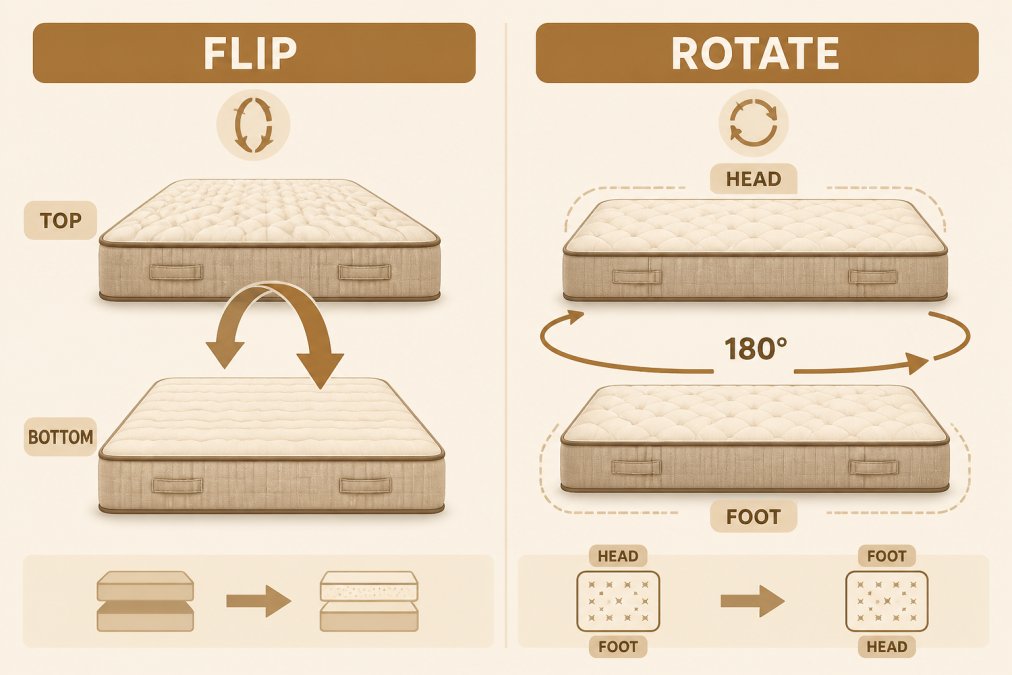
Flipping means turning the mattress over completely, so the bottom becomes the top. This works only on double-sided designs where both surfaces are equally supportive.
Rotating means turning the mattress 180 degrees along its length. The head end moves to the foot end. The top stays on top. Rotation works on all mattress types, including one-sided models.
How to Tell If Your Mattress Is Flippable
Before you flip anything, confirm your mattress is designed for it. Here is a quick identification method:
- Check the care label. Look for the sewn-in tag on the mattress edge or under the bottom. Flippable mattresses typically say "flip and rotate" or "double-sided." One-sided mattresses usually say "rotate only" or "do not flip."
- Look for a pillow-top or euro-top. If the top surface has a sewn-on extra comfort layer, it is almost certainly one-sided. Flipping would put that layer face-down against the foundation.
- Inspect the bottom surface. On a double-sided mattress, the bottom looks and feels like the top, same quilting, same fabric, same cushioning. On a one-sided mattress, the bottom is often a plain, darker fabric with no quilting.
- Check the warranty terms. Many manufacturers void coverage if a one-sided mattress is flipped. The warranty document will state whether flipping is permitted.
If you are unsure whether your mattress is flippable, rotate only. Rotating is safe for every mattress type and will not void your warranty. Flipping a one-sided mattress can expose the support core, reduce comfort, and damage the internal structure.
When to Flip vs. When to Rotate
If your mattress is double-sided and flippable, do both. Flip it every six months to use both surfaces. Rotate it every three months to prevent head-to-foot wear patterns.
If your mattress is one-sided (most modern mattresses are), rotate only. Flipping would expose the non-functional bottom layer and might void your warranty.
Always read your manufacturer's instructions before flipping. When in doubt, rotate only.
Why the Confusion Exists
The query "how often to flip mattress" is common because older mattresses, particularly innerspring models made before the 2000s, were almost all double-sided, so flipping was standard advice. Today most mattresses sold are one-sided, but the old advice persists, and many people flip mattresses that should only be rotated, causing premature wear.
How to Flip a Mattress Safely
Flipping a mattress is straightforward, but it requires the right technique to avoid injury or damage. Most full-size mattresses weigh 50-80 pounds; queen and king sizes can exceed 100 pounds.
Step-by-Step Flipping Instructions
Step 2: Get help. Never flip a mattress alone. One person on each side is the minimum.
Step 3: Position yourselves. Stand on opposite sides of the bed.
Step 5: Flip it over. Once the mattress is off the bed, flip it in one smooth motion.
Step 7: Replace bedding. Add clean sheets and make the bed as usual.
Tools and Help You'll Need
A mattress flipping tool, handles or straps that attach temporarily for better grip, isn't essential but costs $20-$50 and is worth it for heavier mattresses.
If you don't have a flipping tool, ask a friend or family member for help.
Some moving companies offer mattress flipping services, usually $30-$60 per flip, worth considering if you have mobility issues or a very large mattress.
Why Are Mattresses Not Flippable Anymore?
Modern mattress design has shifted away from double-sided, flippable models. Most new mattresses are one-sided. Understanding why helps you make better purchasing decisions.
Manufacturers discovered that customers prefer specialized comfort layers on top. Memory foam, latex, and pillow-top designs create a specific feel. Making both sides identical meant sacrificing that customization.
One-sided mattresses also cost less to produce, since manufacturers use cheaper materials on the bottom layer that won't contact your body.
One-Sided vs. Double-Sided Mattress Construction
One-sided mattresses have a comfort layer on top and a support layer on the bottom. The bottom is designed purely for structural support, so you never flip them.
Double-sided mattresses have comfort and support on both surfaces, so you can flip them without losing comfort or support.
The trade-off is clear: one-sided mattresses wear out faster, while double-sided flippable mattresses last longer because you're using both surfaces.
Flipping and Rotation Schedules by Mattress Type
Different mattress materials need different care. The schedule below is a starting point, but your manufacturer's care label and warranty always take priority.
Memory Foam Mattress Care
Memory foam mattresses are almost always one-sided. The foam top layer is what makes them comfortable, it's not designed to be flipped.
Rotate memory foam mattresses every three to four months, since the foam can develop permanent body impressions over time.
Memory foam is sensitive to heat, so keep your bedroom temperature moderate and avoid jumping on the mattress or putting excessive weight on one area.
Innerspring and Hybrid Mattress Care
Innerspring mattresses have metal coils for support and a comfort layer on top. Some older models are flippable, but most modern ones are one-sided.
Check your documentation. If your innerspring mattress is flippable, flip it every six months. If it's one-sided, rotate it every three to four months.
Hybrid mattresses combine foam and coils. Most hybrids are one-sided due to the foam layer on top. Rotate every three to four months.
Latex Mattress Care
Latex mattresses can be either one-sided or double-sided depending on the manufacturer. Many latex cores are flippable because latex is durable and symmetric. Check your care label.
If flippable, flip every six months and rotate every three months; if one-sided, rotate every three to four months. Latex resists dust mites and mold but can still develop impressions if not rotated.
Pillow-Top and Euro-Top Mattresses
Pillow-top and euro-top mattresses have a sewn-on comfort layer on one side only, so they are never flippable. Flipping would put the pillow-top face-down against the foundation, ruining the comfort layer and potentially damaging the seams.
Rotate every three to four months. Do not attempt to flip.
Adjustable Bed Mattresses
Adjustable bed mattresses are engineered for a specific orientation on a hinged or articulating frame. Never flip one, the internal structure, including any zoned support or reinforced edges, is designed for a fixed top and bottom.
Rotation depends on the frame. Some adjustable mattresses can be rotated head-to-foot; others have a tapered or split design that prevents rotation. Check your manual.
Zoned Mattresses
Zoned mattresses have different support levels along the length of the bed, typically firmer in the middle for hips and softer at the head and foot, calibrated for a specific orientation.
If your mattress is zoned, check the care label before rotating. Some allow rotation; many do not. Never flip a zoned mattress unless the label explicitly says it is double-sided.
Quick Reference Schedule
| Mattress Type | Flip? | Rotate? | Frequency |
|---|---|---|---|
| Double-sided innerspring | Yes | Yes | Flip every 6 months, rotate every 3 months |
| One-sided innerspring | No | Yes | Rotate every 3-4 months |
| Memory foam | No | Yes | Rotate every 3-4 months |
| Latex (flippable) | Yes | Yes | Flip every 6 months, rotate every 3 months |
| Latex (one-sided) | No | Yes | Rotate every 3-4 months |
| Hybrid | No | Yes | Rotate every 3-4 months |
| Pillow-top / euro-top | No | Yes | Rotate every 3-4 months |
| Adjustable bed | No | Check manual | Rotate every 4-6 months if allowed |
| Zoned | No | Check label | Follow label; often rotate only if permitted |
Set a recurring reminder on your phone or calendar for the first day of each quarter. Rotate then. If your mattress is flippable, add a flip reminder every six months, many people pair it with daylight saving time changes or their birthday.
How to Prioritize the Care Label Over Generic Advice
Every mattress ships with a care label, and many include a warranty document. These are the authoritative sources for your model.
If your care label says "rotate only," do not flip. If it says "do not rotate," follow that instruction.
Following the label protects your warranty. Many warranties require proof of proper maintenance, and flipping a one-sided mattress or rotating a zoned mattress against instructions can void coverage.
What to Do When Your Mattress Already Sags
If your mattress already has visible sagging or body impressions, flipping or rotating won't fix it, the damage is done.
A mattress topper can temporarily improve comfort.
Rotate the mattress to even out the wear.
Check your warranty. Many mattresses have a sagging guarantee: if yours sags more than 1.5 inches within the warranty period, the manufacturer may replace it.
If the mattress is beyond repair, it's time to replace it.
Frequently Asked Questions
How often should you flip a mattress?
For double-sided flippable mattresses, flip every 6 months to promote even wear and extend lifespan. For one-sided mattresses, rotate 180 degrees head-to-foot every 3 months instead. Memory foam and pillow-top mattresses should only be rotated, never flipped. Always check your mattress manufacturer's recommendations, as specific construction details affect the ideal schedule.
What is the difference between flipping and rotating a mattress?
Flipping turns your mattress over completely to use the opposite sleep surface, distributing wear across both sides. Rotating turns the mattress 180 degrees so the head end becomes the foot end, evening out pressure points without exposing the underside. Flipping works only for double-sided mattresses; rotating works for all types. Double-sided mattresses benefit from both practices.
Does flipping a mattress make it last longer?
Yes, flipping double-sided mattresses significantly extends their lifespan. Regular flipping distributes body weight and pressure more evenly across both surfaces, preventing sagging and body impressions in a single spot. This practice reduces wear and tear, helping your mattress maintain comfort and support for years.
Why are mattresses not flippable anymore?
Most modern mattresses are one-sided because manufacturers now use specialized materials like memory foam and pillow-top layers designed for the top surface only. These comfort layers perform best facing up and would feel uncomfortable or provide poor support if flipped. Double-sided flippable mattresses like hybrid designs distribute support layers more evenly, allowing safe flipping while maintaining comfort on both sides.
Premature sagging is frustrating after investing in a mattress. The good news: choosing a flippable design prevents this problem. At Durable Mattress, our 2-sided hybrid mattresses are engineered specifically for flipping, which distributes wear evenly across both surfaces and extends longevity. With multiple firmness levels, medium, firm, and soft, you get customized support that lasts. Shop our mattress collection and invest in a mattress built to last a decade or more.

Double the life of your mattress today
Our mattresses will help you get the sleep you need. Not sure which one’s right for you? Check out our firmness guide below.