
Last Updated: November 19, 2026
Quick Summary
Flippable mattresses can spread wear across both sides, but they only last longer when both faces are built to the same standard and the support core is durable. Flipping slows surface wear and does not reverse coil or core fatigue. Check the test protocol and both-sides results before trusting a flippable mattress durability claim.
- Flipping redistributes wear, but it does not stop materials from aging.
- Flipping helps comfort layers most and support cores least.
- Flip roughly every three to six months and rotate end to end between flips.
- A credible durability test reports cycle count, measurement points and units.
- Both sides of a flippable mattress should show comparable compression and recovery.
Table of Contents
- How Flippable Mattresses Are Built and Why Construction Matters
- How a Flippable Mattress Durability Test Works
- Does Flipping Actually Extend Mattress Lifespan?
- How Often to Flip Mattress for Even Wear
- Durability by Material and Construction: Hybrid, Foam, and Latex
- Signs of Mattress Wear and Tear and When to Replace
- Choosing a Durable Mattress That Fits Your Sleep and Budget
- Frequently Asked Questions
Flippable mattresses promise longer life, but the claim only holds up if the design and the flipping habit both do their part. This article looks at what the durability evidence actually shows. A flippable mattress is a bed built with comparable comfort and support layers on both sides, so you can rotate it or turn it over to spread out wear.
How Flippable Mattresses Are Built and Why Construction Matters
Flippable mattresses are built with comfort and support layers on both surfaces. That symmetry is the whole point. A one-sided mattress concentrates body weight and heat on one face, so one side can soften while the other stays firm.
Construction still sets the ceiling. A flippable design cannot compensate for weak coils or low-density foam, so the materials inside matter as much as the flip itself.
How a Flippable Mattress Durability Test Works
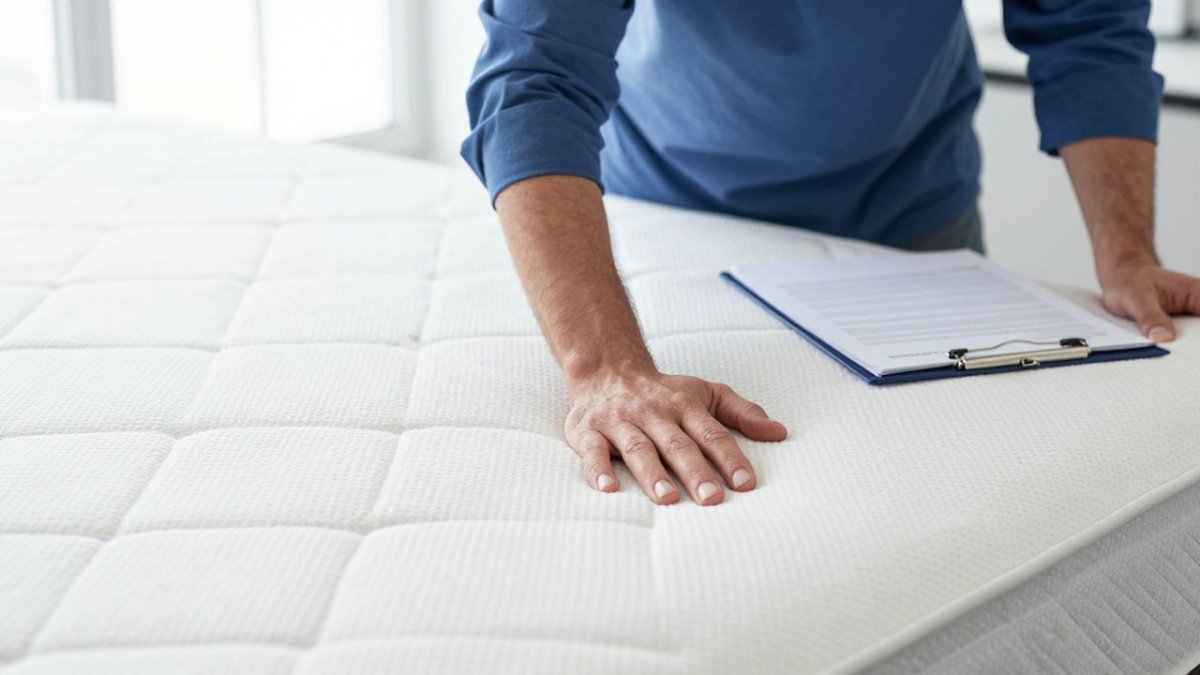
Durability testing simulates years of nightly use in a controlled environment so that wear can be measured instead of guessed. A technician applies repeated loading to the sleep surface, then measures how much the mattress compresses and how well it recovers.
No single public protocol exists for flippable mattresses specifically, so treat any single test result with caution. What you can do is demand that the method be clearly described, repeatable and applied to both sides of the bed.
What a Credible Test Protocol Should Specify
A transparent protocol answers five questions before it reports a single result:
- Load and cycle count. How much weight is applied, in what pattern, and for how many cycles. A common industry approach uses a weighted roller or a hexagonal profile that passes over the surface repeatedly; the cycle count is what stands in for years of sleep. Ask how many cycles were run and what that number is meant to represent.
- Measurement points. Where on the surface height and firmness are recorded, center, shoulder zone, hip zone, edge, and how many readings are averaged. A single center reading can hide a hip-zone dip.
- Measurement units and thresholds. Compression and recovery should be reported in inches or millimeters, and firmness in a repeatable scale such as ILD (indentation load deflection) for foam or a comparable hardness reading. A result without units is not a result.
- Both-sides protocol. Whether each face was tested independently, and whether the mattress was flipped between test phases. This is the step that separates a flippable-specific test from a generic one-sided test.
- Environmental conditions. Temperature and humidity affect foam behavior, so a credible report states the conditions under which readings were taken.
Step-by-Step Testing Methodology
- Baseline measurement. Record the initial height, firmness and surface profile at multiple points on each side. Photograph or map the surface so the same points can be re-measured later.
- Repeated loading. Apply a set cycle of weight and pressure to simulate nightly sleep, using a consistent load pattern so results are comparable across mattresses.
- Intermediate checks. Measure compression and recovery at fixed intervals, for example, after a quarter, half and three-quarters of the total cycles, to see whether wear is linear or accelerates.
- Final measurement. Compare end readings against baseline to calculate sag in inches or millimeters and support loss as a percentage of the original firmness reading.
- Side-by-side review. Confirm that both sides wear at comparable rates before crediting the flip. If one face sags noticeably faster, the design is not delivering the symmetry it promises.
Watch out: a test that reports only a final number without the baseline, the cycle count or the measurement points cannot be checked or repeated, and should not be treated as evidence of durability.
How to Read a Durability Test Result
When you look at a published result, separate what was measured from what was claimed. A measured result tells you the compression in inches at a stated cycle count under stated conditions. A claim tells you the mattress "lasts 10 years" without showing the protocol behind it. The first is evidence; the second is marketing.
A useful pattern to look for is whether the two faces of a flippable mattress converge or diverge over the test. If both faces show similar compression and recovery at the end, the flip is doing what it is supposed to do. If one face is clearly worse, flipping will only postpone the problem, not solve it.
Limitations of Any Lab Test
A controlled test cannot reproduce everything that happens in a bedroom. It typically holds temperature and humidity steady, uses a consistent load pattern, and ignores foundation type, bed frame support, mattress protector use and the way a real sleeper shifts position through the night. It also cannot model the difference between one 200-pound sleeper and two 150-pound sleepers sharing the same surface.
Does Flipping Actually Extend Mattress Lifespan?
Flipping can help redistribute wear that would otherwise concentrate on one side. It does not stop the materials from aging. A mattress that is flipped and rotated still compresses over time, and no flip reverses structural fatigue in the coils or foams. The honest answer is that flipping changes where wear lands, not whether wear happens.
The benefit is real but bounded, and it depends on three conditions being true at once: the two sides are built to match, the mattress is actually flipped on a schedule, and the underlying materials are durable enough to make the redistribution worth the effort. A flippable mattress with mismatched sides gains much less from the habit, because flipping a firm side onto a soft side does not spread load evenly, it just moves the problem.
What Flipping Can and Cannot Change
| Factor | Flipping helps? | Why |
|---|---|---|
| Surface foam softening | Yes, partially | Load shifts to the fresher face, slowing compression on the worn side |
| Body impressions in comfort layers | Yes, if caught early | Redistribution before permanent set can extend usable surface life |
| Coil fatigue and support-core breakdown | No | The core carries load regardless of which face is up |
| Loss of edge support | No | Edge structures age from use, not from which side faces up |
| Heat and moisture buildup | Somewhat | Alternating faces gives each side time to recover and air out |
A common pattern is that flipping buys the most time in the comfort layers and the least time in the support core. That is why a flippable design only pays off when the core is built to last, otherwise you are rotating a surface on top of a foundation that is already failing.
Side-by-Side Wear: Flippable vs. One-Sided
Quantified long-term wear data comparing flippable and one-sided mattresses is scarce in public form, which is exactly why lifespan claims deserve scrutiny. What can be said with confidence is directional: a one-sided mattress concentrates compression, heat and moisture on a single face, so the comfort layer on that face reaches its compression limit sooner.
The core does not get a break from flipping. If the support core is the weak link, the two-sided advantage shrinks toward zero. When you compare designs, compare the core specifications first and the comfort-layer symmetry second.
Objective End-of-Life Criteria
Lifespan estimates are only useful if you know what "end of life" means for your bed. Use measurable signs rather than a calendar:
- Persistent impressions. A body impression deeper than about an inch that does not recover after the mattress has been aired and rotated is a structural sign, not a cosmetic one.
- Measurable support loss. If the surface no longer returns to its baseline height at the hip and shoulder zones, the comfort layer has lost its ability to hold you up.
- Loss of alignment. Waking with new lower-back or hip discomfort that eases during the day is a common signal that the surface is no longer supporting neutral alignment.
When structural signs appear, protection and flipping will not reverse the damage. A protective cover can slow surface wear, and our mattress accessories include options designed for that purpose, but they are preventive, not restorative.
Real-World Factors That Change Lifespan
A single average lifespan figure is close to useless without context. The factors below move the number more than most buyers expect:
- Sleeper weight and occupancy. Higher combined weight loads the center and hip zones faster. A heavier couple should flip and rotate more often than a single lighter sleeper.
- Foundation support. A sagging box spring or a frame with inadequate slats accelerates mattress wear regardless of flipping. Check the foundation before blaming the mattress.
- Humidity and ventilation. Damp environments and poor airflow under the bed trap moisture in foam and fabric, which speeds breakdown. A breathable protector and a ventilated foundation help.
For a fuller picture of expected lifespan by material and construction, our mattress lifespan and durability guide covers the factors that matter most.
How Often to Flip Mattress for Even Wear
A common approach is to flip the mattress every three to six months, and to rotate it end to end in between.
The right frequency depends on how many people sleep on the bed and how heavy they are. A heavier couple will load the center more quickly, so more frequent turns can help.
Need step-by-step instructions for turning your mattress safely? Our guide on how to flip a mattress to prevent wear walks through the process, and our full how often to flip a mattress schedule explains the reasoning behind the timing.
Durability by Material and Construction: Hybrid, Foam, and Latex
Material choice shapes how a mattress ages. Hybrids combine coil support with foam comfort layers, and the coil system often carries most of the long-term load, which is why the support core matters so much.
Whatever the material, a mattress that is flippable only helps if both sides are built to the same standard. Compare the layer specifications rather than assuming symmetry.
For a direct comparison of flippable and non-flippable designs, see our breakdown of flippable vs non-flippable mattress durability.
Signs of Mattress Wear and Tear and When to Replace
Watch for visible body impressions deeper than about an inch, a noticeable dip in support, new morning aches, or a surface that no longer springs back.
Replacement timing varies with materials and use. A protective cover can slow surface wear, and our mattress accessories include options designed for that purpose. When structural signs appear, though, protection will not reverse the damage.
Choosing a Durable Mattress That Fits Your Sleep and Budget
Start with your sleep position and body weight, since both determine the firmness that will hold up for you.
Price should reflect the total cost of ownership, not just the sticker price.
Ready to find a mattress built to last? Shop Mattresses with Durable Mattress and choose a 2-sided hybrid designed to be flipped for longer life and steady comfort.
Frequently Asked Questions
Do double-sided mattresses last longer?
Flipping can help spread body impressions and surface wear across both sides. Lifespan still depends on materials, support core quality, foundation, body weight, and care. Expect the two sides to wear at similar rates only if you rotate and flip on a regular schedule.
How often should you flip a double-sided mattress to maintain support?
Flip and rotate your mattress every three to six months as a general schedule, then adjust based on how the surface feels. If you notice one side sagging or a dip forming in the same spot, flip sooner. Rotating head to foot between flips helps even out wear from pressure points. Always follow the manufacturer's care instructions, since some mattresses are designed to be flipped only in specific ways.
What specific tests determine the durability of a flippable mattress?
Durability testing typically includes repeated compression cycles to simulate years of use, measurement of impression depth before and after testing, and evaluation of support loss under a set load. Testers also check edge collapse and how quickly comfort layers degrade. Ask any brand for its test method, load weights, cycle counts, and pass criteria so you can compare results fairly rather than relying on marketing claims.
What are the primary signs of wear in a flippable mattress?
Common signs include a visible dip or body impression deeper than about one inch, sagging at the edges, squeaking or coil noise, and waking with new aches or stiffness. Uneven firmness across the surface and a noticeable sense of sinking toward the center also point to wear. If these appear within a few months of flipping on schedule, contact the manufacturer to review warranty coverage.

Double the life of your mattress today
Our mattresses will help you get the sleep you need. Not sure which one’s right for you? Check out our firmness guide below.