Table of Contents
- Best Mattress for Side Sleepers: What Actually Matters
- The Mattress Firmness Scale for Side Sleepers
- Pressure Relief, Spinal Alignment, and Body Weight
- Benefits of 2-Sided Flippable Mattresses for Long-Term Durability
- How to Choose a Mattress for Side Sleeping
- Motion Isolation, Cooling, and Edge Support for Couples
- Common Mistakes Side Sleepers Make When Buying a Mattress
- Conclusion: Choosing the Best Mattress for Side Sleepers
- Frequently Asked Questions
Last Updated: October 7, 2026
Best Mattress for Side Sleepers: What Actually Matters
The best mattress for side sleepers keeps the spine straight while cushioning the shoulder and hip, and that single job drives every other decision. At Durable Mattress, we build 2-sided flippable hybrids around exactly this problem.
Your shoulder and hip carry concentrated load all night, so a mattress that feels great on day one can leave you aching by week three. Below, we'll show how firmness, body weight, and construction interact, and how to pick a surface you won't replace in two years.
Why Side Sleepers Have Different Needs
Back and stomach sleepers spread their weight across a wide area. Side sleepers don't. Your body contacts the mattress at the shoulder, ribcage, and hip, so three pressure points take the full load.
A surface that's too firm blocks the shoulder from sinking, pushing the spine out of line. A surface that's too soft lets the hips drop, bowing the lower back. The sleep health guidance from the National Sleep Foundation notes that mattress comfort directly affects how well you stay asleep, and for side sleepers that comfort is a narrow window.
The Mattress Firmness Scale for Side Sleepers
Most side sleepers do best on a medium or medium-firm mattress, roughly a 5 to 7 on the 1-to-10 firmness scale. That range lets the shoulder and hip sink just enough to level the spine without letting the midsection collapse.
Here's how the scale translates in practice:
- 1-3 (soft): Deep contouring. Best for lighter sleepers, but heavier sleepers sink too far.
- 4-6 (medium): Balanced give and support. The sweet spot for most side sleepers.
- 7-8 (medium-firm): Gentle cushioning with a firmer core. Good for heavier builds and combination sleepers.
- 9-10 (firm): Minimal sinkage. Usually too hard on shoulders and hips for side sleeping.
Soft, Medium, and Firm: What Each Does for Hips and Shoulders
Soft surfaces relieve shoulder pressure but let hips sag. Firm surfaces hold the hips up but jam the shoulder. Medium splits the difference, which is why it's the most recommended comfort level for side sleepers.
The practical test: lie on your side and check whether your spine forms a straight line from head to tailbone. If your waist dips, the mattress is too soft. If your shoulder aches, it's too firm.
Bring your own pillow to a showroom and place it between your knees. That small gap changes how your hips align, and it's the fastest way to feel whether a mattress is actually leveling your spine.
Pressure Relief, Spinal Alignment, and Body Weight
Pressure relief and spinal alignment are two sides of the same coin: the mattress must cushion the shoulder and hip while holding the midsection level.
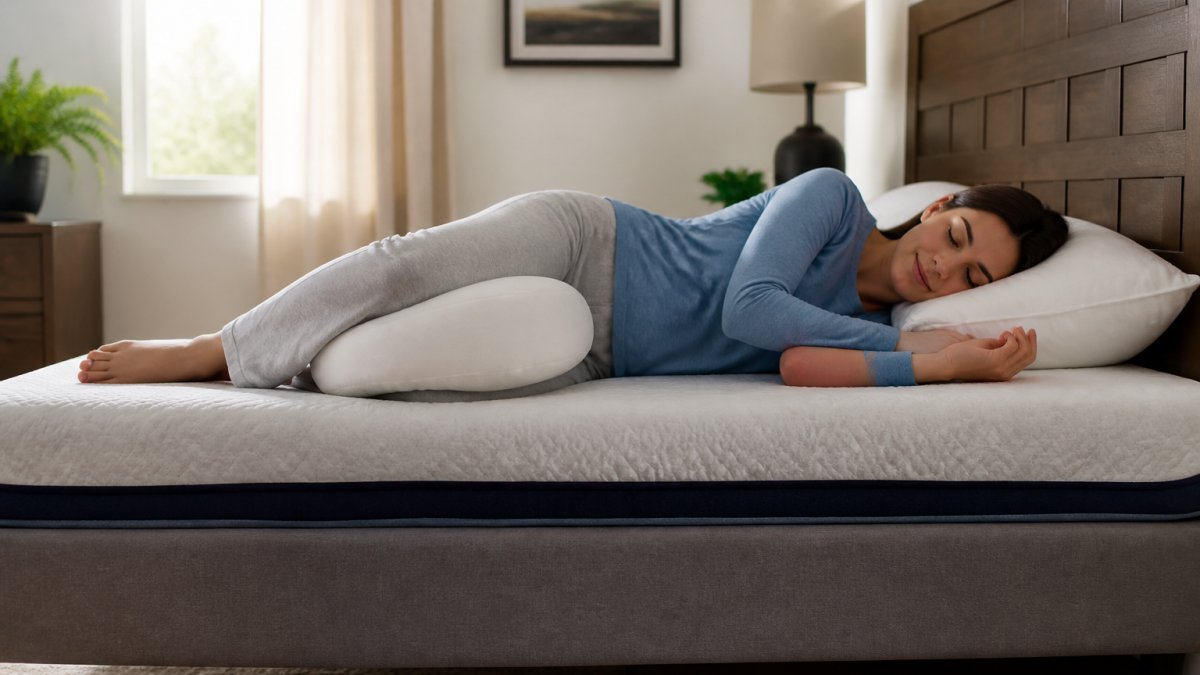
A comfort layer of memory foam or polyfoam compresses under load until it "bottoms out" against the firmer core below. A 120-pound side sleeper may compress that layer an inch, so a firm mattress feels like a board and the shoulder never sinks.
Matching Support to Build and Body Type
Side sleepers sort into three practical build tiers, and the firmness recommendation shifts with each one:
- Lighter builds (under roughly 130 pounds): Soft to medium, about a 4 to 6 on the 1-to-10 scale. A lighter sleeper doesn't generate enough load to compress a firm comfort layer, so the shoulder and hip stay perched on top. A plush or medium hybrid with a conforming top layer usually relieves pressure better than a firm one.
- Average builds (roughly 130 to 230 pounds): Medium to medium-firm, about a 5 to 7. This is the widest band and where most side sleepers land. The comfort layer compresses enough to cradle the shoulder while the core holds the hips level.
- Heavier builds (over roughly 230 pounds): Medium-firm to firm, about a 7 to 8, with a denser support core. A heavier sleeper needs a thicker, higher-density comfort layer and a stronger coil or foam core so the hips don't bottom out and the midsection doesn't collapse into a hammock.
Combination sleepers who roll onto their back or stomach should choose medium-firm, the most versatile comfort level across positions, though a true side sleeper with shoulder pain may still want the softer end of that range.
Pillow Height and the Full Side-Sleeping Setup
A mattress only solves half the alignment problem. On your side, your head needs a pillow tall enough to fill the gap between your ear and the mattress surface, or the neck bends and the upper spine follows.
The second piece is knee support. A pillow between the knees keeps the top hip from rolling forward and twisting the lower back. Test a mattress without a knee pillow and you're judging alignment with one variable missing.
Benefits of 2-Sided Flippable Mattresses for Long-Term Durability
A 2-sided flippable mattress is built with comfort layers on both faces, so you can rotate it over and use the other side. That spreads wear across two surfaces instead of one.
Most one-sided mattresses develop body impressions on the top layer because all the load lands in the same place, night after night.
Durable Mattress builds its hybrid collection this way on purpose: flip it on a schedule and the surface you sleep on stays closer to new for longer.
How to Choose a Mattress for Side Sleeping
Choosing a mattress for side sleeping comes down to four checks: firmness, pressure relief, support, and the terms behind the purchase. Get those right and you avoid the most expensive mistake in mattress buying: guessing.
Run through this before you commit:
- Confirm your firmness range. Start at medium and adjust up for weight or back pain.
- Check the support core. A hybrid with a responsive base holds alignment better than all-foam for most side sleepers.
- Test pressure points. Shoulder and hip should feel cushioned, not pinched.
- Read the fine print. Trial length, warranty, and return process decide your real risk.
- Plan for flipping. A 2-sided design only pays off if you actually rotate it.
Trial Periods, Warranties, and Return Policies
Trial periods, warranties, and return policies protect you when you buy without lying on the mattress first. A sleep trial lets you test it in your own bedroom, where your real sleep position shows up.
Look for a trial long enough to get past the adjustment period, a warranty that covers sagging rather than just manufacturing defects, and a return process that doesn't require you to arrange freight yourself. The FTC's guidance on buying big-ticket items online is a useful reminder to read return terms before you order, not after.
A warranty that only covers "manufacturing defects" often excludes the body impressions side sleepers care about most. Check whether the policy names a sagging depth threshold before you assume you're covered.
Motion Isolation, Cooling, and Edge Support for Couples
Couples need three things side sleepers often overlook: motion isolation, cooling, and edge support.
Motion isolation is about how quickly a disturbance dies out across the surface. Individually wrapped coils, also called pocketed coils, compress independently, so one partner's turn doesn't lift the other.
Cooling depends on airflow and on how much of your body contacts the surface. Memory foam is the usual heat culprit because it conforms and traps body heat.
Edge support matters more for couples than solo sleepers because two people share the perimeter.
When Partners Differ in Weight or Firmness Preference
If one partner is a 120-pound side sleeper who wants soft and the other is a 220-pound side sleeper who wants firm, no single firmness will fully satisfy both. Three workable approaches:
- Split the difference at medium-firm. It's the most versatile single surface, and a flippable design lets you choose which face is up.
- Choose a flippable 2-sided mattress. One face can be medium, the other firm, so the couple picks the side that suits the heavier or more pain-prone sleeper and adjusts from there.
- Use a split or dual-firmness setup if the gap is large. It costs more and limits your options, but it's the only way to give each sleeper a genuinely different feel.
A flippable medium-firm hybrid gives most couples the most room to compromise, pairing the motion isolation and airflow of a hybrid with two firmness options in one purchase.
| Feature | Why It Matters for Side Sleepers | What to Look For |
|---|---|---|
| Firmness | Levels the spine at shoulder and hip | Medium to medium-firm |
| Pressure relief | Cushions shoulder and hip | Contouring comfort layer |
| Support core | Prevents midsection sag | Responsive hybrid base |
| Motion isolation | Reduces partner disturbance | Individually wrapped coils or all-foam |
| Cooling | Prevents heat buildup | Breathable, open construction |
| Edge support | Firm perimeter for couples | Reinforced edges |
| Durability | Resists body impressions | 2-sided flippable design |
Motion isolation and cooling often pull in opposite directions. The all-foam mattress that isolates movement best is usually the one that traps the most heat, so a hot sleeper who also shares a bed may need to prioritize a hybrid with pocketed coils and accept slightly more motion transfer.
Common Mistakes Side Sleepers Make When Buying a Mattress
The biggest mistake is buying too firm. People assume firm equals supportive, then wake up with shoulder and hip pain because the surface never let the joint sink.
A second mistake is judging a mattress in the first ten minutes. Pressure problems show up after a few nights, not a few minutes, which is why a trial period matters more than a showroom test.
And the one nobody tells you about: people buy a one-sided mattress, never flip it, and then blame the brand when it sags.
Match firmness to your body weight first, then confirm the support core and sleep trial. Those three factors decide whether a mattress for side sleepers works for you long term.
Conclusion: Choosing the Best Mattress for Side Sleepers
Finding the best mattress for side sleepers means matching firmness to your build, confirming pressure relief at the shoulder and hip, and choosing a design that holds up over years, not months. Most people get the first two partly right and the last one completely wrong.
That's where Durable Mattress comes in. Our 2-sided flippable hybrid mattresses are built to be flipped for increased longevity, available in Medium, Firm, and Soft, and engineered to prevent premature wear so you get more out of the investment.
Frequently Asked Questions
What type of mattress is better for side sleepers?
Side sleepers generally do best on a medium to medium-firm mattress that lets the shoulders and hips sink in slightly while keeping the spine straight. Memory foam and hybrid mattresses are common picks because they contour to the body and reduce pressure points. A mattress that is too firm creates pressure at the shoulder and hip, while one that is too soft lets the midsection sag and throws the spine out of alignment.
Do side sleepers need firm or plush mattresses?
Most side sleepers land on medium or medium-firm rather than plush or extra-firm. Plush mattresses cushion the shoulder and hip but can let the lower back dip, while extra-firm surfaces push back against the shoulder and cause numbness. The right pick depends on body weight: lighter sleepers often do well on medium, and heavier sleepers usually need medium-firm for core support.
How does a flippable mattress design benefit side sleepers?
A 2-sided flippable mattress lets you rotate the sleep surface, so wear is spread across both sides instead of concentrating on one. For side sleepers, that means the comfort layer keeps its contouring and pressure relief for longer, which matters because compressed foam loses the give that protects shoulders and hips. Flipping also gives you two firmness options in one mattress if the two sides are built differently.
What is the best mattress firmness for side sleepers with hip pain?
Medium-firm is the usual starting point for side sleepers with hip pain, because it supports the pelvis without pressing hard into the hip. A surface that is too firm concentrates pressure on the hip joint, and one that is too soft lets the hips sink and rotate the spine. If hip pain persists after a few weeks on a new mattress, talk to a healthcare provider, since mattress firmness alone may not resolve it.
Buying a mattress you can't lie on first is a real risk, and side sleepers feel a wrong choice fastest. Durable Mattress removes most of that risk with a flippable hybrid design available in Medium, Firm, and Soft, so you can match the surface to your build and keep it supportive for years. Get started with Durable Mattress and choose a mattress built to last.
Double the life of your mattress today
Our mattresses will help you get the sleep you need. Not sure which one’s right for you? Check out our firmness guide below.