Table of Contents
- Why Mattress Quality Is Hard to Judge (and What Actually Matters)
- Mattress Materials and Construction: What Separates Good Builds From Cheap Ones
- How to Read a Mattress Tag and Spot Misleading Labels
- How to Test a Mattress in Person: A Step-by-Step Checklist
- How Long Does a Mattress Last? Lifespan Signals to Check Before You Buy
- Quality vs. Price: Total Cost of Ownership and What to Ignore
- At-Home Inspection: How to Check Your Mattress for Wear and Sagging
- Frequently Asked Questions
Last Updated: October 21, 2026
Why Mattress Quality Is Hard to Judge (and What Actually Matters)
Mattress quality is the measurable combination of material density, coil specification, layer construction, and edge reinforcement that determines how long a bed holds its shape under daily load.
A mattress is a sealed box: you can touch the cover, but the foam density and coil gauge hiding inside decide whether the bed lasts three years or twelve. Here's how to identify mattress quality using the numbers and physical checks that predict lifespan.
Comfort tells you how a bed feels on day one. Construction tells you how it feels in year eight. Judge the second one before you buy.
Mattress Materials and Construction: What Separates Good Builds From Cheap Ones
Mattress construction falls into four families, all-foam, innerspring, hybrid, and latex, and each fails differently, so quality checks change with the build.
All-foam beds live or die by foam density. Innersprings depend on coil count, coil gauge, and how coils are joined.
Layers matter as much as material. A cheap bed often hides a low-density comfort layer above a firm support core, which feels supportive in-store but develops body impressions within a year.
Foam Density, Coil Gauge, and the Numbers That Reveal Quality
Foam density is the weight of foam per cubic foot and the best predictor of how long a foam layer holds up. Higher density resists compression and sagging far longer.
Pocketed coils sit in individual fabric pockets and move independently, improving motion isolation. Interconnected coils are joined with wire or helical lacing, creating a firmer, bouncier surface. Neither is automatically better; they serve different sleepers.
| Specification | What It Measures | Higher Means | Lower Means |
|---|---|---|---|
| Foam density | Weight per cubic foot | Longer life, less sag | Faster breakdown |
| Coil gauge | Wire thickness | Thinner wire, softer | Thicker wire, firmer |
| Coil count | Coils per bed | More contact points | Fewer contact points |
| Edge support | Perimeter reinforcement | Stable seating edge | Roll-off risk |
| Layer count | Comfort and transition layers | Gradual support | Abrupt feel |
A high coil count on a low-gauge, small-diameter coil is a marketing number, not a durability signal. Ask for gauge and coil diameter together, or the count tells you nothing.
How to Read a Mattress Tag and Spot Misleading Labels
A mattress law tag is the white label sewn to the mattress, and federal law requires it to list filling materials by percentage. It's the one document a retailer cannot quietly edit, so read it before any brochure.
Here is what the law tag will and will not tell you:
- It will list fiber content, foam types, and filling percentages by weight.
- It will not list foam density, coil gauge, or coil count. Those live in the spec sheet.
- It will show a manufacturer or distributor name and a model number you can cross-reference.
The Federal Trade Commission's guidance on mattress labeling explains the required disclosures, and it is worth knowing what the tag legally must contain before a salesperson tells you otherwise.
A Practical Checklist for Misleading Marketing Terms
Most words on a mattress tag or product page are unregulated. That doesn't make them lies, but you have to translate them into something verifiable:
| Marketing term | What it usually means | What to ask for instead |
|---|---|---|
| "Organic" | May refer to the cover, the filling, or the entire bed, often only the cover | A third-party organic certification for the specific component, not the whole product |
| "Cooling" or "temperature-regulating" | Often a cover fabric or a phase-change material in a thin layer | The thickness and placement of the cooling layer, and whether it sits above or below the comfort foam |
| "Orthopedic" | No legal definition; frequently just a firm bed | Foam density and firmness rating on a stated scale |
| "Luxury" or "premium" | A price tier, not a material grade | Foam density, coil gauge, and layer thickness in inches |
| "High-density" | Relative to the brand's own line, not an industry benchmark | The actual density in pounds per cubic foot |
| "Hypoallergenic" | No standardized test behind the claim | Material certifications and a list of known allergens in the build |
| "Doctor-recommended" | A survey or paid endorsement, rarely a clinical standard | The specific study or organization behind the claim |
What Evidence to Request
When a brand uses one of those terms, ask for the underlying number or certificate:
- Foam density in pounds per cubic foot for each foam layer, not just the support core.
- Coil gauge and coil count together, since either number alone is easy to game.
- Layer thickness in inches so you can tell whether a "cooling layer" is a meaningful sheet or a spray-on finish.
If a brand won't publish foam density and coil gauge, treat that as your answer: a spec sheet with only marketing language has nothing to hide behind.
How to Test a Mattress in Person: A Step-by-Step Checklist
Testing a mattress takes about fifteen minutes in the right order. Most shoppers lie down for thirty seconds on their back and call it done, which tells you almost nothing.
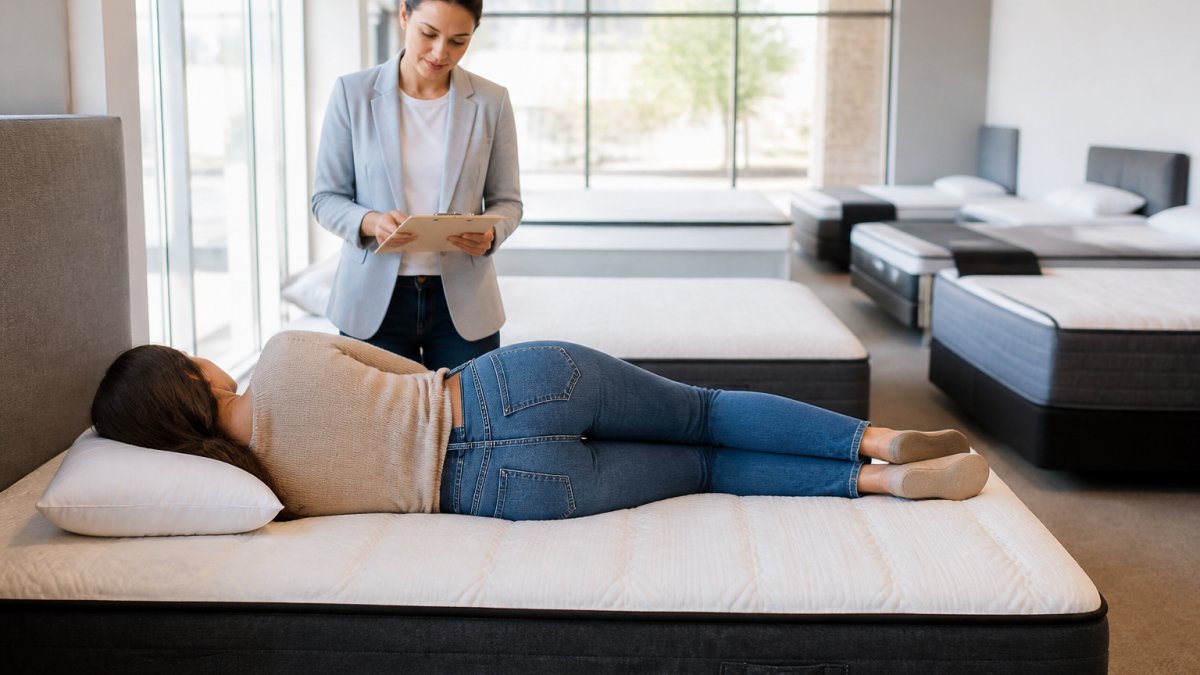
Work through this sequence:
- Lie in your dominant sleep position for at least ten minutes. Set a timer. Discomfort shows up after minute five, not minute one.
- Slide a hand under your lower back. A good fit fills the gap without lifting your hips.
- Roll to your other side and repeat. Asymmetric support is a red flag.
- Sit on the edge and lean back. Feel the perimeter. Weak edge support means the usable sleep surface is smaller than the bed.
- Press your palm into the comfort layer. It should recover quickly, not leave a slow-filling dent.
- Ask for the spec sheet and rate firmness on a 1-10 scale. Write the number down; showroom memory fades fast.
- Check the return policy in writing before you leave the store.
Matching Firmness to Sleep Position and Body Weight
Side sleepers need a softer surface that lets the shoulder and hip sink in, keeping the spine straight. Back sleepers do better with medium support that fills the lumbar curve.
Body weight shifts all of this: a heavier sleeper sinks further into any firmness level, so a medium bed may feel soft to them and firm to a lighter partner.
Bring your own pillow to a showroom test. Half of what people blame on the mattress is actually a pillow that puts the neck at the wrong angle.
How Long Does a Mattress Last? Lifespan Signals to Check Before You Buy
Most mattresses last seven to ten years, with quality construction pushing toward the upper end and cheap foam failing earlier. Lifespan tracks material density and coil durability more than brand promises.
How Each Construction Type Fails
Durability isn't one number. Each build has a characteristic failure point, and knowing it tells you what to inspect.
- All-foam beds fail first in the comfort layer. Low-density polyurethane or memory foam compresses and loses resilience, producing body impressions while the support core stays fine. Check foam density in the comfort layers, not the core.
- Innerspring beds fail at the coil unit and connections. Wire fatigue, bent coils, and broken helical lacing show up as a lumpy or noisy surface. Check coil gauge, coil diameter, and whether coils are pocketed or interconnected.
- Hybrids fail at the interface between coil core and foam comfort layers. A thin or low-density transition layer lets foam shear against the coils, accelerating sagging. Check the transition layer's thickness and density, not just the top comfort foam.
Signals That a Bed Is Built to Last
- Denser foams in the comfort layers, disclosed on the spec sheet in pounds per cubic foot
- Thicker coil wire with a stated gauge, plus a stated coil diameter
- Reinforced perimeter with dedicated edge support foam or coils
Many warranties exclude the exact failure most people experience. Read the sagging clause before assuming coverage protects you: thresholds that kick in only beyond a deep depression, or prorating after the first few years, may not help with the impression you actually develop.
We built our hybrid collection around a 2-sided flippable design for this reason. Flipping spreads load across both surfaces instead of compressing one side for a decade, a wear-management strategy, not a gimmick, and the single most effective way to extend a bed's useful life.
Match the inspection to the build. Foam beds fail at the comfort layer, innersprings at the coil unit, and hybrids at the transition layer. Check the part that actually wears out.
Quality vs. Price: Total Cost of Ownership and What to Ignore
Price and quality correlate, but loosely.
Total cost of ownership is the better lens: divide purchase price by expected years of use.
What to ignore: thread count on the cover, "sleep technology" language, celebrity endorsements, and any firmness claim without a scale.
The Consumer Product Safety Commission's mattress safety guidance is also worth a look for flammability and safety standards, since certifications belong in your buying decision alongside comfort.
Divide price by expected years of use. That number, not the sticker price, tells you which mattress is actually the better value.
At-Home Inspection: How to Check Your Mattress for Wear and Sagging
If you suspect your mattress is failing, check it yourself in about twenty minutes. Strip the bedding and look for these signs:
- Visible body impressions deeper than about an inch and a half
- A dip in the center where two sleepers converge
- Soft or collapsed edges that no longer hold weight
Rotate or flip the mattress if the design allows, then recheck in two weeks.
For a longer read on material standards and testing methods, the ASTM International standards for mattress and bedding testing documents how manufacturers measure firmness, durability, and flammability, which is useful when you want to compare a spec sheet against a real benchmark.
Judging mattress quality comes down to a handful of numbers most shoppers never ask for: foam density, coil gauge, edge construction, and warranty terms on sagging.
At Durable Mattress, we build 2-sided flippable hybrid mattresses in Medium, Firm, and Soft so you can manage wear instead of replacing a bed every few years.
Frequently Asked Questions
What determines a quality mattress?
Mattress quality comes down to materials and construction, not marketing. Check foam density (1.8 lb/ft³ or higher for polyurethane), coil gauge (12-14 gauge for support, 15-16 for comfort layers), and whether the cover and comfort layers use durable materials. A supportive base layer, adequate edge support, and honest labeling matter more than thread count claims or fancy names. High-density foams and properly tempered coils resist sagging, while cheap low-density foam breaks down within a few years.
How can you tell if a mattress is well made?
Look at the law tag, feel the perimeter for edge support, and press into the surface to gauge how quickly it recovers. A well-made mattress has dense foam that springs back, coils that don't shift or creak, and reinforced edges that hold firm. Check whether the brand publishes foam density and coil gauge numbers, since honest manufacturers share specs. Also look for a flippable or two-sided design, which spreads wear across both surfaces and typically extends usable life.
How do you test a mattress for comfort and support?
Lie on the mattress in your normal sleep position for at least 10-15 minutes. Check that your spine stays neutral, your shoulders and hips don't bottom out, and your lower back feels supported. Roll to the edge to test perimeter support. Press your palm into the surface to see how quickly it recovers. Bring your partner if you share a bed and test motion transfer by having them move while you lie still.
How long should a quality mattress last?
A well-constructed mattress typically lasts 8-10 years, with higher-density foams and quality coils pushing toward the upper end. Signs it's time to replace include visible sagging over 1 inch, body impressions that don't recover, morning stiffness, and worsening allergy symptoms from dust mites. A flippable design can extend lifespan because you rotate wear between two surfaces instead of one. Cheap low-density foam mattresses often show sagging within 2-3 years.
Does a mattress warranty indicate its quality?
Not directly. Most warranties cover manufacturing defects like broken coils or seams, not normal softening or body impressions. A 10-year warranty sounds impressive but often excludes the sagging most people actually experience. Read the fine print: some warranties require a certain impression depth (often 1.5 inches) before they'll honor a claim. Use warranty length as one signal, but check foam density and coil specs for a truer picture of durability.
Which foam is better, polyurethane or high-resilience foam?
High-resilience (HR) foam is denser and more durable than standard polyurethane foam, typically rated at 2.5 lb/ft³ or higher. It holds its shape longer, resists sagging, and provides better support. Standard polyurethane at 1.5 lb/ft³ or lower breaks down faster and is common in budget mattresses. When comparing, ask for the foam density number. Higher density means more material and better longevity, though it also adds weight and cost.

Double the life of your mattress today
Our mattresses will help you get the sleep you need. Not sure which one’s right for you? Check out our firmness guide below.