
Last Updated: October 25, 2026
Quick Summary
Mattresses sag early when the materials inside lose their ability to bounce back, or when the support underneath gives way. Most premature sagging traces to foam breakdown, weakened coils, or uneven wear. A quality mattress should not develop a measurable dip over 1.5 inches in the first year.
- Low-density foam can flatten in months, while high-density foam holds its shape for years.
- A broken coil shows up as a sharp, localized dip, often near the middle or edge.
- Measure the dip with a straight edge and ruler in the morning, then recheck in two weeks.
- On queen and king beds, confirm there is a center rail or center leg touching the floor.
- Rotating or flipping a flippable mattress is the single most effective free fix.
Table of Contents
- Why Do Mattresses Sag Early? The Real Causes
- How Much Mattress Sagging Is Normal
- Mattress Sagging After 3 Months: What It Signals
- How to Diagnose the Source of Your Middle Sag
- How to Fix a Sagging Mattress: Temporary and Durable Repairs
- How to Prevent Mattress Sagging Before It Starts
- Documenting a Warranty Claim for Early Sagging
- Choosing a Mattress Built to Resist Early Sagging
- Frequently Asked Questions
Why Do Mattresses Sag Early? The Real Causes
Mattresses sag early when the materials inside lose their ability to bounce back, or when the support underneath gives way.
A sagging mattress has lost height and resilience where you lie. Real sagging is a measurable dip that appears long before a mattress should be replaced.
Below, we break down what causes early sagging, how to tell failure from settling in, and the fixes that work.
Foam Breakdown and Material Fatigue
Foam breakdown is the slow collapse of your mattress's comfort layers.
Cheaper foams have lower density, more air, less material, so they break down faster.
Memory foam softens in warm rooms and under constant pressure; latex holds up better because it rebounds more completely.
Watch out: a soft foam layer that feels great in the store can be the first thing to fail.
Weakened or Broken Innerspring Coils
Innerspring mattresses rely on steel coils to carry your weight. When coils weaken or break, the surface above them dips.
Coils fail in a few ways:
- Fatigue: repeated pressure slowly reduces a coil's spring.
- Bending: low-gauge wire bends instead of pushing back.
- Breakage: a coil snaps and creates a dead spot.
A broken coil shows up as a sharp, localized dip, often near the middle or where you sit on the edge.
Coils with poor surrounding support flex more than they should, and flexing wears them out faster.
Uneven Wear and Repeated Pressure
Sleeping in the same spot every night concentrates pressure there. That spot compresses more, recovers less, and slowly sinks, which is why the middle, where most body weight settles, sags first.
Uneven wear worsens when you never rotate the mattress: one side takes all the load. Shared beds add two pressure zones and a valley forming between them.
Body weight matters too: heavier sleepers stress the core more, so a mattress that lasts one person a decade may wear faster for another. For rotation timing, see how often to flip a mattress.
How Much Mattress Sagging Is Normal
Some settling is normal: a new mattress shows shallow body impressions within the first few weeks as comfort layers compress. That is normal break-in, not a defect. Here is a measurable way to tell break-in from failure.
Define early sagging by age, not just depth
A dip is only "early" relative to how old the mattress is. Use this timeline as a benchmark:
| Mattress age | What is normal | What signals early failure |
|---|---|---|
| 0-90 days | Impressions up to about 1 inch that stop deepening | Any dip still growing after week 6, or a dip over 1 inch |
| 3-12 months | Stable impressions under 1 inch | A measurable dip over 1.5 inches, or a dip that returns after rotation |
| 1-3 years | Gradual, even softening | A localized dip over 1.5 inches, a sharp spot, or a dip that keeps deepening |
| 3-7 years | Moderate softening consistent with use | A dip over 2 inches, or a dip that appears suddenly |
| 7+ years | Expect some loss of resilience | Sagging here is age-related, not early |
A quality mattress should not develop a measurable dip over 1.5 inches in the first year. If it does, treat it as early failure and diagnose the cause before spending.
Measure the dip the same way every time
Inconsistent measurement is why people argue with warranty teams. Use one method every time:
- Lay a straight edge, a yardstick, a level, or a long ruler, across the dip, spanning the highest points on either side.
- Measure from the underside of the straight edge down to the lowest point of the surface with a second ruler.
- Record the number, the date, and the location (for example, "center, 12 inches from the head end").
- Measure in the morning, before body heat and room warmth soften the foam.
- Measure the same spot again in two weeks. A dip that is stable is break-in; a dip that is growing is failure.
Photograph the straight edge and ruler in the same frame so the depth is visible. Warranty teams reject claims that lack a clear measurement.
Separate normal impressions from real sagging
A body impression is a shallow, even depression matching where you lie that stops changing. Real sagging has three markers:
- It is measurable. You can slide a ruler under the straight edge and get a number over about 1.5 inches.
- It is localized. It concentrates in one zone, often the middle, rather than spreading evenly.
- It persists or grows. It does not recover after you rotate the mattress or give it a day to rebound.
If your dip meets all three, it is not break-in. Use the diagnostic steps below to find whether the mattress or its base is at fault.
Why the one-inch rule is not enough
Many warranties use a sag depth threshold, often around 1.5 inches, but depth alone does not tell you whether the mattress is failing early. A 1.5-inch dip at eight years is normal wear; at eight months it is early failure. Pair depth with age and trend: is the dip stable or still deepening?
Mattress Sagging After 3 Months: What It Signals
Mattress sagging after 3 months is a red flag. A quality mattress should not develop a measurable dip that fast. The cause is usually a low-density foam layer, a weak foundation, a manufacturing defect, or a mattress-frame mismatch.
Three months is well inside most warranty periods, so document it and act before the damage spreads.
Ask yourself these questions:
- Did the dip appear suddenly or build slowly?
- Is it in one spot or across the whole middle?
- Does the mattress sit on a proper foundation?
The answers point to the cause. A sudden dip in one spot suggests a coil or a defect. A broad, slow dip across the middle suggests foam fatigue or poor support underneath.
How to Diagnose the Source of Your Middle Sag
Middle sag has two possible sources: the mattress itself or the support system under it. Work through this diagnostic flow in sequence and stop at the first step that explains your dip.
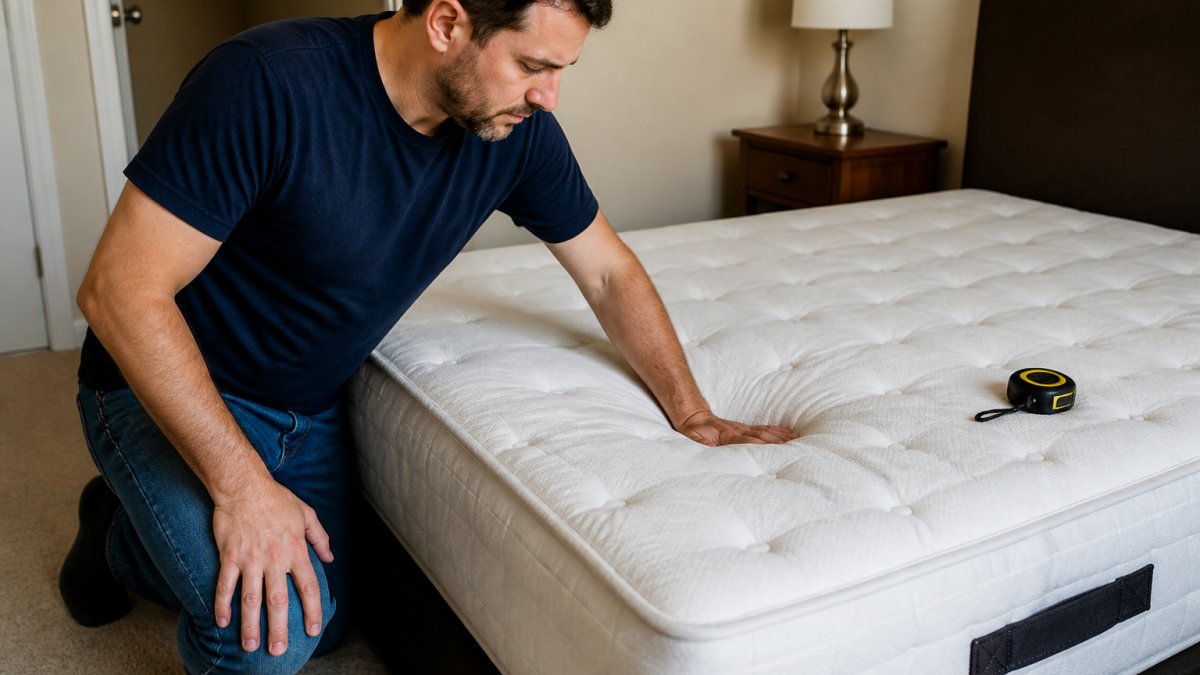
Step 1: Rule out the frame and foundation first
Start underneath, because a sagging middle is often a support problem, not a mattress problem. Check these in order:
- Slats: Look for slats that bow, crack, or sit more than about 3 inches apart. Wide gaps let the mattress sink between them.
- Center support: On queen and king beds, confirm there is a center rail or a center leg touching the floor. Without it, the middle flexes under load.
- Box spring or foundation: Press down firmly in the middle. A worn box spring will give or feel soft compared with the edges. A proper foundation should feel solid and even. For a base that provides proper, even support, see the Durable Adjustable Base.
If any of these fail, fix the support before blaming the mattress. A new foundation is far cheaper than a new mattress and solves the problem when the base is the weak link.
Step 2: Test the mattress on a known-flat surface
If the frame and foundation check out, isolate the mattress. Move it to the floor or another flat, hard surface and lie on it in your normal sleeping position for a few minutes.
- The dip disappears: Your foundation or frame was the cause. Replace or reinforce the support system.
- The dip is still there: The mattress core is failing. Continue to Step 3.
- The dip is worse on the floor: The mattress has lost structural integrity and is likely beyond repair.
This test saves you from replacing the wrong thing: people often buy a new mattress when a new foundation would have fixed it, or replace a foundation when the core is already shot.
Step 3: Match the dip pattern to the likely cause
Once you know the mattress is at fault, the shape and location of the dip narrow down the cause:
| Dip pattern | Likely cause | Next step |
|---|---|---|
| Broad, even dip across the middle | Foam fatigue or soft comfort layers | Check age and warranty; consider replacement |
| Sharp, localized dip in one spot | Broken or bent coil | Check warranty; do not add a topper |
| Dip that returns after rotation | Core material fatigue | Replacement is likely |
| Dip along one edge | Frame or foundation mismatch, or edge breakdown | Reinforce the base; check warranty |
| Two dips with a ridge between them | Shared-bed load concentration | Rotate more often; consider a firmer build |
Step 4: Decide whether to repair, claim, or replace
Use the results to choose a path:
- Support problem only: Replace or reinforce the foundation. No mattress claim needed.
- Mattress under warranty and dip over the threshold: Document the measurement and file a claim before spending on fixes.
- Mattress out of warranty with a localized dip: A topper may buy time, but the core will not recover. Plan for replacement.
Do not skip the floor test. Adding a topper or a board over a failing foundation hides the symptom and lets the real problem worsen.
Test first, then spend, guessing wastes money on the wrong fix.
How to Fix a Sagging Mattress: Temporary and Durable Repairs
Some fixes buy you time. Others solve the problem. Know which is which.
Temporary fixes:
- Add a mattress topper. A thick, firm topper can mask a shallow dip and add comfort. It will not fix a failing core, and it may sag into the same dip over time.
- Rotate or flip the mattress. If your mattress is flippable, flipping it puts a fresh surface up. This is the single most effective free fix.
- Add a rigid board under the mattress. A sheet of plywood over weak slats can restore even support.
- Reinforce the frame. Add a center leg or brace to stop the middle from flexing.
Durable repairs:
- Replace a worn box spring or weak slats.
- Upgrade to a foundation with proper center support.
- Replace the mattress if the core has failed.
Here is the honest truth: a topper on a mattress with a collapsed core is a bandage. It feels better for a while, then the dip returns. If the mattress is still under warranty and the sag is real, pursue the claim before spending on fixes.
How to Prevent Mattress Sagging Before It Starts
Prevention comes down to three habits: spread the load, support the base, and match the mattress to how you sleep. For a step-by-step prevention plan, read how to prevent mattress sagging.
The core habits:
- Rotate regularly. Rotating spreads wear across the surface.
- Use a proper foundation. Even, rigid support stops the middle from flexing.
- Protect the surface. A mattress protector keeps moisture and sweat out of the foam.
Prevention Tailored to Mattress Construction
Different builds fail differently, so prevention should match the construction.
- Memory foam: rotate often and keep the room cool. Heat softens foam.
- Latex foam: holds up well, but still needs even support underneath.
- Flippable: the biggest advantage is that you can flip it to reset the wear pattern. If you are weighing construction types, this flippable vs non-flippable durability comparison breaks down which lasts longer and why.
Documenting a Warranty Claim for Early Sagging
A warranty claim lives or dies on documentation. Most mattress warranties cover sagging beyond a set depth, often around an inch and a half, but only if you can prove it.
Build your case before you call:
- Measure the dip with a straight edge and ruler, and photograph it.
- Note the date you bought the mattress and keep the receipt.
- Confirm the mattress sits on an approved foundation.
Take clear photos with the ruler in frame so the depth is visible. Before you file, review the warranty terms and process so you know exactly what qualifies and what steps to follow.
Watch out: using an unsupported foundation can void a warranty. Many claims fail for that reason alone.
Choosing a Mattress Built to Resist Early Sagging
The best defense against early sagging is a mattress designed to spread wear and hold its shape.
Our hybrid construction pairs supportive coils with comfort layers, and it comes in medium, firm, and soft so you can match support to your body and sleeping position.
If early sagging has already cost you one mattress, the fix is not another one built the same way. It is one built to be flipped.
Frequently Asked Questions
Why is my mattress sagging after only 3 months?
Mattress sagging after 3 months usually points to a support problem rather than normal wear. Check the bed frame first: slats spaced more than 3 inches apart, a missing center rail, or a foundation that flexes under weight can all cause a dip long before the foam or coils fail. Low-quality foam that softens quickly is the other common culprit. If the dip is deeper than 1 inch and the frame checks out, document it and contact the retailer, since a defect this early should fall under warranty.
How much mattress sagging is normal?
A body impression of up to about 1 inch is generally considered normal break-in, especially on memory foam and hybrid mattresses. Anything deeper than 1 to 1.5 inches, measured with a straight edge laid across the dip, is usually treated as abnormal. Most warranties use a threshold in that range, often 1.5 inches. Measure at the deepest point of the middle sag and compare it to the warranty terms before assuming the mattress is defective.
Can a sagging mattress be fixed?
It depends on the cause. If the bed frame or foundation is the problem, a new center support, tighter slats, or a rigid foundation often resolves the dip. For mild surface softening, a firm mattress topper is a temporary fix. Once foam has broken down or coils are bent, though, no repair restores the original support, and replacement is the durable answer. Flippable designs help here because you can rotate the sleep surface before wear becomes permanent.
How can I prevent mattress sagging?
Start with proper support: a rigid frame with slats no more than 3 inches apart and a center rail on queen and king sizes. Rotate the mattress every 3 to 6 months, or flip it if it is two-sided, to spread repeated pressure across the surface. Use a mattress protector to keep moisture and dust out of the foam, and avoid sitting in the same spot every night. Matching the mattress construction to body weight and sleeping position also reduces uneven wear.
Tired of watching the middle of your mattress sink within a year? Durable Mattress builds 2-sided flippable hybrids that spread wear and hold their shape, in medium, firm, and soft. Get started with Durable Mattress and invest in a mattress engineered to last, not one you replace in three years.

Table of Contents
- Mattress Sagging Causes: Why Your Bed Sinks in the Middle
- How to Identify Sagging vs. Normal Softness
- Mattress Support and Bed Frame: The Foundation That Prevents Sag
- How Often to Rotate a Mattress (And Why It Matters)
- How to Fix a Sagging Mattress: Temporary Repairs vs. Real Fixes
- Flippable vs. One-Sided Mattresses: Care That Matches the Design
- Measuring Sag and Checking Warranty Coverage
- Frequently Asked Questions
Last Updated: October 18, 2026
Mattress Sagging Causes: Why Your Bed Sinks in the Middle
Mattress sagging is the permanent compression of the comfort layers in the spot where you sleep, and it usually starts long before you notice it. At Durable Mattress, we see the same pattern again and again: the dip forms where body weight concentrates, not where the bed gets the most use.
The causes stack up fast:
- Body weight in one spot. Hips and shoulders press into the same few inches of foam every night.
- Weak support underneath. Slats that bow, a box spring past its prime, or no center rail on a queen or king.
- Heat and moisture. Trapped sweat and warmth break down foam faster. A cool, dry bed lasts longer.
Here's what most guides miss: sagging is rarely a mattress problem alone. It's a support system problem. Fix the foundation and you slow the wear.
A mattress only sags as much as the support beneath it allows. Check the frame before you blame the bed.
How to Identify Sagging vs. Normal Softness
Normal softness feels even across the whole sleep surface. Sagging is localized and stays put after you get up.
Try this simple test. Lay a straight edge, like a broom handle or a ruler, across the dip and measure the gap underneath. A dip of 1 inch or more is the point where most warranties consider it a real problem, so measure before you call anyone.
Watch for these signs:
- A visible body impression that doesn't bounce back within a few minutes
- Rolling toward the middle when you lie near the edge
- Waking with hip or lower back pain that eases once you're up
Softness you can press through and recover from is comfort. A crater that stays is wear.
Mattress Support and Bed Frame: The Foundation That Prevents Sag
The single best way to prevent mattress sagging is a rigid, well-ventilated foundation. A firm base spreads weight across the whole mattress instead of letting it pool in the middle.
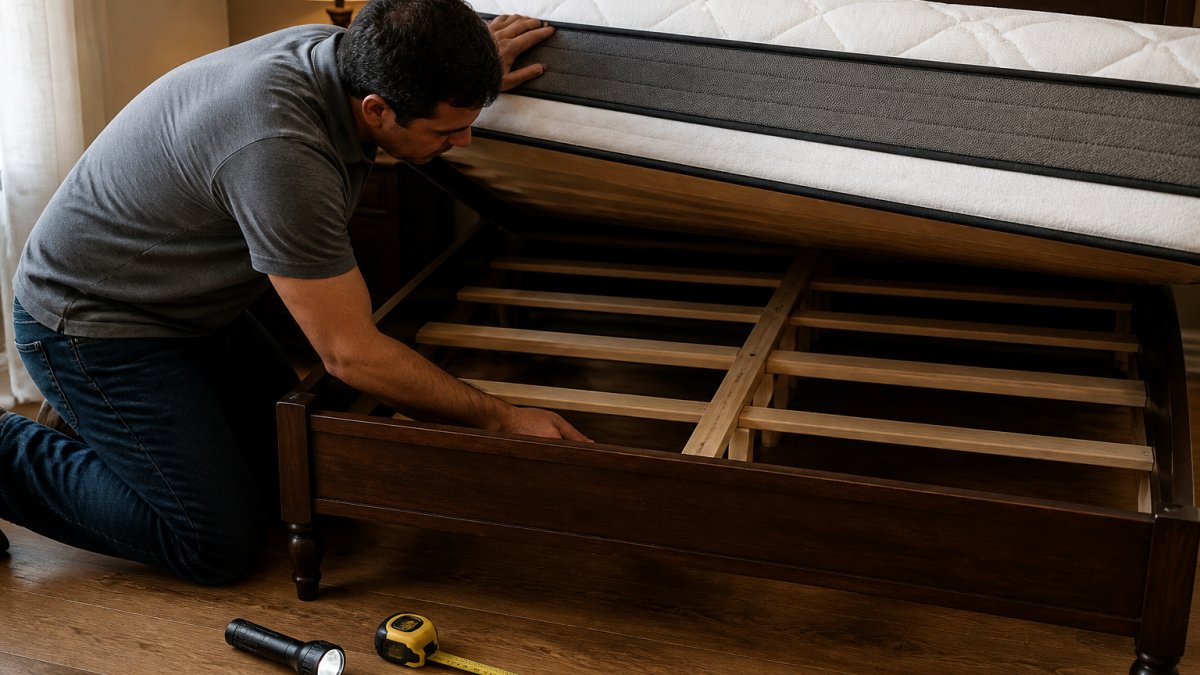
Foundation Compatibility by Mattress Type
| Mattress Type | Best Foundation | Slat Spacing | Center Support | Adjustable Base |
|---|---|---|---|---|
| Foam and memory foam | Solid platform or closely spaced slats | 2-3 inches or less | Required on queen and king | Check manufacturer approval; some foam beds flex poorly on adjustable bases |
| Innerspring | Box spring or slatted base that flexes with the coils | 3 inches or less | Required on queen and king | Usually compatible if the base has a solid deck or close slats |
| Hybrid | Firm platform or slats with a center rail | 3 inches or less | Required on queen and king | Often compatible; confirm the coil core is rated for articulation |
| Latex | Solid platform or closely spaced slats | 2-3 inches or less | Required on queen and king | Check manufacturer guidance; latex is heavy and may need a reinforced deck |
Slat spacing matters because a mattress bridges the gaps between slats. Wider gaps let the comfort layers dip between them, and the dip becomes permanent over time. Gaps under about 3 inches are the common standard; foam and latex do best at 2-3 inches or less.
Checking Slats, Center Support, and Box Springs
On a queen or king, a center support rail with a leg to the floor is not optional. It carries the middle, which is exactly where sagging starts. Without it, the mattress bridges a gap and caves in the center within a couple of years.
Press down on each slat. If one bows or cracks, replace it. Look for slats that have slipped out of their brackets or bowed under the mattress weight.
Adjustable Bases: What to Check Before You Buy
An adjustable base can be a good foundation, but not every mattress is built for it. Before pairing a mattress with an adjustable base:
- Confirm the mattress is rated for articulation. Foam and hybrid beds usually are; some innerspring and latex beds are not.
- Check that the base has a solid deck or slats close enough to support the mattress in the flat position.
- Make sure the base has a center support or a reinforced deck for queen and king sizes.
Skipping the center support on a queen or king is the most common cause of middle sag. Without it, the mattress bridges a gap and caves in the center within a couple of years.
Ventilation and Moisture
A foundation that traps heat and moisture accelerates foam breakdown. Slatted bases ventilate better than solid platforms, and a breathable mattress protector helps keep sweat away from the comfort layers. If you live in a humid climate or sleep hot, prioritize airflow under the mattress, a solid platform with no ventilation can trap moisture and soften foam faster.
Match the foundation to the mattress type, keep slat gaps under 3 inches, and never skip the center support on a queen or king. The foundation is the cheapest part of the sleep system to fix and the most common cause of preventable sag.
How Often to Rotate a Mattress (And Why It Matters)
Rotation is the cheapest prevention tool you own, but "rotate every few months" is too vague to act on. The right interval depends on your mattress construction, your body weight, and how many sleepers share the bed. Use the schedule below as a starting point, then tighten it if you notice early softening.
A Practical Rotation and Inspection Schedule
| Task | How Often | What to Look For |
|---|---|---|
| Head-to-foot rotation (180 degrees) | Every 3 months for foam and hybrid; every 6 months for innerspring | Fresh pressure points under hips and shoulders |
| Flip (flippable beds only) | Every 3-6 months, paired with rotation | Even wear across both sleep faces |
| Slat and frame check | Every 6 months | Bowed slats, cracked rails, missing center leg |
| Full inspection and sag measurement | Once a year | A dip of 1 inch or more under a straight edge |
| Mattress tag date check | At every rotation | Confirm the flip or rotation date is written down |
A 180-degree rotation moves your body's pressure points to a fresh section of the sleep surface. That spreads wear and delays the dip. Mark the date on the mattress tag with a marker so the schedule stays honest, a calendar reminder works too, but the tag travels with the bed.
Why the Interval Changes by Mattress Type
- Memory foam and polyurethane foam: These soften fastest under concentrated load. A 3-month rotation is a reasonable default, especially for sleepers over 200 pounds or couples who sleep close to the center.
- Innerspring: Steel coils hold their shape longer, but the comfort layers above them still compress. A 6-month rotation is usually enough unless the mattress has a pillow-top or euro-top, which behaves more like foam.
- Hybrid: Treat it like foam for the top layers and like innerspring for the coil core. A 3-6 month rotation covers both.
One-Sided vs. Flippable: Different Rules
A one-sided mattress only rotates. The support core sits on the bottom and is not built to sleep on, so flipping it can damage the foundation layers and may void the warranty.
A flippable mattress gives you two sleep surfaces. Flip and rotate on the same schedule to redistribute wear across both faces. If one side starts to soften, flip to the fresh surface instead of shopping for a replacement.
Pair Rotation With a Quick Inspection
Ten minutes twice a year is cheaper than a new mattress. At each rotation:
- Vacuum the sleep surface and the foundation to remove dust and allergens.
- Press down on each slat and the center rail; replace any that bow or crack.
- Run a straight edge across the sleep surface and note any dip.
- Check the box spring or foundation for broken springs, a sagging top, or new squeaks.
- Photograph the tag date and any visible impression for your records.
Set a phone reminder for the first weekend of January, April, July, and October. Quarterly reminders match the 3-month foam schedule and are easy to remember.
If you share the bed, rotate more often, two sleepers concentrate weight in the same zones and accelerate compression. Couples over 200 pounds each may benefit from a 2-3 month rotation on a foam mattress.
How to Fix a Sagging Mattress: Temporary Repairs vs. Real Fixes
A quick fix buys time. A real fix stops the sag from coming back.
Temporary repairs:
- Add a mattress topper to level the dip
- Slide a plywood board or a support insert under the sagging zone
- Tighten or add slats and a center leg
Real fixes:
- Replace a worn box spring or bowed slats
- Add proper center support to the frame
- Rotate or flip the mattress to a fresh side
The difference matters. A topper hides the problem; fixing the foundation solves it. Start with the support system, then decide if the mattress itself needs replacing.
Flippable vs. One-Sided Mattresses: Care That Matches the Design
One-sided mattresses only rotate. Flippable mattresses rotate and flip, which doubles the usable sleep surface and spreads wear across both sides.
For a one-sided bed, rotate head-to-foot every three to six months and never flip it. The support core sits on the bottom and isn't built to sleep on.
For a flippable design, you get two sleep sides. Flip and rotate on the same schedule to redistribute wear across both faces.
Write the flip date on the mattress tag with a marker. It's the easiest way to keep the schedule honest.
Measuring Sag and Checking Warranty Coverage
Measure the dip before you file a claim, because warranty coverage usually has a threshold. Lay a straight edge across the sag, measure the gap, and photograph it with a ruler in frame.
Then check the fine print:
- Foundation requirement. Many warranties are void if you used an unsupportive base.
- Proper support. Missing center support can disqualify a claim.
- Normal softening. Body impressions under the threshold usually aren't covered.
If the sag is real and the support was right, warranty replacement may apply. For guidance on mattress care and materials, the Consumer Product Safety Commission and sleep health guidance from the National Institutes of Health are useful starting points.
Frequently Asked Questions
Why is my mattress sagging after only 3 months?
Early sagging usually points to a support problem, not a defective mattress. Check the bed frame first: slats spaced more than 2 to 3 inches apart, a missing center rail, or a worn box spring can let the mattress sink within weeks. Memory foam also softens slightly in the first month as it adjusts to room temperature, which is normal. If the dip is deeper than about 1 inch and the foundation checks out, document it with photos and a straight edge and contact the retailer about warranty coverage.
How often should you rotate a mattress to prevent sagging?
Rotate a mattress head to foot every 3 to 6 months during the first year, then every 6 to 12 months after that. A 180-degree rotation spreads body weight across a fresh section of the sleep surface and reduces localized sagging where hips and shoulders press hardest. Set a calendar reminder so you do not forget. If you sleep alone, rotate more often, since one side takes all the wear. Flippable mattresses can also be turned over, which doubles the usable surface.
Can a bed frame cause a mattress to sag?
Yes. Mattress support and bed frame quality decide how evenly weight distributes across the sleep surface. Slats spaced wider than 3 inches, weak or bowed slats, and frames without a center support rail let the middle of the mattress drop. Box springs older than 8 to 10 years also lose their structure. For foam and hybrid mattresses, a solid platform or closely spaced slats work best. Add a center rail on queen and king sizes and check the frame annually for cracks or loose hardware.
Does flipping a mattress help prevent sagging?
Flipping helps only if the mattress is designed for it. Two-sided flippable mattresses can be turned over to use a fresh sleep surface, which spreads wear and extends mattress lifespan. One-sided mattresses should never be flipped, only rotated head to foot, because the support core sits on the bottom. Check the care label before you flip. If you own a flippable model, flip it every 6 months alongside your rotation schedule for the most even wear distribution.
Preventing mattress sagging comes down to three habits: support the bed properly, rotate on schedule, and catch dips early. Durable Mattress builds 2-sided flippable hybrid mattresses in Medium, Firm, and Soft so you can flip to a fresh surface and get more years from your investment. Our dual-sided design is made to be flipped for longer life, with the support and comfort to match your sleep style. Ready to stop replacing sagging beds? Shop Mattresses and find your fit.

Double the life of your mattress today
Our mattresses will help you get the sleep you need. Not sure which one’s right for you? Check out our firmness guide below.