
Last Updated: October 30, 2026
Quick Summary
Choose a medium mattress if you are a side sleeper who needs cushioning at the shoulders and hips, and a firm mattress if you sleep on your back or stomach and need steadier support. The medium vs firm mattress decision depends on sleep position, body weight and where your pain sits, not the firmness label alone.
- Medium mattresses give more contouring at the hips and shoulders for pressure relief.
- Firm mattresses resist sinking and often steady back sleepers and heavier bodies.
- Firmness describes surface feel; support depends on the deeper core layers.
- Heavier sleepers compress the comfort layer more and feel a softer effective firmness.
- Give a new mattress at least two weeks before judging whether it helps your back.
Table of Contents
- Medium vs Firm Mattress: How the Two Firmness Levels Differ
- How Mattress Firmness Is Measured on the Firmness Scale
- Best Mattress Firmness for Back Pain by Pain Type
- Mattress Firmness for Side Sleepers With Back Pain
- How Body Weight and Sleep Position Change the Right Firmness
- How to Test a Mattress and Adjust to a New Firmness
- Booking Your Durable Mattress Trial for Your Back
- Frequently Asked Questions
Medium vs Firm Mattress: How the Two Firmness Levels Differ
Choosing between a medium vs firm mattress for back pain comes down to how much the surface lets your spine sink in versus how much it holds your body up. The difference is worth understanding before you buy. The right answer depends less on the label and more on your sleep position and pain pattern.
A medium mattress cushions the shoulders and hips a little more, which can relieve pressure points for side sleepers. A firm mattress resists sinking. Neither is universally better. Sleep Foundation guide to mattress firmness describes these trade-offs in detail.
Here is the core difference in plain terms:
- Medium: More contouring, more give at the hips and shoulders, better pressure relief for many side sleepers.
- Firm: Less sink, stronger resistance, often steadier support for back sleepers and heavier bodies.
How Mattress Firmness Is Measured on the Firmness Scale
Firmness is not standardized by any single legal rule, and each manufacturer calibrates its own scale, so a "firm" from one brand may feel different from a "firm" from another.
That inconsistency is why the number alone is a weak buying signal. A rating describes the intended feel of the top comfort layer, not how the mattress will behave under your body. Two mattresses both labeled "firm" can feel completely different if one uses a dense support core and the other relies on a thin layer of high-density foam over springs.
Firmness Is Not the Same as Support
This is the most common misconception in mattress shopping, and it matters for back pain. Firmness is how the surface feels when you first lie down, plush, cushioning, or hard. Support is how well the deeper layers keep your spine in neutral alignment and prevent the heaviest parts of your body from sinking out of line.
A mattress can feel plush on top and still support your spine, and a mattress can feel hard on the surface while sagging in the middle. For back pain, support is the property that matters most; firmness is the feel you use to match your sleep position and comfort preference. When you shop, ask how the support core is built, coil gauge, foam density, and layer thickness, rather than relying on the firmness number alone.
What Actually Changes How Firm a Mattress Feels
Several construction and body factors shift perceived firmness even when the label stays the same:
- Comfort-layer thickness: A thick plush top layer can make a firm support core feel medium. A thin top layer exposes the firmer core sooner.
- Foam density: Higher-density foams resist compression longer and feel firmer under load; lower-density foams soften faster.
- Coil gauge and count: Thicker-gauge coils feel firmer; more coils distribute weight more evenly and can soften the overall feel.
- Body weight and shape: A heavier sleeper compresses the comfort layer more and feels a softer effective firmness; a lighter sleeper stays closer to the surface and feels the core sooner.
- Temperature: Memory foam softens in warmth, so a mattress can feel firmer in a cool room and softer after you have been lying on it.
Treat the firmness rating as a starting point, not a guarantee. Read the construction details, layer thickness, foam density, and coil specs, and judge how the mattress actually feels under your body.
Keep the firmness-versus-support distinction in mind as you read the recommendations below.
The table below sums up what changes how firm a mattress actually feels, using the factors the article describes.
| Factor | Effect on feel | Note |
|---|---|---|
| Comfort-layer thickness | Thick top layer feels softer | Can make a firm core feel medium |
| Foam density | Higher density feels firmer | Resists compression longer |
| Coil gauge and count | Thicker gauge feels firmer | More coils spread weight evenly |
| Body weight | Heavier sleepers feel softer | Compresses the comfort layer more |
| Temperature | Warm memory foam softens | Can feel firmer in a cool room |
Best Mattress Firmness for Back Pain by Pain Type
The best firmness depends on where your pain sits and what triggers it. Back pain is not one problem, so a single recommendation rarely fits everyone.
Lower Back Pain and Spinal Alignment
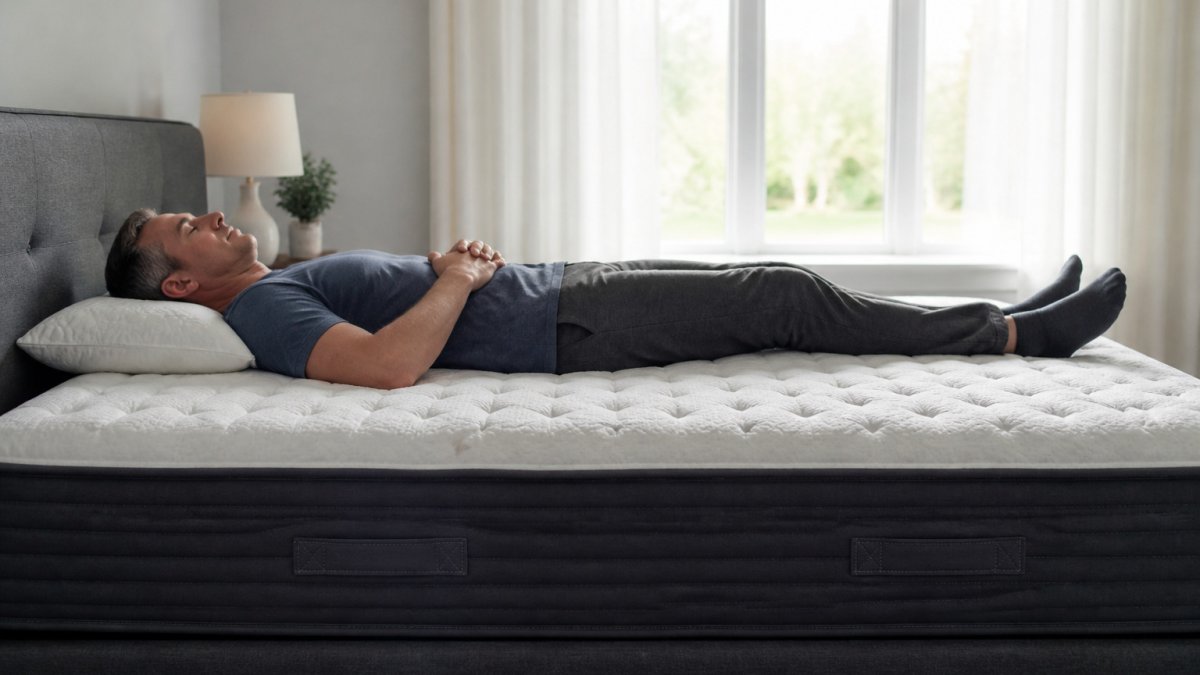
If your pain is in the lower back, the goal is keeping the spine straight from neck to hips. A surface that sags lets the pelvis tilt and strains the lumbar area. A medium-firm to firm surface can hold the spine level while still easing pressure at the hips.
Test this yourself. Lie on your back and check whether a hand fits under your lower back with light resistance. Too much room suggests the mattress is too soft.
When Back Pain Warrants Professional Medical Advice
A new mattress is not a treatment for injury or ongoing medical conditions. See a doctor or physical therapist if pain is severe, spreads down a leg, comes with numbness or weakness, follows an accident, or lasts more than a few weeks despite rest and changes at home. A clinician can tell you whether firmness is part of the solution at all.
Mattress Firmness for Side Sleepers With Back Pain
Side sleepers often prefer medium surfaces because the shoulders and hips need room to sink slightly. Without that give, pressure builds at the joints and the spine can bend sideways. Some side sleepers with back pain may find a medium-firm mattress that keeps the midsection supported suits them. You can compare options in our best mattresses for side sleepers guide.
If you sleep on your side and wake with lower back discomfort, a surface that is too firm may be the cause. Pay attention to whether your waist sits in a neutral line when you lie on your side.
How Body Weight and Sleep Position Change the Right Firmness
Body weight changes how a mattress feels, and it can change how the same mattress feels from one sleeper to another. Heavier sleepers compress the comfort layer more, so a surface that feels medium on a lighter person may feel softer than expected on a heavier one. Lighter sleepers may find firm mattresses feel harder than the rating suggests.
Sleep position matters just as much. Back sleepers usually benefit from firmer support so the lumbar region does not dip; side sleepers need enough give at the shoulder and hip to keep the spine straight; stomach sleepers need a firmer surface that stops the hips from sinking and arching the lower back. Combine the two factors when you choose.
A Practical Weight-and-Position Framework
Rather than memorizing rules, use this decision framework to narrow your choice between medium and firm:
- Back sleeper, average weight: Medium-firm is usually the safer starting point. It holds the lumbar spine level while still cushioning the hips. Choose firm if you wake with lower-back stiffness and prefer a harder surface.
- Back sleeper, heavier body: Firm often works better because a medium surface may compress enough to let the pelvis tilt. Confirm the support core is rated for your weight.
- Back sleeper, lighter body: Medium may feel firmer than the label suggests; a firm mattress can feel like a board. Start with medium and use the trial period to test.
- Side sleeper with back pain: Medium is usually the better match for shoulder and hip pressure relief, but medium-firm can work if the waist stays in a neutral line.
- Stomach sleeper: Firm is generally the better choice to keep the hips from dipping and the lower back from arching.
- Couples with different weights or positions: A medium-firm surface is a common compromise. Check the construction details of any mattress you consider.
Why the Same Mattress Feels Different to Different People
Perceived firmness is a product of your body and the mattress construction together, not the label alone. A 150-pound back sleeper and a 250-pound back sleeper can lie on the same medium mattress and have opposite experiences: the lighter sleeper stays on top of the comfort layer and feels the support core, while the heavier sleeper sinks through it and feels the firmer base. That is why a mattress that feels supportive to one partner can feel like a hammock to the other.
Match firmness to your sleep position first, then adjust for body weight. If you and your partner differ on both, prioritize a medium-firm surface or a flippable mattress that lets each side pick a feel.
If you are unsure, start with the firmness that matches your dominant sleep position and use the trial period to confirm it under your own body weight.
How to Test a Mattress and Adjust to a New Firmness
Most people need one to three weeks to adapt to a new firmness, and the first few nights can feel unfamiliar even if the mattress is a good fit. Give your body time before deciding it is wrong.
Here is a practical way to evaluate a mattress at home:
- Sleep on it for at least two weeks, tracking morning back stiffness.
- Note whether pain eases, stays the same, or worsens.
- Check spinal alignment in your usual sleep position.
- Flip the mattress on schedule, since the 2-sided construction is designed to help prevent premature wear.
Watch out: a mattress that causes sharp pain or numbness after several weeks should be reassessed with a clinician.
Booking Your Durable Mattress Trial for Your Back
If you want a firm feel for back support, the firm option in the Durable Mattress hybrid collection is worth considering.
Durable Mattress offers 2-sided, flippable hybrid mattresses designed to help prevent premature wear. Choose the firmness that matches your sleep position and pain pattern, then give it a fair trial. Shop Mattresses to find the level that fits your back.
Frequently Asked Questions
Is a medium or firm mattress better for back pain?
Neither firmness is better for every back. Firm mattresses can suit stomach and back sleepers, while medium or medium-firm options can suit side sleepers who need pressure relief at the shoulders and hips. If your pain is severe, persistent or radiates down a leg, talk to a doctor before changing your bed. Durable Mattress offers medium, firm and soft options in its hybrid collection, and current pricing is available on the Durable Mattress website.
Can a mattress that is too firm cause back pain?
Yes. A mattress that is too firm can leave pressure points at the hips and shoulders, which pushes the spine out of its natural curve and can cause morning stiffness. Signs that a mattress is too firm include waking with aching shoulders or hips, lying awkwardly to avoid pressure, or feeling that your body sits on top of the bed rather than sinking in slightly. Side sleepers are the most likely to notice this. A medium or medium-soft feel often reduces these pressure points while still supporting alignment.
What mattress firmness is best for side sleepers with back pain?
Side sleepers with back pain usually do best on a medium or medium-firm mattress. The surface needs enough give to cushion the shoulder and hip, which carry most of your weight in this position, while still keeping the spine level. A mattress that is too soft lets the hips sink and twist the spine, and one that is too firm creates pressure at the joints. Using a pillow between the knees can further support alignment on any firmness.
How do I know if my mattress is too soft or too firm?
Lie in your usual sleep position for 10 to 15 minutes and check your spine. A mattress that is too soft lets your hips or shoulders sink so your spine bends out of line, while one that is too firm keeps your body resting on top with pressure at the hips and shoulders. Waking with new aches usually points to a firmness problem.

Last Updated: October 28, 2026
Quick Summary
To choose mattress firmness, use the 1-to-10 firmness scale rather than the brand label, then match it to your sleep position: side sleepers need soft to medium, back sleepers medium to medium-firm, and stomach sleepers firm. Adjust for body weight, since heavier sleepers press deeper and need a firmer surface.
- Ignore the label and use the 1-to-10 number, because medium from one brand can feel firm from another.
- Combination sleepers should choose medium to handle more than one posture.
- Lighter sleepers under about 130 lb will still feel supported on a soft or medium surface.
- Firmness is how the surface feels, while support is how well the mattress holds your spine in line.
- Give a new mattress at least 30 nights before deciding, unless it is clearly wrong.
Table of Contents
- Start With the Mattress Firmness Scale, Not the Label
- Match Mattress Firmness by Sleep Position
- Adjust Mattress Firmness by Body Weight and Body Type
- Firmness Is Not Support: Spinal Alignment and Pressure Relief
- How to Test Mattress Firmness Before and After You Buy
- Two Sleepers, One Mattress: Handling Different Firmness Preferences
- How Firmness Changes With Mattress Age, Temperature, and Pain
- Pick Your Firmness Level and Shop Durable Mattress
- Frequently Asked Questions
Start With the Mattress Firmness Scale, Not the Label
Learning how to choose mattress firmness starts with one shift in thinking: ignore the word on the tag and look at the number behind it. Most brands rate firmness on a 1-to-10 scale, where 1 is pillowy soft and 10 is rock hard.
Here is the catch. "Medium" from one brand can feel like "firm" from another. The label is marketing. The number is closer to physics.
At Durable Mattress, our two-sided flippable design gives you a choice of sleep surfaces.
Soft, Medium, and Firm: What Each Comfort Grade Feels Like
Each comfort grade describes how far your body sinks before the mattress pushes back.
- Soft (roughly 3-4): Deep cushioning. Your shoulders and hips settle in. Best for lighter sleepers and side sleepers.
- Medium (roughly 5-6): A balance of give and push-back. Most sleepers land here.
- Firm (roughly 7-8): Little sinkage. Your body stays closer to the surface. Best for heavier sleepers and stomach sleepers.
- Very firm (9-10): Minimal contouring. A niche pick, usually for specific back needs.
Why Firmness Ratings Differ Between Brands
Two mattresses can both say "medium" and feel nothing alike. Materials explain most of it. A soft foam comfort layer sinks more than a latex or hybrid top. Innerspring and hybrid builds push back faster than all-foam.
So compare within a brand's own scale, not across brands. If you switch brands, expect to re-test.
Match Mattress Firmness by Sleep Position
The fastest way to narrow your choice is your sleeping posture. Mattress firmness by sleep position is the single most useful filter you have.
Side, Back, Stomach, and Combination Sleepers
- Side sleepers: Choose soft to medium. Your shoulder and hip need room to sink so your spine stays straight.
- Back sleepers: Choose medium to medium-firm. You want support under the lower back without a hard gap.
- Stomach sleepers: Choose firm. A soft surface lets your hips drop and arches your lower back.
- Combination sleepers: Choose medium. It handles more than one posture without punishing either.
Side sleepers who want a deeper breakdown can read our guide to the best mattress for side sleepers before committing.
Adjust Mattress Firmness by Body Weight and Body Type
Weight changes everything about how a mattress feels, which is why mattress firmness by body weight matters as much as position.
Heavier sleepers press deeper into any surface. A mattress that feels medium to a lighter person can feel soft to someone heavier. The reverse is also true.
- Lighter sleepers (under about 130 lb): A soft or medium surface will still feel supportive.
- Average sleepers: Medium is the safe middle.
- Heavier sleepers (over about 230 lb): Go firmer for support and to avoid bottoming out.
Body shape plays a role too. Broad shoulders and wider hips need more give at those pressure points.
Lighter sleepers who want more cushioning can consider a soft mattress.
Firmness Is Not Support: Spinal Alignment and Pressure Relief
Here is the distinction most shoppers miss: firmness and support are not the same thing.
Firmness is how the surface feels. Support is how well the mattress holds your spine in line. A soft mattress can still support you well. A hard mattress can still leave your lower back unsupported.
The test is simple. Lie down and check three things:
- Does your spine stay roughly straight?
- Do your shoulders and hips sink without bottoming out?
- Do you feel pressure building at the hip or shoulder?
Pressure relief comes from cushioning. Spinal alignment comes from support. You need both, and firmness is just the dial that balances them.
If your check points toward more push-back, consider a firm mattress.
How to Test Mattress Firmness Before and After You Buy
A short test can give you an initial impression of how a mattress feels.
The In-Store Screen
You can rule a mattress out in about ten minutes, but only if you test it the way you actually sleep.
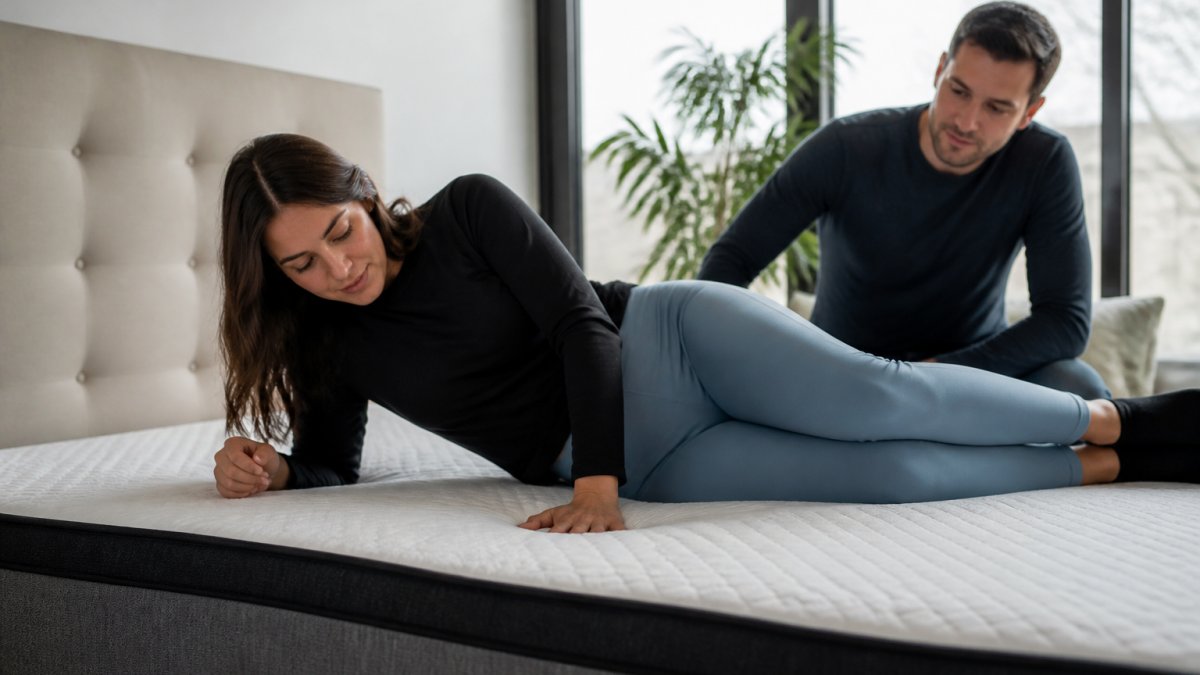
- Lie in your normal position. If you sleep on your side, lie on your side. Testing on your back out of politeness tells you nothing about your shoulder and hip.
- Give it at least five to ten minutes. Foam and hybrid comfort layers need time to warm and contour. A quick press with your hand measures the top inch, not the support beneath it.
- Roll from side to side. You want to feel the surface give under your shoulder and hip without a hard stop underneath.
- Check the edge. Sit on the edge, then lie near it. Weak edge support makes a mattress feel softer than its rating when you sleep near the perimeter.
- Bring your pillow. Your pillow height changes how your neck and spine line up, and a mattress that feels wrong with the store pillow may feel right with yours.
If a mattress fails the screen, move on. If it passes, the real test starts at home.
The At-Home Trial: What to Track
Track these signals over the first two to four weeks:
- Morning feel: Do you wake with stiffness, numbness, or pressure at the shoulder or hip? Note which side you slept on.
- Mid-night waking: Do you wake because a limb fell asleep, or because you feel like you are sinking or fighting the surface?
- Spinal position: Have a partner check, or take a photo from the side, to see whether your spine stays roughly straight.
- Sinkage: Are you bottoming out (feeling the layer beneath), or floating on top with a gap at your lower back?
- Temperature: Does the surface feel noticeably harder or softer depending on room temperature?
A simple log works: date, sleep position, morning comfort rating from 1 to 5, and one note about pressure or alignment. Patterns show up fast.
Judge the mattress on your worst nights, not your best. One great night after an exhausting day is not evidence; three consecutive mornings with hip pressure is.
When to Adjust, Exchange, or Return
- Give it at least 30 nights before deciding, unless the mattress is clearly wrong (severe pressure, bottoming out, or a hard gap under your lower back).
- If the feel is close but slightly off, a mattress topper is a cheaper fix than a return. A soft topper adds cushioning; a firm topper adds push-back.
- If the feel is wrong in the same way every night for two weeks, use the exchange or return policy rather than hoping it changes.
- Check the deadline. Put the return-by date on your calendar the day the mattress arrives, and note any restocking fee or return-shipping cost.
Two Sleepers, One Mattress: Handling Different Firmness Preferences
Couples rarely agree on firmness, and the disagreement is usually real: a 130 lb side sleeper and a 220 lb back sleeper genuinely need different surfaces. The goal is not to find a mattress that is perfect for both. It is to find a setup where neither sleeper is uncomfortable.
Start With the Actual Gap
Before shopping, each partner should answer three questions separately:
- What position do you sleep in most of the night?
- What is your body weight range?
- Do you wake with pressure (shoulder, hip) or with stiffness (lower back)?
If both partners land in the same comfort band, a single mattress may suit them. If one prefers soft and the other firm, they may need to consider different arrangements.
The Main Options
Split-firmness mattress. One mattress with two halves built to different firmness levels. Each sleeper gets their own side, and the split is usually available in king and sometimes queen sizes. Eliminating the friction of mismatched comfort preferences remains a foundational step to improve deep sleep throughout the night.
Two-sided (flippable) mattress. One surface leans softer, the other firmer.
Adjustable base with a split. An adjustable base lets each side raise the head or feet independently. It does not change firmness, but it can relieve pressure and alignment issues for one partner without affecting the other.
Mattress topper on one side. The cheapest fix. A soft topper on the firmer sleeper's side, or a firm topper on the softer sleeper's side, narrows the gap without replacing the mattress.
How to Compromise Without Losing
- Do not split the difference on firmness. A medium mattress chosen to satisfy a soft sleeper and a firm sleeper often leaves both mildly unhappy. Pick a split solution instead.
- Prioritize the sleeper with pain. If one partner wakes with back or hip pain, their needs should carry more weight than a preference.
- Test together. Lie on the mattress side by side in the store, in your normal positions, for at least ten minutes. A mattress that feels fine alone can feel different when your partner moves.
- Agree on the trial plan. Decide before purchase who will track comfort and what would trigger an exchange, so the decision is not relitigated every night.
Best for: couples with different preferences, and shoppers who want a longer-lasting bed. A two-sided design is the simplest shared option when the gap is moderate; a split-firmness mattress is the better answer when the gap is wide.
How Firmness Changes With Mattress Age, Temperature, and Pain
Firmness is not fixed. It shifts over time and with conditions.
- Age: Foam softens and compresses with use. A mattress that felt firm in year one often feels softer by year five.
- Temperature: Memory foam softens in a warm room and firms up when cold. A cool bedroom can make a mattress feel harder.
- Pain and mobility: Back pain often calls for medium-firm support. Hip or shoulder pain usually calls for more cushioning. Talk to a doctor about persistent pain rather than self-diagnosing through a mattress.
Pick Your Firmness Level and Shop Durable Mattress
You now have a repeatable process. Use the scale, match your sleep position, adjust for weight, then confirm support and pressure relief with a real test.
Here is the short version:
| Step | What to Check | Quick Rule |
|---|---|---|
| 1. Scale | Find the 1-10 rating | Ignore the label, use the number |
| 2. Position | Side, back, stomach, combo | Side = soft/medium, back = medium, stomach = firm |
| 3. Weight | Lighter or heavier | Lighter = softer, heavier = firmer |
| 4. Support | Spine and pressure points | Straight spine, no pressure build-up |
| 5. Test | In store and at home | Five minutes in position, several nights at home |
A mattress should fit your body, not the other way around. That is the idea behind every Durable Mattress build: a hybrid construction with a two-sided flippable design, available in soft, medium, and firm. Read about the benefits of double sided mattresses for durability and comfort.
Frequently Asked Questions
Is a soft or firm mattress better for back pain?
The best firmness depends on personal preference. Durable Mattress offers soft, medium, and firm options.
How does body weight affect the mattress firmness you need?
Durable Mattress offers soft, medium, and firm options in its two-sided flippable hybrid collection.
How can you test mattress firmness in a store?
Consider your sleep position and personal comfort when choosing a firmness level. Durable Mattress offers soft, medium, and firm options.
How often should you replace a mattress, and does firmness change over time?
Durable Mattress's two-sided flippable design helps prevent premature wear and extends the life of the mattress.
The hardest part of choosing firmness is trusting your own test over a label. We built Durable Mattress to make that easier, with a two-sided hybrid design you can flip to a firmer or softer surface and a build made to resist premature wear. Get started with Durable Mattress and choose the firmness that fits how you actually sleep.

Double the life of your mattress today
Our mattresses will help you get the sleep you need. Not sure which one’s right for you? Check out our firmness guide below.