
Quick Summary
Choose a mattress for side sleeping couples by agreeing on a firmness target band, testing pressure relief and motion isolation together, and confirming size and trial terms before buying. A medium or medium-firm surface suits many side sleepers, but the right choice depends on each partner's pressure points and body weight.
- Each partner rates preferred firmness from 1 to 10 and explains the reason behind the number.
- Agree on a two-point firmness band, such as 5 to 6, rather than a single number.
- Lie on your sides for at least 10 to 15 minutes each during the firmness test.
- Test motion isolation by having one partner sit up or roll over while the other stays still.
- Queen gives two side sleepers roughly 30 inches each, while king adds about 16 inches of width.
Table of Contents
- Why Two Side Sleepers Need a Different Buying Process
- Mattress Firmness for Side Sleepers: Pressure Relief and Spinal Alignment
- Mattress for Couples with Different Firmness Preferences
- Mattress Motion Isolation for Couples: Testing for Partner Disturbance
- Hybrid Mattress Pros and Cons for Side Sleeping Couples
- Sizing, Usable Sleep Space and Trial Periods
- Booking Your Shared Mattress Decision with Durable Mattress
- Frequently Asked Questions
Why Two Side Sleepers Need a Different Buying Process
Last Updated: November 8, 2026
Choosing a mattress for side sleeping couples is harder than choosing one for a single person. Two bodies, two sets of pressure points, and two different ideas of "comfortable" all share the same surface.
Side sleepers put most of their body weight on the shoulder and hip. That concentrated pressure is why a mattress that feels fine in a 10-minute store test can leave one partner waking up sore after a few weeks.
Two side sleepers also disturb each other in ways a single sleeper never does. A partner who shifts often, or who sits up in the night, can break the other person's sleep. So the buying process has to cover your individual comfort and how the bed behaves when you both use it.
Here's the process we recommend:
- Agree on firmness goals before you shop
- Check each person's pressure relief needs
- Test motion isolation together, not separately
- Confirm sizing and trial terms before you order
Each step below covers one of these points in more detail.
Mattress Firmness for Side Sleepers: Pressure Relief and Spinal Alignment
Many side sleepers find a medium or medium-firm mattress comfortable. A softer surface lets the shoulder and hip sink in, which reduces pressure. A surface that is too soft lets the hips drop too far, which can strain the lower back.
Look for these signs of a good fit:
- The shoulder and hip sink in enough to cushion the joint
- The spine stays roughly straight from the neck to the lower back
- You don't feel a hard ridge under the hip or waist
- You can change position without feeling stuck
The right firmness also depends on body weight. A heavier side sleeper usually needs more support to keep the spine aligned, while a lighter sleeper may find a firm surface too hard.
Mattress for Couples with Different Firmness Preferences
When two side sleepers want different firmness levels, the goal is not to split the difference on a number. It is to find a surface where both partners get enough shoulder and hip pressure relief and enough spinal support to wake up without soreness. That requires translating each person's preference into the underlying needs it represents.
Start by separating preference from need. A partner who says "I want something soft" is usually asking for pressure relief at the shoulder and hip. See whether a two-sided mattress is a practical solution for mismatched preferences.
A practical decision process for two side sleepers:
- Rate firmness and identify the reason. Each partner rates the desired feel from 1 (very soft) to 10 (very firm) and writes one sentence about why. "I want a 4 because my shoulder goes numb" is more useful than a bare number.
- Weigh body size against the rating. A heavier side sleeper generally needs more support to keep the spine aligned, so their preferred number may need to move up one step on a shared bed. A lighter partner may need the surface to stay softer so the shoulder and hip can sink in.
- Set a target band, not a point. Agree on a two-point range (for example, 5-6) rather than a single number. This gives you room to test and adjust without reopening the whole debate.
- Test the band together, in your normal sleep positions. Lie on your sides for at least 10-15 minutes each, not just a quick sit. Check the shoulder and hip for pressure and the lower back for a hard ridge or a deep sag.
- Revisit after two to three weeks of real use. Short store tests favor firmer surfaces because they feel supportive; longer home tests reveal whether pressure points build up overnight.
When a single firmness will not work, the realistic options are:
- Dual-firmness or flippable designs. A mattress with two distinct firmness sides lets you choose the side that suits the partner with the stronger need and rotate it as preferences change.
- Split-firmness mattresses. These put a different firmness level on each half of the bed, which is the most direct solution when partners are far apart on the scale. They typically cost more and narrow your selection, so confirm the return terms before ordering.
- A firmness topper on one side. A topper can soften one half of a shared bed without replacing the mattress. It is a lower-cost experiment, but it can shift and may reduce the benefit of the mattress's own comfort layer.
- Separate mattresses or a split king setup. When preferences, body weights, or sleep schedules diverge sharply, two mattresses on a split king base can be the lowest-conflict answer. It costs more and takes more room, but it removes the compromise problem entirely.
Watch out: partners often anchor on the number they picked in the store and resist changing it after the first uncomfortable week. Treat the initial rating as a starting hypothesis, not a commitment, and use the trial period to test whether the target band actually holds up overnight.
Mattress Motion Isolation for Couples: Testing for Partner Disturbance
Motion transfer is one of the most common complaints from couples. One partner rolls over, gets up, or changes position, and the other feels it right away.

Test motion isolation before you buy:
- Lie down together and have one partner sit up or roll over
- Notice how much movement reaches the other side
- Repeat the test on both sides of the bed
- Pay attention to how quickly the surface settles after movement
A mattress that absorbs motion well keeps the other partner's sleep steady. Keep in mind that in-store tests are short, so a longer test at home during a trial period gives you a more accurate result.
Hybrid Mattress Pros and Cons for Side Sleeping Couples
Hybrid mattresses combine a coil support core with foam or other comfort layers. For side sleepers, that mix often works well, but it has trade-offs.
Pros:
- Coils support the spine and keep the body from sinking too far
- Comfort layers help cushion the shoulder and hip
- Airflow through the coils can help with temperature regulation
- Many hybrids offer more bounce for easier position changes
Cons:
- Heavier than all-foam designs, which can make rotating or flipping harder
- Motion isolation varies by construction, so test it before you commit
- Prices vary by size, configuration, and retailer, so check Durable Mattress directly for current pricing
Still, the right choice depends on your individual needs, so use the testing steps above to decide.
Sizing, Usable Sleep Space and Trial Periods
Sizing matters more for two side sleepers than for a single sleeper because both partners need room to turn, settle, and change position without rolling into each other. The key distinction is between total mattress dimensions and usable sleep space, the area each partner can actually occupy without feeling the other's movement or hitting the edge.
Common mattress sizes and what they mean for two adults:
- Full (double): about 54 inches wide by 75 inches long. Workable for one adult; tight for two side sleepers, especially if either partner is tall or moves a lot.
- Queen: about 60 inches wide by 80 inches long. The most common couple size, but two side sleepers share roughly 30 inches each, which leaves little buffer for movement.
- King: about 76 inches wide by 80 inches long. Adds about 16 inches of width over a queen, which is often the difference between feeling a partner's movement and sleeping through it.
- California king: about 72 inches wide by 84 inches long. Trades four inches of width for four inches of length, which suits taller partners better than it suits movers.
Edge support changes the math. A mattress with weak edges loses several inches of usable sleep space on each side because neither partner can sleep near the perimeter without feeling like they will roll off.
Before you order, run through this buying checklist:
- Trial length and start date. Confirm how many nights the trial runs and when it begins, some policies start at delivery, others at the first night of sleep.
- Return fees and conditions. Check for restocking fees, return shipping costs, and requirements such as a minimum number of nights or a law tag still attached.
- Delivery and setup. Confirm whether delivery is to the door or inside the home, whether old-mattress removal is included, and whether setup is part of the price.
- Warranty exclusions. Read what voids coverage, improper foundation, stains, or using the mattress without a protector are common exclusions.
- Foundation and frame requirements. A mattress that needs a specific base or box spring adds cost and can affect the warranty if you use the wrong one.
Trial periods are your safety net for a shared purchase. Compare the specific trial terms offered before you commit.
Watch out: couples often assume a larger size will solve disturbance problems, but if the mattress has poor motion isolation or weak edge support, extra width alone will not fix it.
The article gives standard dimensions for common mattress sizes, which can be summarised for quick scanning:
| Size | Dimensions (W × L) | Note for two adults |
|---|---|---|
| Full (double) | 54 in × 75 in | Tight for two side sleepers |
| Queen | 60 in × 80 in | Most common couple size, about 30 in each |
| King | 76 in × 80 in | Adds about 16 in of width over queen |
| California king | 72 in × 84 in | Four more inches of length, less width |
Standard mattress dimensions for two adults
Booking Your Shared Mattress Decision with Durable Mattress
Choosing a mattress for two side sleepers takes planning, but the process is manageable when you focus on firmness, pressure relief, motion isolation, and sizing. Work through each step together, and you're more likely to end up with a bed that suits both of you.
If you're ready to start, explore Durable Mattress's firm, medium-firm, and soft options to see which feel fits your shared goals. The flippable design is intended to help the mattress last.
Frequently Asked Questions
Do side sleepers need a soft or medium-firm mattress?
Most side sleepers do best on a medium-firm to medium surface because it cushions the shoulders and hips while keeping the spine level. Softer mattresses can let the hips sink too far, which pulls the spine out of line. Firmer mattresses can leave pressure points unrelieved. Body weight matters too: heavier side sleepers often need a firmer feel than lighter ones. Durable Mattress offers Medium, Firm and Soft options, so you can compare them against your own sleep position and pressure points before deciding.
Is a hybrid mattress better for a side sleeper?
A hybrid mattress often suits side sleepers because it combines a supportive coil base with comfort layers that contour to the shoulders and hips. The coils add responsiveness, which helps you change position without feeling stuck. Foam-only mattresses can offer more contouring but may trap heat and feel slower to move on. Hybrid designs vary in thickness and layer makeup, so check the construction details rather than assuming all hybrids feel the same.
How can couples choose a mattress when they prefer different firmness levels?
Start by listing each partner's body weight, sleep position and pressure concerns, then identify where you overlap. Couples with different firmness preferences often settle on a medium-firm option that is comfortable enough for the softer sleeper and supportive enough for the firmer one. Try lying on the mattress together, and if you can't test in person, rely on the return window to confirm the choice works for both of you.
What mattress features help keep couples from feeling each other move?
Motion isolation depends on how the mattress absorbs movement. Pocketed coils and dense foam layers typically reduce motion transfer better than open innerspring systems. Lie down together and have one partner shift position while the other notes how much movement they feel. Edge support also affects how easily you can get in and out of bed without disturbing your partner.

Last Updated: November 4, 2026
Quick Summary
The best flippable mattress for couples gives you two firmness options in one bed, and Durable Mattress is our top pick with a 2-sided flippable design in Soft, Medium, or Firm. A flippable mattress suits couples whose firmness preferences are close, since both partners sleep on the same surface at once.
- Engineered Sleep Classic Hybrid starts at $720 and is the value pick for budget-conscious couples.
- Original Mattress Factory Two-Sided offers 13 comfort levels starting at $443.
- Zenhaven by Saatva costs $2,395 and pairs a Luxury Plush side with a Gentle Firm side.
- Flip a two-sided mattress every three to six months and rotate head-to-foot on the same schedule.
- Couples more than one firmness step apart should consider split-firmness instead of a flippable bed.
Table of Contents
- Why a Flippable Mattress Makes Sense for Couples in 2026
- Quick Comparison: Best Flippable Mattresses for Couples
- The 6 Best Flippable Mattresses for Couples
- Mattress for Couples With Different Firmness Preferences
- Best Flippable Mattress for Side Sleepers
- Flippable Mattress Motion Isolation: What Partners Should Know
- How Often to Flip a Mattress (And How to Handle It)
- Shop the Durable Mattress Collection
- Frequently Asked Questions
Why a Flippable Mattress Makes Sense for Couples in 2026
A flippable mattress is a two-sided bed built so both surfaces can serve as the sleep surface, which doubles the usable life of the mattress and gives couples two firmness options in one purchase. At Durable Mattress, we build every bed around that idea: a 2-sided flippable design that prevents premature wear instead of hiding it under a pillow top.
Here is the problem many couples run into. One partner wants a soft landing for their shoulders, the other wants a firm deck under their lower back.
That is the real case for a flippable mattress for couples: not a gimmick, but a way to reset the sleep surface and split the firmness difference without buying two beds.
Quick Comparison: Best Flippable Mattresses for Couples
| Mattress | Starting Price | Firmness Options | Best For |
|---|---|---|---|
| Durable Mattress | See site for pricing | Soft, Medium, Firm | Longevity and firmness choice |
| Engineered Sleep Classic Hybrid | $720 | Multiple profiles | Budget-conscious couples |
| Original Mattress Factory Two-Sided | $443 | 13 varieties | Traditional innerspring feel |
| Zenhaven by Saatva | $2,395 | Plush and Firm | Latex and natural materials |
| Plank Firm | $849 | Firm and Ultra-Firm | Very firm support |
| DLX Classic | $1,099 | Limited options | Classic hybrid feel |
The 6 Best Flippable Mattresses for Couples
Durable Mattress: Best Overall for Longevity
Our top pick is our own Durable Mattress, and the reason is simple: the 2-sided flippable design is the whole point of the bed, not an add-on.
The hybrid construction pairs support with comfort, and you choose your firmness level: Soft, Medium, or Firm.
See the soft version, the firm version, or the medium version to match your sleep style.
Best for: couples who want one bed, two firmness options, and a longer replacement cycle.
Engineered Sleep Classic Hybrid: Best Value
At $720, the Engineered Sleep Classic Hybrid is the value play on this list. The two-sided construction and coil-and-foam hybrid give couples balanced support without the premium price. The catch is availability: you will not find it in most showrooms, so you are buying mostly on spec.
Best for: budget-conscious couples who want a durable hybrid.
Skip if: you want to lie on it before you buy.
Original Mattress Factory Two-Sided: Best Firmness Variety
With 13 comfort levels from very firm to very soft, Original Mattress Factory offers the widest firmness range here, starting at $443. The traditional innerspring build suits couples who like a bouncier, more responsive feel. What most guides miss: that traditional feel is exactly what some sleepers want and others cannot stand, so test the feel before committing.
Best for: shoppers who want a traditional innerspring mattress with options.
Skip if: you prefer modern foam or hybrid comfort.
Zenhaven by Saatva: Best Latex Option
Zenhaven is the premium latex pick at $2,395, with a Luxury Plush side and a Gentle Firm side in 100% natural Talalay latex. Latex sleeps cooler and responds faster than foam, which helps couples who run hot. The trade-off is the price, and latex feels firmer than its label suggests.
Best for: couples who want natural materials and a responsive surface.
Skip if: budget is the deciding factor.
Plank Firm Mattress: Best for Very Firm Support
Plank is built for one preference: firm. Both sides are firm or ultra-firm, which makes it a strong match for back and stomach sleepers who want a flat, supportive deck. Side sleepers should look elsewhere, since the surface offers little give at the shoulder and hip.
Best for: couples who both want very firm support.
Skip if: either partner sleeps on their side.
DLX Classic: Best Traditional Feel
The DLX Classic at $1,099 delivers a classic mattress feel with a two-sided design, a supportive coil system, and breathable construction that helps with temperature regulation. Firmness options are fewer than some rivals, so couples with very different preferences may find it limiting.
Best for: couples who want a familiar feel with flip-friendly durability.
Skip if: you need a wide firmness spread.
Mattress for Couples With Different Firmness Preferences
A flippable mattress solves a firmness disagreement only when both partners can live with one of the two surfaces. That is the honest starting point most roundups skip. A two-sided bed gives you two feels, not two independent feels, both partners sleep on the same side at the same time, so the question is whether one surface is acceptable to both people, not whether each person gets their ideal.
Here is how to tell whether a flippable mattress will actually work for your pairing:
- Small preference gap (one step apart): a medium side and a firm side, or a soft side and a medium side, usually covers both partners. This is the scenario where flipping genuinely ends the compromise.
- Large preference gap (two or more steps apart): one partner wants plush, the other wants ultra-firm. A single flippable mattress rarely satisfies both at once, because whichever side is up is the side both people sleep on. Flipping helps over time, not within a single night.
- Weight difference between partners: a lighter partner on a firm surface may feel like they are sleeping on a board, while a heavier partner on a soft surface may bottom out to the support layer. A medium side is usually the safer shared surface when body weights differ by more than roughly 50 pounds.
When a flippable mattress is not enough, couples have three realistic alternatives:
- Split-firmness mattress: each half of the bed is built to a different firmness. This is the only option that gives each partner an independent feel night after night, but it limits you to specific brands and sizes (usually king and sometimes queen), and the seam down the middle is a real comfort variable.
- Split-firmness adjustable air bed: each side inflates to its own firmness setting and can be changed later. The trade-off is more moving parts, a pump, and a feel many couples describe as less plush than foam or latex.
- Two twin XL mattresses on a split king frame: each partner buys their own mattress and firmness. It is the most flexible answer and the most expensive in total, and it requires a frame built for two foundations.
A flippable mattress is the better buy when your preferences are close, when you both want the longevity benefit of two sleep surfaces, or when you want one purchase and one delivery. Split-firmness is the better buy when one of you genuinely cannot sleep on the other's preferred feel. The mistake couples make is buying a flippable bed expecting split-firmness performance, then discovering that the firm side is still the side both of them sleep on.
Watch out: if you and your partner are more than one firmness step apart, test the exact surface you plan to sleep on together before the trial window closes, a flippable mattress cannot be flipped mid-night to satisfy two different preferences.
Best Flippable Mattress for Side Sleepers
The best flippable mattress for side sleepers is one with a softer surface that cushions the shoulder and hip while still supporting the spine. Side sleeping concentrates body weight on a small area, so pressure buildup is the enemy.
For couples where one partner sleeps on their side, look for a model with a soft or medium side rather than an all-firm build. If side sleeping is the priority for both of you, our guide to mattresses for side sleepers breaks down the fit in more detail.
Flippable Mattress Motion Isolation: What Partners Should Know
Motion isolation is how much of one partner's movement reaches the other side of the bed (How We Determine Motion Isolation Ratings).
What drives motion transfer on a flippable mattress
- Support core: pocketed coils isolate motion better than open coils or a continuous wire unit, because each coil moves independently. A traditional innerspring with connected coils transfers movement across the whole surface.
- Comfort layer: memory foam and dense polyfoam absorb movement; latex is responsive and bouncier, so it transfers more motion than memory foam but less than bare coils.
- Surface firmness: firmer surfaces transfer more motion. A soft side dampens movement; a firm side transmits it. This is why the same mattress can feel calm on one side and restless on the other.
How flipping changes the equation
A two-sided mattress has two different comfort builds, so motion isolation is not one number, it is two. The softer side generally isolates motion better. If one partner is a light sleeper and the other is restless, you can consider placing the light sleeper on the softer side, then flip on schedule so wear stays even.
How to test motion transfer as a couple
- Both lie on the mattress in your normal sleep positions, about a foot apart.
- One partner rolls from back to side three times while the other rests a hand flat on the surface and notes how much movement they feel.
- Repeat with the other partner moving.
- Switch sides and repeat, so you test both surfaces.
- Note whether the movement is a quick ripple (acceptable) or a sustained bounce that would wake you.
A common pattern is that couples notice motion most in the first 20 minutes of the night, when both are settling in, and again during position changes.
Watch out: very firm surfaces, including the firm side of a flippable bed, transfer noticeably more motion, so couples who both want ultra-firm support should test motion transfer together rather than assuming a hybrid will be quiet.
How Often to Flip a Mattress (And How to Handle It)
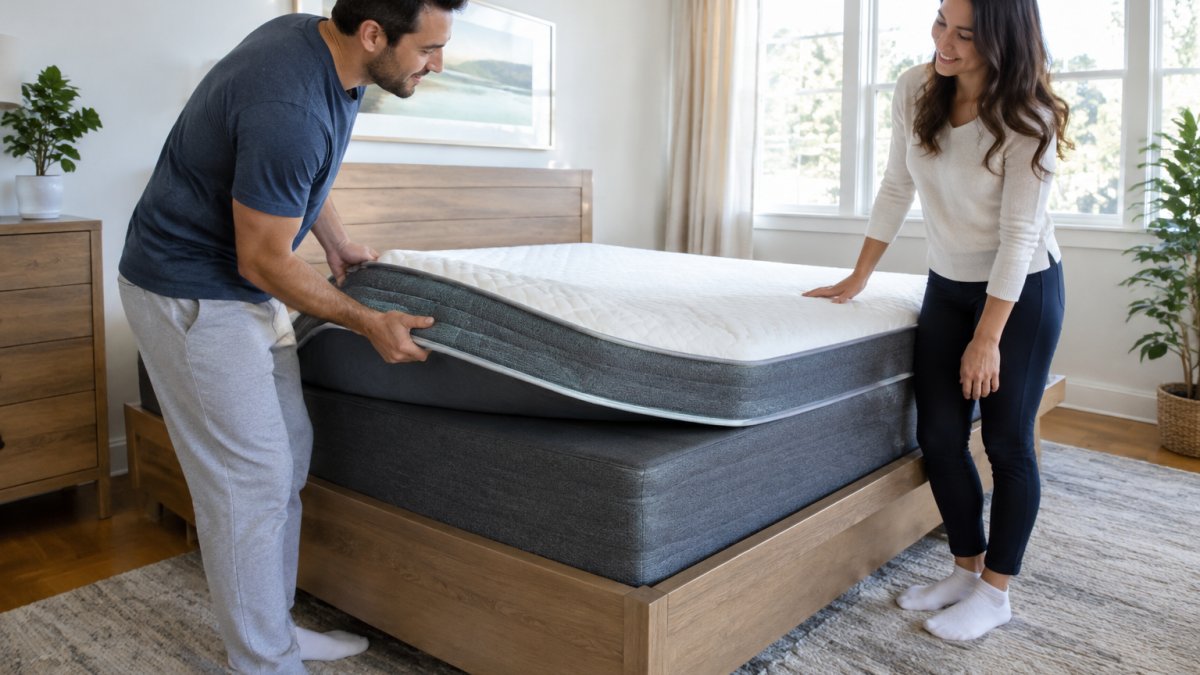
Most two-sided mattresses are commonly flipped every three to six months, and rotated head-to-foot on the same schedule to even out wear. Flipping is the maintenance step that can help a double-sided mattress last longer.
Handling a queen mattress alone is awkward, so flip with two people and clear the floor first. Rotate first, then flip, and keep a calendar reminder so it actually happens. For a step-by-step schedule and technique, read our complete guide to how often to flip a mattress.
Shop the Durable Mattress Collection
The right flippable mattress for couples comes down to two things: a surface each partner can live with, and a build that rewards flipping instead of fighting it. Durable Mattress is built around a 2-sided flippable design, hybrid construction, and Soft, Medium, and Firm options, so couples can choose a firmness level that fits how they both sleep.
Ready to choose your firmness level? Browse the collection and pick the side that fits how you both sleep.
Frequently Asked Questions
Do flippable mattresses last longer than one-sided mattresses?
A flippable mattress typically lasts longer because you rotate the wear across two sleeping surfaces instead of one. With a one-sided mattress, the top comfort layer compresses in the same spots night after night. Flipping spreads that load, which slows sagging and body impressions. How much extra life you get depends on construction, foam density, and how consistently you flip. For couples, the payoff is bigger because two bodies create more concentrated wear.
Can couples with different firmness preferences use the same flippable mattress?
Yes, and this is where a flippable mattress shines. Two-sided mattresses can offer distinct comfort levels on each side, so a couple can agree on one mattress and still get different feels. The catch: you both sleep on the same side at any given time, so you have to pick the side that works for both of you, or flip periodically if preferences shift. If one partner needs soft and the other needs extra-firm, a two-sided mattress with a wide firmness gap is the practical compromise. Talk through firmness before you buy.
How often should you flip a flippable mattress?
Most manufacturers recommend flipping a two-sided mattress every three to six months, and rotating it head-to-foot in between. That schedule keeps wear even and protects the comfort layers from settling in one spot. Couples should lean toward the three-month end because two sleepers concentrate weight in the same zones. Set a calendar reminder, and pair each flip with a quick vacuum of the surface. If you notice body impressions starting to form, flip sooner rather than waiting for the next scheduled date.
Is a flippable mattress good for side sleepers?
It can be, as long as you choose the right firmness side. Side sleepers need pressure relief at the shoulders and hips, so a medium or soft side usually works better than a firm one. A flippable hybrid with a responsive coil core and a cushioned top layer supports the spine while easing pressure points. Very firm surfaces are often a poor fit for side sleepers. Look for a two-sided mattress with at least one medium or plush option, and check the return policy before committing.
How does motion isolation work on a flippable mattress?
Motion isolation depends on the core and comfort layers, not on whether the mattress flips. Foam-heavy two-sided mattresses absorb movement well, while traditional innerspring models transfer more motion across the surface. Hybrids with pocketed coils and dense foam fall in the middle. For couples, test the mattress with a partner if you can, or read reviews from co-sleepers. If one partner is a light sleeper, prioritize models with high-density foam and individually wrapped coils, and avoid open-coil innerspring designs.
Your next step is simple: decide your firmness, then let the flip do the rest. Durable Mattress gives you a 2-sided flippable design built to be flipped, hybrid construction for balanced support, and three firmness levels to match each partner. Get started with Durable Mattress and choose the mattress that lasts longer and sleeps better for both of you.
Double the life of your mattress today
Our mattresses will help you get the sleep you need. Not sure which one’s right for you? Check out our firmness guide below.