
Table of Contents
- What Double Sided Mattresses Are and How They Work
- How Often to Flip a Mattress for Maximum Lifespan
- Even Wear and Reduced Body Impressions
- Flippable Mattress vs. One-Sided Mattress: Key Differences
- How to Flip a Mattress Safely and Effectively
- Long-Term Cost Effectiveness and Value
- Who Benefits Most From Double Sided Mattresses
- Conclusion
- Frequently Asked Questions
Last Updated: October 16, 2026
What Double Sided Mattresses Are and How They Work
A double sided mattress is a flippable bed with two distinct sleep surfaces, each built for comfort and support. Unlike one-sided mattresses, both the top and bottom of a double sided mattress are designed for sleeping, so you can flip it periodically to distribute wear evenly.
Construction typically combines foam comfort layers with innerspring or coil support systems. Flipping regularly rotates which side bears your body weight, preventing the concentrated wear that leads to permanent impressions and sagging, and extending usable lifespan versus one-sided alternatives.
At Durable Mattress, we build our flippable mattresses with this principle at the core. Our hybrid collection balances cushioning comfort with durable support in medium, firm, and soft, so you can choose the feel that suits you.
How Often to Flip a Mattress for Maximum Lifespan
Most manufacturers recommend flipping a double sided mattress every three to six months. Exact frequency depends on body weight, sleep position, and how many people share the bed.
Heavier individuals or those who sleep in the same spot nightly should flip every three months; lighter sleepers or couples who rotate positions can stretch to six months. Tying the routine to seasonal changes makes it easier to remember.
The goal is simple: prevent any single area from bearing concentrated pressure too long. Consistent flipping keeps any part from compressing permanently, separating a mattress that lasts a decade from one that sags after three years.
Mark your calendar when you flip. A consistent schedule prevents the "I think I flipped it last month" confusion that leads to skipped rotations and premature wear.
Even Wear and Reduced Body Impressions
Body impressions are permanent indentations that form where your torso, hips, and shoulders rest night after night. On a one-sided mattress, body weight compresses the foam and support layers into your shape, and over time that compression becomes permanent, costing you proper support.
A double sided mattress distributes pressure across two surfaces. Flipping every few months gives the loaded side a rest period to recover while the opposite side handles the load, dramatically reducing the depth and speed of impression formation.
The difference shows after two to three years: a one-sided mattress often has clear body-shaped depressions, while a properly maintained double sided mattress stays relatively flat on both surfaces, keeping its support structure and comfort profile. That even wear is why flippable mattresses typically outlast traditional designs by several years.
The ability to flip distributes wear across two surfaces instead of concentrating it on one. This simple mechanic is the primary reason double sided mattresses last longer and feel supportive for a decade or more.
Flippable Mattress vs. One-Sided Mattress: Key Differences
The core difference between a flippable mattress and a one-sided mattress is construction and durability strategy. A one-sided mattress has a single comfort surface over a base layer not meant for sleeping; once the top compresses, you're stuck with a degrading experience until replacement.
A flippable mattress is engineered as two complete sleep systems stacked back-to-back, both with full comfort and support layers. Each flip switches you to a genuinely fresh sleep surface, not just a worn side rotated back into use.
| Feature | Double Sided Mattress | One-Sided Mattress |
|---|---|---|
| Sleep surfaces | Two full, usable surfaces | One optimized surface |
| Flipping benefit | Extends lifespan by 40-60% | No benefit; cannot flip |
| Body impression timeline | 5-7 years to noticeable depth | 2-3 years to significant sagging |
| Long-term support | Maintains firmness across lifespan | Degrades progressively |
| Repair options | Flip to fresh surface when worn | Replace mattress |
| Best for | Long-term value seekers | Budget-conscious buyers accepting shorter lifespan |
One-sided mattresses cost less upfront because manufacturers skip half the construction. Flippable mattresses require twice the engineered layers, raising the initial investment, but cost-per-year often favors the flippable design because you replace it less often.
How to Flip a Mattress Safely and Effectively
Flipping a mattress safely takes two people and proper technique to avoid strain or damage:
First, strip all bedding and clear the floor around the bed. Remove any bed frame components in the way, and if the mattress is in a tight corner or against a wall, move it to the center of the room.
Stand on opposite sides, one person at the head and one at the foot. Bend at your knees, not your waist, and grip the edges or handles firmly. On the count of three, lift together, rotate 180 degrees so the head end becomes the foot end, then flip so the bottom faces up, rotating and flipping at once is the most efficient method.
For heavy mattresses or mobility concerns, a mattress flipper tool or furniture dolly reduces strain. Some prefer to rotate first (spin 180 degrees without flipping), then flip on a separate occasion, slower, but less physically demanding.
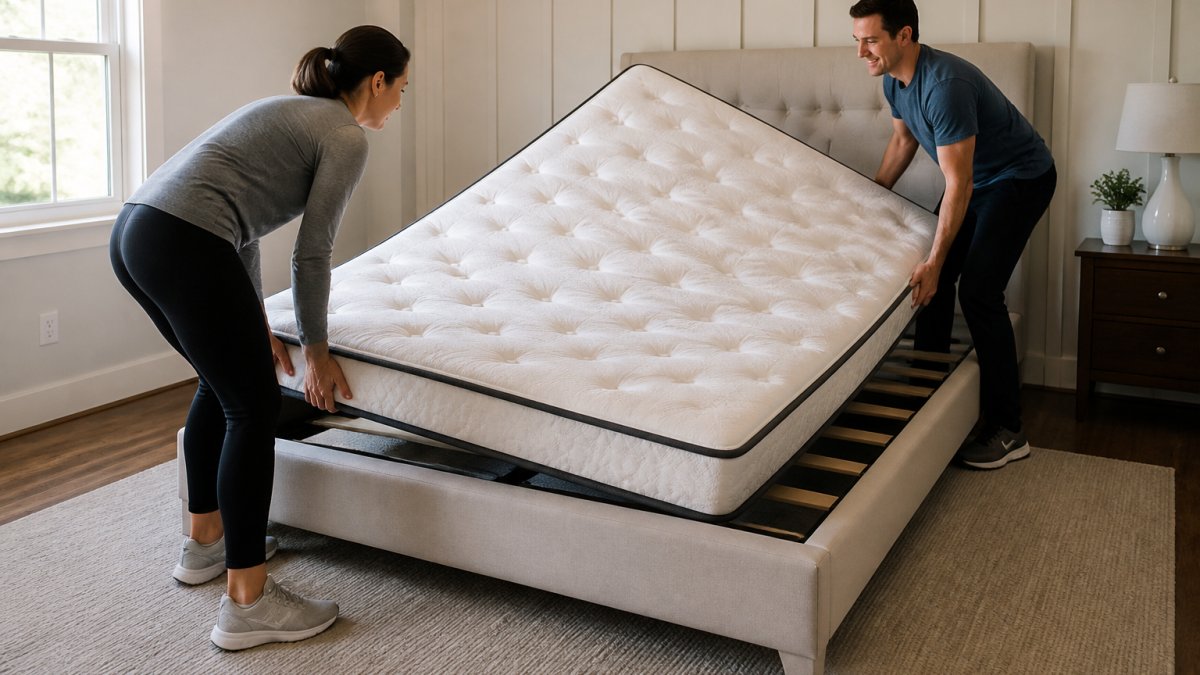
After flipping, let the mattress settle for a few hours before making the bed so compressed areas can begin recovering. If you notice odors or moisture, ventilate the room before sleeping on the newly flipped side.
Never flip a mattress alone if it weighs over 100 pounds. Attempting to lift and rotate solo significantly increases injury risk to your back, shoulders, and wrists. A second person or mechanical aid is worth the effort.
Long-Term Cost Effectiveness and Value
The usual line is that a double sided mattress costs more upfront but lasts longer, so it wins on cost per year.
The basic cost-per-year formula
Cost per year = purchase price ÷ realistic years of service. The catch is that "realistic years of service" depends far more on materials and construction than on whether the mattress flips.
The honest framing: flipping is a multiplier on good construction, not a substitute. A two-sided mattress made with low-density foam will still break down, just on a slightly longer timeline.
A transparent example
Suppose a one-sided mattress costs $1,000 and serves 6 years, about $167 per year.
The lesson: run the numbers with your own price quotes and a conservative lifespan estimate for each option. Do not accept "lasts twice as long" as a given.
What actually drives lifespan
- Support core density and gauge. Higher-density foam and heavier-gauge coils resist compression longer. This matters more than the number of sleep surfaces.
- Comfort layer quality. Low-density comfort foam is the first thing to break down, on either design.
- Foundation and frame support. A sagging or flexing foundation accelerates wear regardless of how often you flip.
- Body weight and sleep position. Higher weight and a fixed sleep position concentrate load and shorten life on any mattress.
- Rotation and flipping discipline. Consistent flipping is what unlocks the two-sided advantage. Skip it and you are paying a premium for a feature you are not using.
The non-financial value
Cost per year is not the only variable. Fewer replacement cycles mean fewer shopping trips, delivery windows, and disposal hassles, real value if you dislike the mattress-buying process, even when dollar savings are modest.
When one-sided makes more sense
Treat the value claim as a calculation, not a slogan. Compare upfront price against a conservative lifespan estimate for each specific mattress, and remember that construction quality sets the ceiling while flipping only helps you reach it.
Who Benefits Most From Double Sided Mattresses
Whether a double sided mattress is worth it depends less on the mattress than on you: sleep position, body weight, how you use the bed, and whether you'll keep up with flipping.
By sleep position
- Side sleepers concentrate pressure at the hips and shoulders, which is exactly where one-sided mattresses develop deep impressions first. A flippable design lets you move that load to a fresh surface, so side sleepers tend to see the clearest benefit. They also generally need a softer, more contouring surface to keep the spine aligned, so a soft or medium flippable model is often the better match.
- Back sleepers need even support along the spine and are usually well served by a medium to medium-firm feel. Because they tend to sleep in a consistent position, they also concentrate wear in predictable zones, another good case for flipping.
- Stomach sleepers need a firmer surface to keep the hips from sinking and the lower back from arching. They often move around more during the night, which spreads pressure and can mean slightly slower wear. The benefit of flipping is real but less dramatic for this group.
- Combination sleepers who shift positions throughout the night distribute load more evenly, so they may see a smaller durability advantage from flipping.
By body weight
Higher body weight accelerates compression on any mattress, most pronounced on lower-density comfort layers. Sleepers above roughly 200 pounds often find a one-sided mattress softens noticeably within a few years, making the dual-surface design of a flippable mattress more valuable.
Lighter sleepers put less stress on the comfort layers and may find that a well-built one-sided mattress lasts long enough that the flipping advantage is modest.
By firmness preference
Firmness is personal, but the guidance holds: softer contours more and suits side sleepers and lighter bodies; firmer supports more and suits back and stomach sleepers and heavier bodies.
Who should not flip a mattress
This is the part most benefit pages leave out. Do not flip:
- One-sided mattresses. Many modern beds have a single sleep surface and a non-sleepable base. Flipping puts you on the support core.
- Mattresses with a designated head and foot. Some two-sided models are built to be rotated end-to-end, not turned over. Check the law tag or care instructions.
- Mattresses with structural damage. A torn cover, exposed coils, or a broken edge support will not be fixed by flipping.
- Anyone unable to handle the weight safely. If lifting and turning the mattress is a strain or a fall risk, rotation-only or a professional service may be the better routine.
A quick self-check
If you sleep mainly on your side or back, weigh above roughly 200 pounds, plan to keep the mattress for years, and will commit to flipping every few months, a double sided mattress is likely a strong fit.
The benefit of a double sided mattress is conditional. It rewards sleepers who concentrate pressure in fixed spots, carry more weight, and will actually flip on schedule. For everyone else, construction quality matters more than the number of sleep surfaces.
Conclusion
Double sided mattresses address a fundamental problem with traditional design: concentrated wear in predictable locations. Distributing pressure across two sleep surfaces through regular flipping extends lifespan, maintains support, and reduces costly replacements.
The durability advantage is real: a properly maintained double sided mattress resists body impressions and sagging significantly longer than a one-sided alternative, delivering genuine long-term value for anyone wanting a decade or more of performance.
Durable Mattress engineers our flippable collection with this principle at the core. Our hybrid construction, in medium, firm, and soft, balances comfort and durability to make flipping worthwhile, an investment in years of consistent, supportive sleep rather than repeated replacements.
Consumer Reports mattress durability testing
Sleep Foundation guide to mattress lifespan and care
American Chiropractic Association recommendations on mattress support
Frequently Asked Questions
Are double sided mattresses more durable than one-sided mattresses?
Yes, double sided mattresses typically last longer because flipping distributes wear across both surfaces. One-sided mattresses concentrate all body weight and pressure on a single comfort layer, causing faster sagging and deterioration. By rotating use between two surfaces, flippable designs extend the overall lifespan and maintain consistent support longer than traditional one-sided options.
How often should you flip a double-sided mattress?
Most manufacturers recommend flipping every 3 to 6 months for optimal wear distribution. Some suggest rotating quarterly and flipping semi-annually. The exact frequency depends on your mattress construction, body weight, and sleep position. Heavier sleepers may benefit from more frequent flipping. Check your mattress care guidelines for brand-specific recommendations to maximize longevity.
What are the main benefits of a double-sided mattress?
The primary benefits include extended lifespan through even wear distribution, reduced body impressions and sagging, improved long-term comfort consistency, and better value over time. Double sided mattresses also offer flexibility if you prefer switching between firmness levels, and they reduce the need for early replacement, making them a cost-effective investment for homeowners seeking durability.
Is flipping a mattress really worth the effort?
Yes, regular flipping significantly extends mattress life and prevents premature sagging. While it requires minimal effort every few months, the payoff is substantial: you avoid replacing your mattress every 5-7 years and instead enjoy 10+ years of consistent support. For value-conscious buyers investing in quality construction, the maintenance effort is worthwhile and pays dividends in long-term comfort and cost savings.
Double the life of your mattress today
Our mattresses will help you get the sleep you need. Not sure which one’s right for you? Check out our firmness guide below.