
Table of Contents
- What Double Sided Mattresses Are and How They Work
- How Often to Flip a Mattress for Maximum Lifespan
- Even Wear and Reduced Body Impressions
- Flippable Mattress vs. One-Sided Mattress: Key Differences
- How to Flip a Mattress Safely and Effectively
- Long-Term Cost Effectiveness and Value
- Who Benefits Most From Double Sided Mattresses
- Conclusion
- Frequently Asked Questions
Last Updated: October 16, 2026
What Double Sided Mattresses Are and How They Work
A double sided mattress is a flippable bed with two distinct sleep surfaces, each built for comfort and support. Unlike one-sided mattresses, both the top and bottom of a double sided mattress are designed for sleeping, so you can flip it periodically to distribute wear evenly.
Construction typically combines foam comfort layers with innerspring or coil support systems. Flipping regularly rotates which side bears your body weight, preventing the concentrated wear that leads to permanent impressions and sagging, and extending usable lifespan versus one-sided alternatives.
At Durable Mattress, we build our flippable mattresses with this principle at the core. Our hybrid collection balances cushioning comfort with durable support in medium, firm, and soft, so you can choose the feel that suits you.
How Often to Flip a Mattress for Maximum Lifespan
Most manufacturers recommend flipping a double sided mattress every three to six months. Exact frequency depends on body weight, sleep position, and how many people share the bed.
Heavier individuals or those who sleep in the same spot nightly should flip every three months; lighter sleepers or couples who rotate positions can stretch to six months. Tying the routine to seasonal changes makes it easier to remember.
The goal is simple: prevent any single area from bearing concentrated pressure too long. Consistent flipping keeps any part from compressing permanently, separating a mattress that lasts a decade from one that sags after three years.
Mark your calendar when you flip. A consistent schedule prevents the "I think I flipped it last month" confusion that leads to skipped rotations and premature wear.
Even Wear and Reduced Body Impressions
Body impressions are permanent indentations that form where your torso, hips, and shoulders rest night after night. On a one-sided mattress, body weight compresses the foam and support layers into your shape, and over time that compression becomes permanent, costing you proper support.
A double sided mattress distributes pressure across two surfaces. Flipping every few months gives the loaded side a rest period to recover while the opposite side handles the load, dramatically reducing the depth and speed of impression formation.
The difference shows after two to three years: a one-sided mattress often has clear body-shaped depressions, while a properly maintained double sided mattress stays relatively flat on both surfaces, keeping its support structure and comfort profile. That even wear is why flippable mattresses typically outlast traditional designs by several years.
The ability to flip distributes wear across two surfaces instead of concentrating it on one. This simple mechanic is the primary reason double sided mattresses last longer and feel supportive for a decade or more.
Flippable Mattress vs. One-Sided Mattress: Key Differences
The core difference between a flippable mattress and a one-sided mattress is construction and durability strategy. A one-sided mattress has a single comfort surface over a base layer not meant for sleeping; once the top compresses, you're stuck with a degrading experience until replacement.
A flippable mattress is engineered as two complete sleep systems stacked back-to-back, both with full comfort and support layers. Each flip switches you to a genuinely fresh sleep surface, not just a worn side rotated back into use.
| Feature | Double Sided Mattress | One-Sided Mattress |
|---|---|---|
| Sleep surfaces | Two full, usable surfaces | One optimized surface |
| Flipping benefit | Extends lifespan by 40-60% | No benefit; cannot flip |
| Body impression timeline | 5-7 years to noticeable depth | 2-3 years to significant sagging |
| Long-term support | Maintains firmness across lifespan | Degrades progressively |
| Repair options | Flip to fresh surface when worn | Replace mattress |
| Best for | Long-term value seekers | Budget-conscious buyers accepting shorter lifespan |
One-sided mattresses cost less upfront because manufacturers skip half the construction. Flippable mattresses require twice the engineered layers, raising the initial investment, but cost-per-year often favors the flippable design because you replace it less often.
How to Flip a Mattress Safely and Effectively
Flipping a mattress safely takes two people and proper technique to avoid strain or damage:
First, strip all bedding and clear the floor around the bed. Remove any bed frame components in the way, and if the mattress is in a tight corner or against a wall, move it to the center of the room.
Stand on opposite sides, one person at the head and one at the foot. Bend at your knees, not your waist, and grip the edges or handles firmly. On the count of three, lift together, rotate 180 degrees so the head end becomes the foot end, then flip so the bottom faces up, rotating and flipping at once is the most efficient method.
For heavy mattresses or mobility concerns, a mattress flipper tool or furniture dolly reduces strain. Some prefer to rotate first (spin 180 degrees without flipping), then flip on a separate occasion, slower, but less physically demanding.
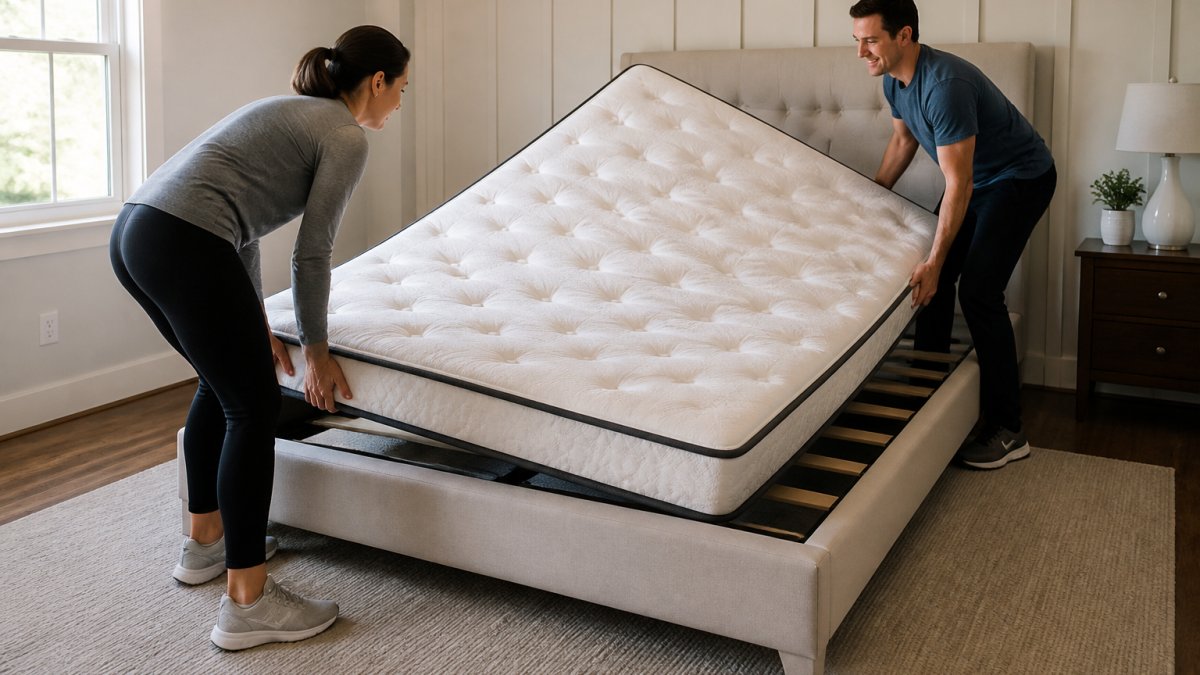
After flipping, let the mattress settle for a few hours before making the bed so compressed areas can begin recovering. If you notice odors or moisture, ventilate the room before sleeping on the newly flipped side.
Never flip a mattress alone if it weighs over 100 pounds. Attempting to lift and rotate solo significantly increases injury risk to your back, shoulders, and wrists. A second person or mechanical aid is worth the effort.
Long-Term Cost Effectiveness and Value
The usual line is that a double sided mattress costs more upfront but lasts longer, so it wins on cost per year.
The basic cost-per-year formula
Cost per year = purchase price ÷ realistic years of service. The catch is that "realistic years of service" depends far more on materials and construction than on whether the mattress flips.
The honest framing: flipping is a multiplier on good construction, not a substitute. A two-sided mattress made with low-density foam will still break down, just on a slightly longer timeline.
A transparent example
Suppose a one-sided mattress costs $1,000 and serves 6 years, about $167 per year.
The lesson: run the numbers with your own price quotes and a conservative lifespan estimate for each option. Do not accept "lasts twice as long" as a given.
What actually drives lifespan
- Support core density and gauge. Higher-density foam and heavier-gauge coils resist compression longer. This matters more than the number of sleep surfaces.
- Comfort layer quality. Low-density comfort foam is the first thing to break down, on either design.
- Foundation and frame support. A sagging or flexing foundation accelerates wear regardless of how often you flip.
- Body weight and sleep position. Higher weight and a fixed sleep position concentrate load and shorten life on any mattress.
- Rotation and flipping discipline. Consistent flipping is what unlocks the two-sided advantage. Skip it and you are paying a premium for a feature you are not using.
The non-financial value
Cost per year is not the only variable. Fewer replacement cycles mean fewer shopping trips, delivery windows, and disposal hassles, real value if you dislike the mattress-buying process, even when dollar savings are modest.
When one-sided makes more sense
Treat the value claim as a calculation, not a slogan. Compare upfront price against a conservative lifespan estimate for each specific mattress, and remember that construction quality sets the ceiling while flipping only helps you reach it.
Who Benefits Most From Double Sided Mattresses
Whether a double sided mattress is worth it depends less on the mattress than on you: sleep position, body weight, how you use the bed, and whether you'll keep up with flipping.
By sleep position
- Side sleepers concentrate pressure at the hips and shoulders, which is exactly where one-sided mattresses develop deep impressions first. A flippable design lets you move that load to a fresh surface, so side sleepers tend to see the clearest benefit. They also generally need a softer, more contouring surface to keep the spine aligned, so a soft or medium flippable model is often the better match.
- Back sleepers need even support along the spine and are usually well served by a medium to medium-firm feel. Because they tend to sleep in a consistent position, they also concentrate wear in predictable zones, another good case for flipping.
- Stomach sleepers need a firmer surface to keep the hips from sinking and the lower back from arching. They often move around more during the night, which spreads pressure and can mean slightly slower wear. The benefit of flipping is real but less dramatic for this group.
- Combination sleepers who shift positions throughout the night distribute load more evenly, so they may see a smaller durability advantage from flipping.
By body weight
Higher body weight accelerates compression on any mattress, most pronounced on lower-density comfort layers. Sleepers above roughly 200 pounds often find a one-sided mattress softens noticeably within a few years, making the dual-surface design of a flippable mattress more valuable.
Lighter sleepers put less stress on the comfort layers and may find that a well-built one-sided mattress lasts long enough that the flipping advantage is modest.
By firmness preference
Firmness is personal, but the guidance holds: softer contours more and suits side sleepers and lighter bodies; firmer supports more and suits back and stomach sleepers and heavier bodies.
Who should not flip a mattress
This is the part most benefit pages leave out. Do not flip:
- One-sided mattresses. Many modern beds have a single sleep surface and a non-sleepable base. Flipping puts you on the support core.
- Mattresses with a designated head and foot. Some two-sided models are built to be rotated end-to-end, not turned over. Check the law tag or care instructions.
- Mattresses with structural damage. A torn cover, exposed coils, or a broken edge support will not be fixed by flipping.
- Anyone unable to handle the weight safely. If lifting and turning the mattress is a strain or a fall risk, rotation-only or a professional service may be the better routine.
A quick self-check
If you sleep mainly on your side or back, weigh above roughly 200 pounds, plan to keep the mattress for years, and will commit to flipping every few months, a double sided mattress is likely a strong fit.
The benefit of a double sided mattress is conditional. It rewards sleepers who concentrate pressure in fixed spots, carry more weight, and will actually flip on schedule. For everyone else, construction quality matters more than the number of sleep surfaces.
Conclusion
Double sided mattresses address a fundamental problem with traditional design: concentrated wear in predictable locations. Distributing pressure across two sleep surfaces through regular flipping extends lifespan, maintains support, and reduces costly replacements.
The durability advantage is real: a properly maintained double sided mattress resists body impressions and sagging significantly longer than a one-sided alternative, delivering genuine long-term value for anyone wanting a decade or more of performance.
Durable Mattress engineers our flippable collection with this principle at the core. Our hybrid construction, in medium, firm, and soft, balances comfort and durability to make flipping worthwhile, an investment in years of consistent, supportive sleep rather than repeated replacements.
Consumer Reports mattress durability testing
Sleep Foundation guide to mattress lifespan and care
American Chiropractic Association recommendations on mattress support
Frequently Asked Questions
Are double sided mattresses more durable than one-sided mattresses?
Yes, double sided mattresses typically last longer because flipping distributes wear across both surfaces. One-sided mattresses concentrate all body weight and pressure on a single comfort layer, causing faster sagging and deterioration. By rotating use between two surfaces, flippable designs extend the overall lifespan and maintain consistent support longer than traditional one-sided options.
How often should you flip a double-sided mattress?
Most manufacturers recommend flipping every 3 to 6 months for optimal wear distribution. Some suggest rotating quarterly and flipping semi-annually. The exact frequency depends on your mattress construction, body weight, and sleep position. Heavier sleepers may benefit from more frequent flipping. Check your mattress care guidelines for brand-specific recommendations to maximize longevity.
What are the main benefits of a double-sided mattress?
The primary benefits include extended lifespan through even wear distribution, reduced body impressions and sagging, improved long-term comfort consistency, and better value over time. Double sided mattresses also offer flexibility if you prefer switching between firmness levels, and they reduce the need for early replacement, making them a cost-effective investment for homeowners seeking durability.
Is flipping a mattress really worth the effort?
Yes, regular flipping significantly extends mattress life and prevents premature sagging. While it requires minimal effort every few months, the payoff is substantial: you avoid replacing your mattress every 5-7 years and instead enjoy 10+ years of consistent support. For value-conscious buyers investing in quality construction, the maintenance effort is worthwhile and pays dividends in long-term comfort and cost savings.
Table of Contents
- How Often to Flip a Mattress: The Basics
- How Often to Rotate a Mattress
- Mattress Rotation vs. Flipping: What's the Difference?
- How to Flip a Mattress Safely
- Why Are Mattresses Not Flippable Anymore?
- Flipping and Rotation Schedules by Mattress Type
- What to Do When Your Mattress Already Sags
- Frequently Asked Questions
Last Updated: October 9, 2026
How Often to Flip a Mattress: The Basics
Knowing how often to flip a mattress is one of the simplest ways to extend its lifespan and prevent sagging. Most double-sided mattresses benefit from regular flipping, while modern one-sided designs require only rotation. At Durable Mattress, our 2-sided flippable mattresses are engineered to distribute wear evenly.
The general rule: flip your mattress every six months if it's designed to be flipped, giving both sides equal time supporting your body weight.
The 6-Month Rule for Double-Sided Mattresses
Double-sided mattresses are built to be flipped. Flipping every six months keeps both surfaces in good condition, like rotating tires on a car.
Some flip every three months, others stretch it to nine. The key is consistency.
Mark your calendar or set a phone reminder, many people flip when seasons change or on their birthday.
Why Frequency Matters for Mattress Lifespan
A mattress that never gets flipped will sag in the same spots where you sleep night after night, as body weight creates an indent and the support underneath weakens.
Flipping spreads that wear across both sides, so both surfaces share the load. This simple step can add years to your mattress.
Neglecting to flip is one of the biggest reasons mattresses fail early, soft spots, body-shaped impressions, and reduced support within a few years.
How Often to Rotate a Mattress
Rotation is different from flipping. When you rotate, you turn the mattress 180 degrees, moving the head end to the foot end, which addresses wear patterns along its length.
Even one-sided mattresses need rotation, which prevents the head area from wearing faster than the foot area.
Rotation Schedules by Mattress Type
One-sided mattresses should be rotated every three to six months.
Double-sided mattresses can be both flipped and rotated. Many people flip every six months and rotate every three months for maximum longevity.
Memory foam and latex mattresses often come one-sided. Rotate these every three to four months.
Innerspring and hybrid mattresses vary by design. Check your manufacturer's instructions, some can be flipped, others cannot.
Mattress Rotation vs. Flipping: What's the Difference?
These two tasks do different jobs, and confusing them can damage a modern mattress or void your warranty.
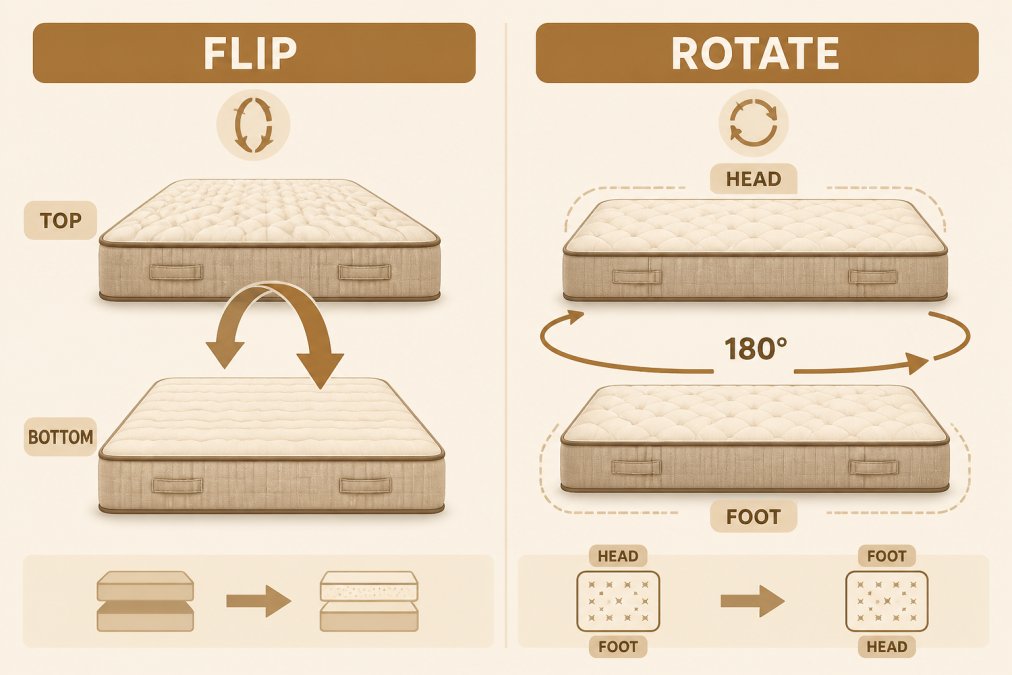
Flipping means turning the mattress over completely, so the bottom becomes the top. This works only on double-sided designs where both surfaces are equally supportive.
Rotating means turning the mattress 180 degrees along its length. The head end moves to the foot end. The top stays on top. Rotation works on all mattress types, including one-sided models.
How to Tell If Your Mattress Is Flippable
Before you flip anything, confirm your mattress is designed for it. Here is a quick identification method:
- Check the care label. Look for the sewn-in tag on the mattress edge or under the bottom. Flippable mattresses typically say "flip and rotate" or "double-sided." One-sided mattresses usually say "rotate only" or "do not flip."
- Look for a pillow-top or euro-top. If the top surface has a sewn-on extra comfort layer, it is almost certainly one-sided. Flipping would put that layer face-down against the foundation.
- Inspect the bottom surface. On a double-sided mattress, the bottom looks and feels like the top, same quilting, same fabric, same cushioning. On a one-sided mattress, the bottom is often a plain, darker fabric with no quilting.
- Check the warranty terms. Many manufacturers void coverage if a one-sided mattress is flipped. The warranty document will state whether flipping is permitted.
If you are unsure whether your mattress is flippable, rotate only. Rotating is safe for every mattress type and will not void your warranty. Flipping a one-sided mattress can expose the support core, reduce comfort, and damage the internal structure.
When to Flip vs. When to Rotate
If your mattress is double-sided and flippable, do both. Flip it every six months to use both surfaces. Rotate it every three months to prevent head-to-foot wear patterns.
If your mattress is one-sided (most modern mattresses are), rotate only. Flipping would expose the non-functional bottom layer and might void your warranty.
Always read your manufacturer's instructions before flipping. When in doubt, rotate only.
Why the Confusion Exists
The query "how often to flip mattress" is common because older mattresses, particularly innerspring models made before the 2000s, were almost all double-sided, so flipping was standard advice. Today most mattresses sold are one-sided, but the old advice persists, and many people flip mattresses that should only be rotated, causing premature wear.
How to Flip a Mattress Safely
Flipping a mattress is straightforward, but it requires the right technique to avoid injury or damage. Most full-size mattresses weigh 50-80 pounds; queen and king sizes can exceed 100 pounds.
Step-by-Step Flipping Instructions
Step 2: Get help. Never flip a mattress alone. One person on each side is the minimum.
Step 3: Position yourselves. Stand on opposite sides of the bed.
Step 5: Flip it over. Once the mattress is off the bed, flip it in one smooth motion.
Step 7: Replace bedding. Add clean sheets and make the bed as usual.
Tools and Help You'll Need
A mattress flipping tool, handles or straps that attach temporarily for better grip, isn't essential but costs $20-$50 and is worth it for heavier mattresses.
If you don't have a flipping tool, ask a friend or family member for help.
Some moving companies offer mattress flipping services, usually $30-$60 per flip, worth considering if you have mobility issues or a very large mattress.
Why Are Mattresses Not Flippable Anymore?
Modern mattress design has shifted away from double-sided, flippable models. Most new mattresses are one-sided. Understanding why helps you make better purchasing decisions.
Manufacturers discovered that customers prefer specialized comfort layers on top. Memory foam, latex, and pillow-top designs create a specific feel. Making both sides identical meant sacrificing that customization.
One-sided mattresses also cost less to produce, since manufacturers use cheaper materials on the bottom layer that won't contact your body.
One-Sided vs. Double-Sided Mattress Construction
One-sided mattresses have a comfort layer on top and a support layer on the bottom. The bottom is designed purely for structural support, so you never flip them.
Double-sided mattresses have comfort and support on both surfaces, so you can flip them without losing comfort or support.
The trade-off is clear: one-sided mattresses wear out faster, while double-sided flippable mattresses last longer because you're using both surfaces.
Flipping and Rotation Schedules by Mattress Type
Different mattress materials need different care. The schedule below is a starting point, but your manufacturer's care label and warranty always take priority.
Memory Foam Mattress Care
Memory foam mattresses are almost always one-sided. The foam top layer is what makes them comfortable, it's not designed to be flipped.
Rotate memory foam mattresses every three to four months, since the foam can develop permanent body impressions over time.
Memory foam is sensitive to heat, so keep your bedroom temperature moderate and avoid jumping on the mattress or putting excessive weight on one area.
Innerspring and Hybrid Mattress Care
Innerspring mattresses have metal coils for support and a comfort layer on top. Some older models are flippable, but most modern ones are one-sided.
Check your documentation. If your innerspring mattress is flippable, flip it every six months. If it's one-sided, rotate it every three to four months.
Hybrid mattresses combine foam and coils. Most hybrids are one-sided due to the foam layer on top. Rotate every three to four months.
Latex Mattress Care
Latex mattresses can be either one-sided or double-sided depending on the manufacturer. Many latex cores are flippable because latex is durable and symmetric. Check your care label.
If flippable, flip every six months and rotate every three months; if one-sided, rotate every three to four months. Latex resists dust mites and mold but can still develop impressions if not rotated.
Pillow-Top and Euro-Top Mattresses
Pillow-top and euro-top mattresses have a sewn-on comfort layer on one side only, so they are never flippable. Flipping would put the pillow-top face-down against the foundation, ruining the comfort layer and potentially damaging the seams.
Rotate every three to four months. Do not attempt to flip.
Adjustable Bed Mattresses
Adjustable bed mattresses are engineered for a specific orientation on a hinged or articulating frame. Never flip one, the internal structure, including any zoned support or reinforced edges, is designed for a fixed top and bottom.
Rotation depends on the frame. Some adjustable mattresses can be rotated head-to-foot; others have a tapered or split design that prevents rotation. Check your manual.
Zoned Mattresses
Zoned mattresses have different support levels along the length of the bed, typically firmer in the middle for hips and softer at the head and foot, calibrated for a specific orientation.
If your mattress is zoned, check the care label before rotating. Some allow rotation; many do not. Never flip a zoned mattress unless the label explicitly says it is double-sided.
Quick Reference Schedule
| Mattress Type | Flip? | Rotate? | Frequency |
|---|---|---|---|
| Double-sided innerspring | Yes | Yes | Flip every 6 months, rotate every 3 months |
| One-sided innerspring | No | Yes | Rotate every 3-4 months |
| Memory foam | No | Yes | Rotate every 3-4 months |
| Latex (flippable) | Yes | Yes | Flip every 6 months, rotate every 3 months |
| Latex (one-sided) | No | Yes | Rotate every 3-4 months |
| Hybrid | No | Yes | Rotate every 3-4 months |
| Pillow-top / euro-top | No | Yes | Rotate every 3-4 months |
| Adjustable bed | No | Check manual | Rotate every 4-6 months if allowed |
| Zoned | No | Check label | Follow label; often rotate only if permitted |
Set a recurring reminder on your phone or calendar for the first day of each quarter. Rotate then. If your mattress is flippable, add a flip reminder every six months, many people pair it with daylight saving time changes or their birthday.
How to Prioritize the Care Label Over Generic Advice
Every mattress ships with a care label, and many include a warranty document. These are the authoritative sources for your model.
If your care label says "rotate only," do not flip. If it says "do not rotate," follow that instruction.
Following the label protects your warranty. Many warranties require proof of proper maintenance, and flipping a one-sided mattress or rotating a zoned mattress against instructions can void coverage.
What to Do When Your Mattress Already Sags
If your mattress already has visible sagging or body impressions, flipping or rotating won't fix it, the damage is done.
A mattress topper can temporarily improve comfort.
Rotate the mattress to even out the wear.
Check your warranty. Many mattresses have a sagging guarantee: if yours sags more than 1.5 inches within the warranty period, the manufacturer may replace it.
If the mattress is beyond repair, it's time to replace it.
Frequently Asked Questions
How often should you flip a mattress?
For double-sided flippable mattresses, flip every 6 months to promote even wear and extend lifespan. For one-sided mattresses, rotate 180 degrees head-to-foot every 3 months instead. Memory foam and pillow-top mattresses should only be rotated, never flipped. Always check your mattress manufacturer's recommendations, as specific construction details affect the ideal schedule.
What is the difference between flipping and rotating a mattress?
Flipping turns your mattress over completely to use the opposite sleep surface, distributing wear across both sides. Rotating turns the mattress 180 degrees so the head end becomes the foot end, evening out pressure points without exposing the underside. Flipping works only for double-sided mattresses; rotating works for all types. Double-sided mattresses benefit from both practices.
Does flipping a mattress make it last longer?
Yes, flipping double-sided mattresses significantly extends their lifespan. Regular flipping distributes body weight and pressure more evenly across both surfaces, preventing sagging and body impressions in a single spot. This practice reduces wear and tear, helping your mattress maintain comfort and support for years.
Why are mattresses not flippable anymore?
Most modern mattresses are one-sided because manufacturers now use specialized materials like memory foam and pillow-top layers designed for the top surface only. These comfort layers perform best facing up and would feel uncomfortable or provide poor support if flipped. Double-sided flippable mattresses like hybrid designs distribute support layers more evenly, allowing safe flipping while maintaining comfort on both sides.
Premature sagging is frustrating after investing in a mattress. The good news: choosing a flippable design prevents this problem. At Durable Mattress, our 2-sided hybrid mattresses are engineered specifically for flipping, which distributes wear evenly across both surfaces and extends longevity. With multiple firmness levels, medium, firm, and soft, you get customized support that lasts. Shop our mattress collection and invest in a mattress built to last a decade or more.

Double the life of your mattress today
Our mattresses will help you get the sleep you need. Not sure which one’s right for you? Check out our firmness guide below.