
Last Updated: November 19, 2026
Quick Summary
Flippable mattresses can spread wear across both sides, but they only last longer when both faces are built to the same standard and the support core is durable. Flipping slows surface wear and does not reverse coil or core fatigue. Check the test protocol and both-sides results before trusting a flippable mattress durability claim.
- Flipping redistributes wear, but it does not stop materials from aging.
- Flipping helps comfort layers most and support cores least.
- Flip roughly every three to six months and rotate end to end between flips.
- A credible durability test reports cycle count, measurement points and units.
- Both sides of a flippable mattress should show comparable compression and recovery.
Table of Contents
- How Flippable Mattresses Are Built and Why Construction Matters
- How a Flippable Mattress Durability Test Works
- Does Flipping Actually Extend Mattress Lifespan?
- How Often to Flip Mattress for Even Wear
- Durability by Material and Construction: Hybrid, Foam, and Latex
- Signs of Mattress Wear and Tear and When to Replace
- Choosing a Durable Mattress That Fits Your Sleep and Budget
- Frequently Asked Questions
Flippable mattresses promise longer life, but the claim only holds up if the design and the flipping habit both do their part. This article looks at what the durability evidence actually shows. A flippable mattress is a bed built with comparable comfort and support layers on both sides, so you can rotate it or turn it over to spread out wear.
How Flippable Mattresses Are Built and Why Construction Matters
Flippable mattresses are built with comfort and support layers on both surfaces. That symmetry is the whole point. A one-sided mattress concentrates body weight and heat on one face, so one side can soften while the other stays firm.
Construction still sets the ceiling. A flippable design cannot compensate for weak coils or low-density foam, so the materials inside matter as much as the flip itself.
How a Flippable Mattress Durability Test Works
Durability testing simulates years of nightly use in a controlled environment so that wear can be measured instead of guessed. A technician applies repeated loading to the sleep surface, then measures how much the mattress compresses and how well it recovers.
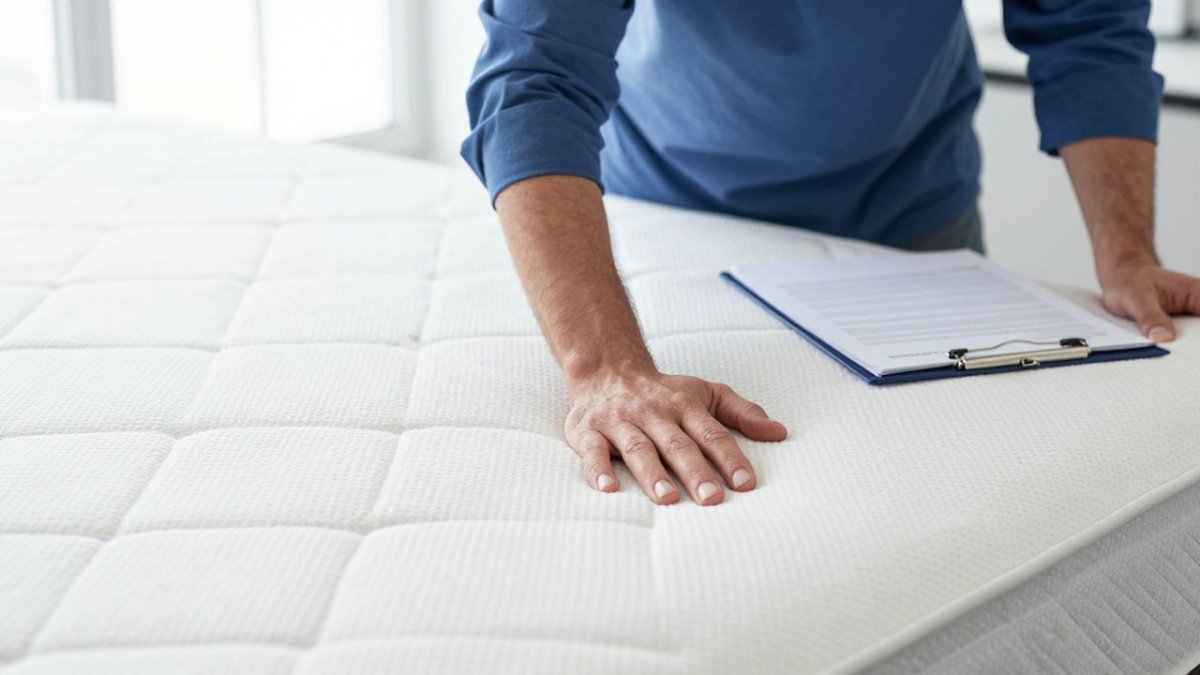
No single public protocol exists for flippable mattresses specifically, so treat any single test result with caution. What you can do is demand that the method be clearly described, repeatable and applied to both sides of the bed.
What a Credible Test Protocol Should Specify
A transparent protocol answers five questions before it reports a single result:
- Load and cycle count. How much weight is applied, in what pattern, and for how many cycles. A common industry approach uses a weighted roller or a hexagonal profile that passes over the surface repeatedly; the cycle count is what stands in for years of sleep. Ask how many cycles were run and what that number is meant to represent.
- Measurement points. Where on the surface height and firmness are recorded, center, shoulder zone, hip zone, edge, and how many readings are averaged. A single center reading can hide a hip-zone dip.
- Measurement units and thresholds. Compression and recovery should be reported in inches or millimeters, and firmness in a repeatable scale such as ILD (indentation load deflection) for foam or a comparable hardness reading. A result without units is not a result.
- Both-sides protocol. Whether each face was tested independently, and whether the mattress was flipped between test phases. This is the step that separates a flippable-specific test from a generic one-sided test.
- Environmental conditions. Temperature and humidity affect foam behavior, so a credible report states the conditions under which readings were taken.
Step-by-Step Testing Methodology
- Baseline measurement. Record the initial height, firmness and surface profile at multiple points on each side. Photograph or map the surface so the same points can be re-measured later.
- Repeated loading. Apply a set cycle of weight and pressure to simulate nightly sleep, using a consistent load pattern so results are comparable across mattresses.
- Intermediate checks. Measure compression and recovery at fixed intervals, for example, after a quarter, half and three-quarters of the total cycles, to see whether wear is linear or accelerates.
- Final measurement. Compare end readings against baseline to calculate sag in inches or millimeters and support loss as a percentage of the original firmness reading.
- Side-by-side review. Confirm that both sides wear at comparable rates before crediting the flip. If one face sags noticeably faster, the design is not delivering the symmetry it promises.
Watch out: a test that reports only a final number without the baseline, the cycle count or the measurement points cannot be checked or repeated, and should not be treated as evidence of durability.
How to Read a Durability Test Result
When you look at a published result, separate what was measured from what was claimed. A measured result tells you the compression in inches at a stated cycle count under stated conditions. A claim tells you the mattress "lasts 10 years" without showing the protocol behind it. The first is evidence; the second is marketing.
A useful pattern to look for is whether the two faces of a flippable mattress converge or diverge over the test. If both faces show similar compression and recovery at the end, the flip is doing what it is supposed to do. If one face is clearly worse, flipping will only postpone the problem, not solve it.
Limitations of Any Lab Test
A controlled test cannot reproduce everything that happens in a bedroom. It typically holds temperature and humidity steady, uses a consistent load pattern, and ignores foundation type, bed frame support, mattress protector use and the way a real sleeper shifts position through the night. It also cannot model the difference between one 200-pound sleeper and two 150-pound sleepers sharing the same surface.
Does Flipping Actually Extend Mattress Lifespan?
Flipping can help redistribute wear that would otherwise concentrate on one side. It does not stop the materials from aging. A mattress that is flipped and rotated still compresses over time, and no flip reverses structural fatigue in the coils or foams. The honest answer is that flipping changes where wear lands, not whether wear happens.
The benefit is real but bounded, and it depends on three conditions being true at once: the two sides are built to match, the mattress is actually flipped on a schedule, and the underlying materials are durable enough to make the redistribution worth the effort. A flippable mattress with mismatched sides gains much less from the habit, because flipping a firm side onto a soft side does not spread load evenly, it just moves the problem.
What Flipping Can and Cannot Change
| Factor | Flipping helps? | Why |
|---|---|---|
| Surface foam softening | Yes, partially | Load shifts to the fresher face, slowing compression on the worn side |
| Body impressions in comfort layers | Yes, if caught early | Redistribution before permanent set can extend usable surface life |
| Coil fatigue and support-core breakdown | No | The core carries load regardless of which face is up |
| Loss of edge support | No | Edge structures age from use, not from which side faces up |
| Heat and moisture buildup | Somewhat | Alternating faces gives each side time to recover and air out |
A common pattern is that flipping buys the most time in the comfort layers and the least time in the support core. That is why a flippable design only pays off when the core is built to last, otherwise you are rotating a surface on top of a foundation that is already failing.
Side-by-Side Wear: Flippable vs. One-Sided
Quantified long-term wear data comparing flippable and one-sided mattresses is scarce in public form, which is exactly why lifespan claims deserve scrutiny. What can be said with confidence is directional: a one-sided mattress concentrates compression, heat and moisture on a single face, so the comfort layer on that face reaches its compression limit sooner.
The core does not get a break from flipping. If the support core is the weak link, the two-sided advantage shrinks toward zero. When you compare designs, compare the core specifications first and the comfort-layer symmetry second.
Objective End-of-Life Criteria
Lifespan estimates are only useful if you know what "end of life" means for your bed. Use measurable signs rather than a calendar:
- Persistent impressions. A body impression deeper than about an inch that does not recover after the mattress has been aired and rotated is a structural sign, not a cosmetic one.
- Measurable support loss. If the surface no longer returns to its baseline height at the hip and shoulder zones, the comfort layer has lost its ability to hold you up.
- Loss of alignment. Waking with new lower-back or hip discomfort that eases during the day is a common signal that the surface is no longer supporting neutral alignment.
When structural signs appear, protection and flipping will not reverse the damage. A protective cover can slow surface wear, and our mattress accessories include options designed for that purpose, but they are preventive, not restorative.
Real-World Factors That Change Lifespan
A single average lifespan figure is close to useless without context. The factors below move the number more than most buyers expect:
- Sleeper weight and occupancy. Higher combined weight loads the center and hip zones faster. A heavier couple should flip and rotate more often than a single lighter sleeper.
- Foundation support. A sagging box spring or a frame with inadequate slats accelerates mattress wear regardless of flipping. Check the foundation before blaming the mattress.
- Humidity and ventilation. Damp environments and poor airflow under the bed trap moisture in foam and fabric, which speeds breakdown. A breathable protector and a ventilated foundation help.
For a fuller picture of expected lifespan by material and construction, our mattress lifespan and durability guide covers the factors that matter most.
How Often to Flip Mattress for Even Wear
A common approach is to flip the mattress every three to six months, and to rotate it end to end in between.
The right frequency depends on how many people sleep on the bed and how heavy they are. A heavier couple will load the center more quickly, so more frequent turns can help.
Need step-by-step instructions for turning your mattress safely? Our guide on how to flip a mattress to prevent wear walks through the process, and our full how often to flip a mattress schedule explains the reasoning behind the timing.
Durability by Material and Construction: Hybrid, Foam, and Latex
Material choice shapes how a mattress ages. Hybrids combine coil support with foam comfort layers, and the coil system often carries most of the long-term load, which is why the support core matters so much.
Whatever the material, a mattress that is flippable only helps if both sides are built to the same standard. Compare the layer specifications rather than assuming symmetry.
For a direct comparison of flippable and non-flippable designs, see our breakdown of flippable vs non-flippable mattress durability.
Signs of Mattress Wear and Tear and When to Replace
Watch for visible body impressions deeper than about an inch, a noticeable dip in support, new morning aches, or a surface that no longer springs back.
Replacement timing varies with materials and use. A protective cover can slow surface wear, and our mattress accessories include options designed for that purpose. When structural signs appear, though, protection will not reverse the damage.
Choosing a Durable Mattress That Fits Your Sleep and Budget
Start with your sleep position and body weight, since both determine the firmness that will hold up for you.
Price should reflect the total cost of ownership, not just the sticker price.
Ready to find a mattress built to last? Shop Mattresses with Durable Mattress and choose a 2-sided hybrid designed to be flipped for longer life and steady comfort.
Frequently Asked Questions
Do double-sided mattresses last longer?
Flipping can help spread body impressions and surface wear across both sides. Lifespan still depends on materials, support core quality, foundation, body weight, and care. Expect the two sides to wear at similar rates only if you rotate and flip on a regular schedule.
How often should you flip a double-sided mattress to maintain support?
Flip and rotate your mattress every three to six months as a general schedule, then adjust based on how the surface feels. If you notice one side sagging or a dip forming in the same spot, flip sooner. Rotating head to foot between flips helps even out wear from pressure points. Always follow the manufacturer's care instructions, since some mattresses are designed to be flipped only in specific ways.
What specific tests determine the durability of a flippable mattress?
Durability testing typically includes repeated compression cycles to simulate years of use, measurement of impression depth before and after testing, and evaluation of support loss under a set load. Testers also check edge collapse and how quickly comfort layers degrade. Ask any brand for its test method, load weights, cycle counts, and pass criteria so you can compare results fairly rather than relying on marketing claims.
What are the primary signs of wear in a flippable mattress?
Common signs include a visible dip or body impression deeper than about one inch, sagging at the edges, squeaking or coil noise, and waking with new aches or stiffness. Uneven firmness across the surface and a noticeable sense of sinking toward the center also point to wear. If these appear within a few months of flipping on schedule, contact the manufacturer to review warranty coverage.

Last Updated: October 26, 2026
Quick Summary
A flippable mattress worth the investment depends on your sleep position and willingness to maintain it actively. Side sleepers benefit most from the even wear distribution, potentially enjoying years of continued comfort instead of gradual deterioration, while durability ultimately depends on material quality and construction rather than the flippable design alone.
- Flippable mattresses distribute wear evenly across both surfaces when flipped periodically, preventing premature sagging on one side.
- Side sleepers experience more localized pressure and benefit more from flippable designs than back or stomach sleepers.
- Material quality and construction determine durability more than the flippable design itself; poor materials will sag on both sides.
- Many flippable mattresses offer 100-night sleep trials or longer warranties, reducing financial risk compared to one-sided options.
- Flippable designs require active maintenance through regular flipping, unlike passive one-sided mattresses.
Table of Contents
- What a Flippable Mattress Is and How It's Constructed
- Do Flippable Mattresses Last Longer Than One-Sided Options?
- Flippable Mattress Pros and Cons
- How Often to Flip a Mattress for Maximum Benefit
- Flippable vs One-Sided Mattress: Which Delivers Better Value?
- Total Cost of Ownership and Break-Even Analysis
- Finding Your Right Flippable Mattress
- Frequently Asked Questions
What a Flippable Mattress Is and How It's Constructed
A flippable mattress is a two-sided bed with usable comfort on both surfaces, designed so you can flip it periodically to distribute wear evenly across the entire mattress. A flippable mattress has usable comfort on both surfaces, designed so you can flip it periodically to distribute wear evenly across the entire mattress.
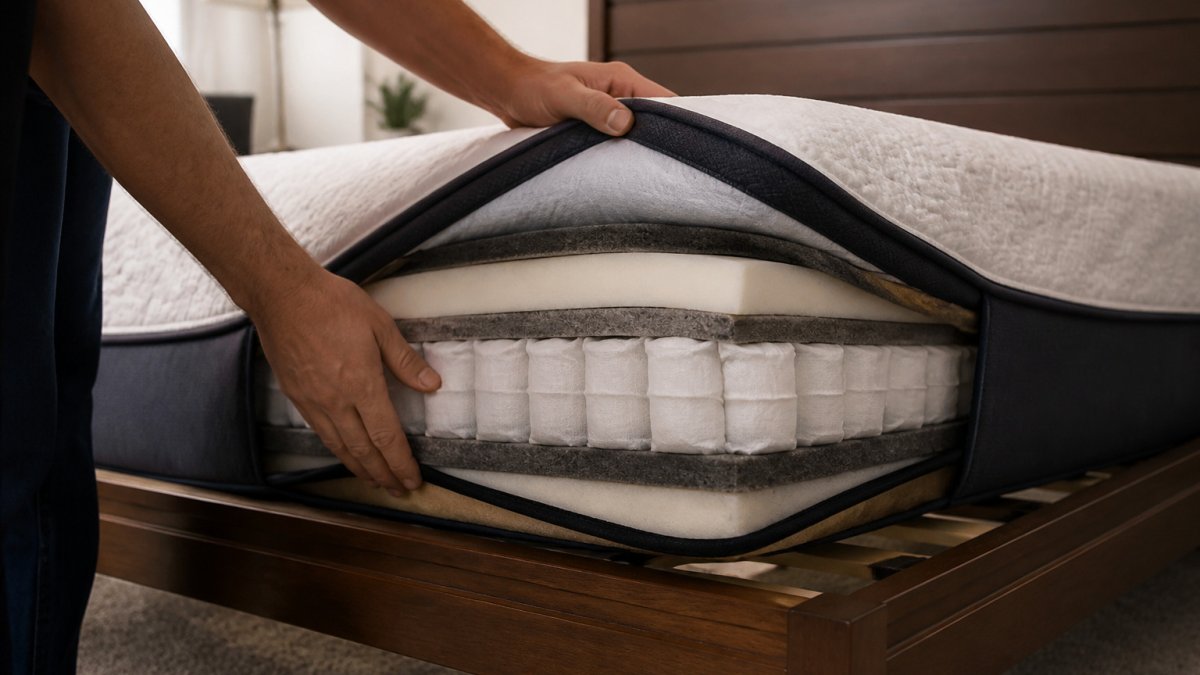
A hybrid mattress combines foam comfort layers with coil support systems.
At Durable Mattress, our hybrid flippable mattresses are built with a dual-sided design. The design helps prevent premature wear.
Do Flippable Mattresses Last Longer Than One-Sided Options?
Flippable mattresses have two usable surfaces.
However, durability also depends on materials and construction quality. A poorly made flippable mattress with thin comfort layers will still sag, just on both sides instead of one. A high-quality flippable mattress with dense foam, quality coils, and strong base construction will outperform a cheap one-sided mattress by a substantial margin. The flippable design amplifies the benefits of good construction but doesn't rescue poor materials.
Flippable Mattress Pros and Cons
Pros:
Cons:
Sleep Foundation's guide to mattress maintenance notes that consistent care is essential for any mattress investment. Flippable designs demand more active participation than passive one-sided models.
How Often to Flip a Mattress for Maximum Benefit
Don't confuse flipping with rotating. Learn how often to flip a mattress for maximum benefit and longevity. Rotating a mattress means turning it 180 degrees so the foot end becomes the head end. Flipping means turning it upside down to use the other side.
Flippable vs One-Sided Mattress: Which Delivers Better Value?
Consider your sleep position too. Side sleepers experience more localized pressure and benefit more from flippable designs than back or stomach sleepers. If you're a side sleeper dealing with shoulder or hip discomfort, the even wear of a flippable mattress can mean years of continued comfort instead of gradual deterioration.
Flippable mattresses offer distinct advantages depending on your sleep position and comfort needs.
| Factor | Flippable Mattress | One-Sided Mattress |
|---|---|---|
| Wear distribution | Even across both surfaces | Concentrated on one side |
| Best for side sleepers | Benefits from even wear | Less pressure relief |
| Durability | Depends on material quality | Depends on material quality |
| Maintenance | Requires active flipping | Passive use |
| Trial periods | Often 100 nights or longer | Varies widely |
Total Cost of Ownership and Break-Even Analysis
Warranty and trial periods also matter. Many flippable mattresses come with 100-night sleep trials or longer warranties than one-sided competitors. These protections reduce your financial risk when investing in a higher-priced option. Check the specific terms, they vary widely and can meaningfully affect your true cost of ownership.
Finding Your Right Flippable Mattress
When shopping for a flippable mattress, start by identifying your firmness preference. Durable Mattress offers medium, firm, and soft support levels.
Hybrid mattresses combine foam comfort with coil support.
Best Dual Sided Mattress Reviews: 2026 Buyer's Guide provides detailed product recommendations and specifications for flippable models currently available. You can review specific options, compare construction details, and see what other buyers report about long-term durability and maintenance.
Durable Mattress offers a hybrid flippable collection available in medium, firm, and soft support levels. Our dual-sided design helps prevent premature wear. [Durable 2-Sided Mattress Soft | page:5] is our soft option; we also offer firm and medium options.
Is a flippable mattress worth it? Durable Mattress offers a two-sided flippable hybrid collection in medium, firm, and soft support levels. Shop Durable Mattress's flippable collection to find a firmness option that matches your needs.
Frequently Asked Questions
How often should you flip a flippable mattress?
Most manufacturers recommend flipping a flippable mattress every 3 to 6 months to ensure even wear on both sides. Some suggest monthly rotation for the first year, then quarterly flipping thereafter. Consistency matters more than frequency, regular flipping spreads wear evenly across both surfaces, which is the core mechanism that extends mattress life and prevents sagging in one location.
Do flippable mattresses last longer than one-sided mattresses?
Flippable mattresses can last significantly longer if you actively flip them regularly. By distributing body weight and pressure across two usable surfaces instead of one, you reduce concentrated wear, body impressions, and sagging. A well-maintained flippable mattress may deliver 2 to 5 additional years of usable life compared to a one-sided mattress of similar construction quality, though actual lifespan depends on materials, usage, and maintenance consistency.
What are the main drawbacks of flippable mattresses?
The primary drawbacks include higher upfront cost, the physical effort and inconvenience of regular flipping, and the requirement that both sides offer acceptable comfort. If you neglect flipping, a flippable mattress provides no durability advantage over a one-sided model. Additionally, flippable designs with different firmness levels on each side may not suit every sleeper's needs, and some people find the maintenance burden not worth the effort.
Is a flippable mattress worth the extra cost?
A flippable mattress is worth the investment if you commit to regular flipping, prioritize long-term durability over initial savings, and plan to keep your mattress for 8 to 10 years or longer. The higher upfront price can be justified by extended usable life and reduced replacement frequency. However, if you rarely flip or prefer a lower entry cost, a high-quality one-sided mattress may offer better value. Calculate your expected ownership period and replacement costs to determine if the durability premium aligns with your budget.
Last Updated: October 23, 2026
Quick Summary
The best dual sided mattress has mirrored comfort layers on both faces, a symmetric coil core, and a warranty that explicitly permits flipping. Verify these four checks in writing before buying, since most flippable claims collapse under inspection. Durable Mattress is our verified pick, a two-sided hybrid in Medium, Firm, and Soft.
- Flip a two-sided mattress every three to six months and rotate it head-to-foot in between.
- Confirm both faces have a real comfort layer, the warranty covers flipping, and the trial applies to both surfaces.
- Side sleepers should choose the Soft or Medium face for pressure relief at the shoulder and hip.
- Divide purchase price by expected comfortable years to compare cost per year of usable life.
- Give a new firm face a full two weeks before judging it, since most returns happen in the first week.
Table of Contents
- Why Dual Sided Mattress Reviews Matter in 2026
- Our Verified Shortlist: Best Dual Sided Mattress Picks
- What Makes the Best Flippable Mattress Worth Buying
- Benefits of a Flippable Mattress for Sleep and Longevity
- Mattress Durability: What the Construction Actually Tells You
- How Often to Flip a Mattress (and How to Do It Right)
- Matching a Dual Sided Mattress to Your Sleeper Profile
- Conclusion
- Frequently Asked Questions
Why Dual Sided Mattress Reviews Matter in 2026
Most mattress reviews tell you how a bed feels on day one. That is the wrong test.
Here is the tension nobody addresses: the top layer of any mattress takes the compression. Body weight, heat, and moisture break down foam and fiber where you lie, not where you don't.
That is the whole argument. Everything below explains how to verify it before you buy.
Our Verified Shortlist: Best Dual Sided Mattress Picks
Our shortlist has one entry, and that is deliberate. Genuinely two-sided mattresses are rare, and most "flippable" claims collapse under inspection once you check whether the comfort layers are actually mirrored on both faces. Rather than pad this list with beds that only rotate, we verified each candidate against four tests before it earned a spot.
How We Verified Each Pick
Every mattress considered for this shortlist had to pass all four checks. If a model failed any one of them, it was cut, regardless of review score or brand recognition.
- Both faces have a real comfort layer. We confirmed a quilted or foam comfort layer on each side, not a finished sleeping surface on one face and a nonskid base fabric on the other.
- The coil or core system is symmetric. A two-sided hybrid only works if the support core performs the same in either orientation. Asymmetric cores create a "good side" and a "bad side," which defeats the purpose.
- The warranty explicitly permits flipping. If turning the mattress voids coverage, the design was never meant to be flipped. We read the fine print, not the marketing page.
- The trial and return terms survive a flip. A sleep trial that requires the mattress to remain in its original orientation is a red flag. We confirmed the trial applies to both surfaces.
Many mattresses marketed as flippable have a finished sleeping surface on one side and a nonskid base fabric on the other. Flipping that bed means sleeping on the bottom. Before you buy any reversible mattress, confirm that both faces have a real comfort layer, and ask the seller to confirm it in writing.
Durable Mattress: The Two-Sided Hybrid Built to Be Flipped
Durable Mattress is a hybrid mattress with a 2-sided flippable design, available in Medium, Firm, and Soft.
Construction, surface by surface. The build pairs a symmetric coil core with mirrored comfort layers on both faces.
Firmness and intended sleeper. The Soft face suits side sleepers and lighter body weights who need pressure relief at the shoulder and hip.
What it does well. A flippable hybrid spreads compression across two surfaces instead of one, which is the mechanism behind the brand's core claim: it prevents premature wear and extends the life of the mattress. The multiple firmness levels also mean couples with different preferences can sometimes split the difference by choosing a build with contrasting faces.
Where it falls short. We do not publish a price on this page, and pricing depends on size and firmness selection, so check the current price on the Durable Mattress site before you commit.
What to Confirm Before You Buy Any Pick
Because genuinely two-sided mattresses are rare, the purchase conversation matters as much as the review. Before you commit to any model on this list, confirm four things in writing: that both faces carry a comfort layer, that the warranty covers flipping, that the sleep trial applies to both surfaces, and that the foundation or adjustable base is rated for a two-sided mattress.
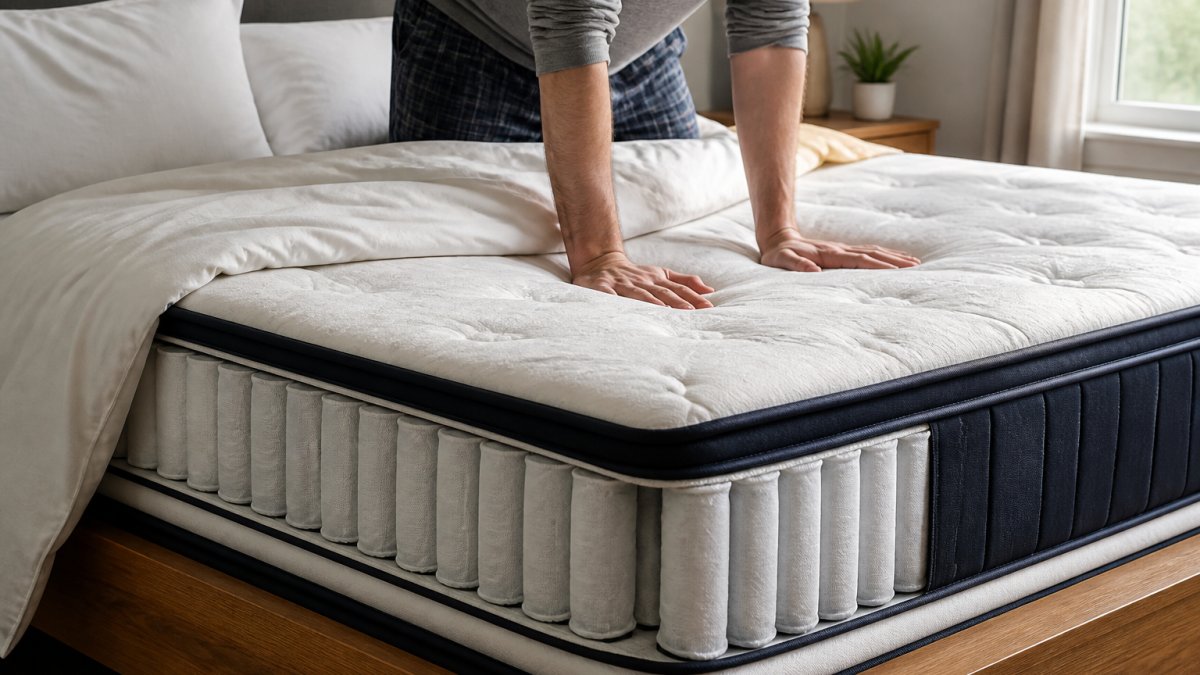
What Makes the Best Flippable Mattress Worth Buying
The best flippable mattress earns its price through construction you can inspect, not marketing language. Four things separate a real reversible mattress from a gimmick.
- Mirrored comfort layers. Both faces need a genuine comfort layer, not one sleeping surface and one base.
- A coil system that works in both orientations. Offset coils and a stable coil gauge keep support consistent whichever way the bed sits.
- Edge support that survives the flip. Weak edges are the first thing to fail on a reversible build.
That last point is where most shoppers get caught. Read the fine print before the trial clock starts.
Benefits of a Flippable Mattress for Sleep and Longevity
The benefits of a flippable mattress come down to one number: how many years you get before the comfort layer compresses past the point of comfort.
For back sleepers and stomach sleepers who need firmer support, a two-sided build also lets you choose which face matches your spinal alignment on a given night.
Cooling is the quiet benefit. A hybrid with a coil core moves air better than an all-foam block, and flipping exposes a fresher surface when the top one starts holding heat.
Mattress Durability: What the Construction Actually Tells You
Mattress durability is a construction question, not a brand promise.
Coil gauge and count. A lower gauge means thicker wire. Thicker wire resists sagging longer under heavier body weight, though it feels firmer.
Comfort layer density. Higher-density memory foam holds its shape. Low-density foam feels plush in the showroom and flattens within a couple of years.
Whether the bed can be flipped. This is the one most buyers ignore.
The Cost-Per-Year Framing Competitors Skip
Most reviews compare sticker prices. A more honest comparison is cost per year of usable life, and it is simple arithmetic: divide the purchase price by the number of years you expect the comfort layer to remain comfortable. A bed that costs more up front but holds its feel for several additional years can cost less per year than a cheaper one that flattens early.
What the Warranty Actually Covers
Warranty length is not the same as warranty usefulness. Read three things: whether the warranty covers sagging and at what threshold (a common industry threshold is a measured indentation, not a subjective "feels soft"), whether flipping the mattress voids coverage, and whether the warranty is prorated after an initial period. A long warranty that excludes the wear pattern you are trying to prevent is marketing, not protection.
What We Can and Cannot Prove
We cannot hand you a lab report proving a specific year count, and we will not invent one. Our durability claims rest on a structural mechanism, more usable surface, slower compression, plus the construction signals above, which you can verify yourself before purchase. That is a different kind of evidence than a test lab, and we would rather be honest about the difference than dress up a guess as a measurement.
Durability is the one spec you cannot feel in a showroom. Verify it with three numbers, coil gauge and count, comfort-layer density, and the warranty's sag threshold, plus one design fact: whether the bed can actually be flipped.
How Often to Flip a Mattress (and How to Do It Right)
Flip a two-sided mattress every three to six months, and rotate it head-to-foot on the months in between. How often to flip a mattress depends on body weight and how many people sleep on it; heavier sleepers and couples should lean toward the three-month end.
Here is the routine we recommend:
- Strip the bedding and vacuum the surface.
- Rotate head-to-foot on month one.
- Flip it over on month three, so the other face takes the compression.
- Check the foundation or adjustable base for even support.
- Note the date so you stop guessing.
If your bed sits on an adjustable base, flip it in the flat position and confirm the base is rated for a two-sided mattress. Flipping a bed on a raised base is how people tear handles and pinch fingers.
Matching a Dual Sided Mattress to Your Sleeper Profile
Match the face to the sleeper, not the other way around. A dual sided mattress only pays off if you pick firmness deliberately.
| Sleeper Profile | Recommended Face | Why |
|---|---|---|
| Side sleeper | Soft or Medium | Pressure relief at shoulder and hip |
| Back sleeper | Medium | Spinal alignment without sinking |
| Stomach sleeper | Firm or Extra Firm | Keeps hips from dropping |
| Couples, mixed preferences | Medium and Firm pairing | Each side gets a workable surface |
| Heavier body weight | Firm | Thicker support resists compression |
If you are coming from a one-sided pillow top, expect the firm face to feel harder than you are used to. Give it a full two weeks before you judge it. Most returns happen in the first week, before the comfort layer has settled.
Conclusion
The real challenge with any mattress purchase is that you cannot feel the years ahead of you, only the first night. Construction is the closest thing to a preview, and a two-sided design is the most honest durability feature a bed can carry.
Durable Mattress builds around exactly that: a 2-sided flippable design, hybrid construction, and Medium, Firm, and Soft options so the support matches the sleeper. If you want a bed engineered to be turned rather than replaced, start there.
Sleep Foundation guidance on mattress care and rotation
Frequently Asked Questions
Are dual sided mattresses good for back pain?
They can be, because the two surfaces let you choose the firmness your back responds to. A firm side suits back and stomach sleepers who need spinal alignment, while a medium or soft side cushions side sleepers at the hips and shoulders. Durable Mattress builds its hybrid collection in Medium, Firm, and Soft, so you can start on the surface that matches your sleep position and flip if your needs change. Pair the choice with a supportive base and rotate the mattress on schedule for consistent pressure relief.
How long do dual-sided mattresses last?
A genuinely two-sided mattress spreads wear across both surfaces instead of concentrating it on one. Flipping and rotating on a regular schedule keeps the comfort layers and coil system from compressing in the same spot. Lifespan still depends on body weight, foundation type, and how faithfully you flip. Ask the brand for its warranty terms and expected service life before buying, and treat any specific year count as a claim to verify rather than a guarantee.
Do both sides of a double-sided mattress have the same firmness?
Not always. Some reversible mattresses use identical construction on both faces, while others pair a firm side with a medium or soft side so couples and changing sleep needs are covered. Check the spec sheet for each surface before ordering, because the firmness difference decides whether the flip actually solves a comfort problem or just moves it. Durable Mattress publishes Medium, Firm, and Soft options, which makes it easier to match a surface to your sleep position rather than guessing.
Can you flip a hybrid mattress?
Only if it is built as a two-sided hybrid. Many hybrid mattresses have a comfort layer on top and a non-sleepable base underneath, so flipping them ruins the feel and voids the warranty. A flippable hybrid puts a full comfort and support build on both faces, which is what makes the turn safe. Confirm the design in writing before you flip anything, and check whether the mattress is rated for an adjustable base, since some two-sided models are not.
The mattress you buy today is the one you sleep on for the next decade, so choose a build that gives you two surfaces instead of one. Durable Mattress offers a 2-sided flippable hybrid in Medium, Firm, and Soft, engineered to prevent premature wear and extend the life of your investment. Shop Mattresses at Durable Mattress and give yourself a bed built to be flipped, not replaced.
Table of Contents
- What to Look for in a Flippable Hybrid Mattress
- Mattress Firmness Levels Explained
- How Often to Flip Mattress for Maximum Lifespan
- Benefits of Double-Sided Mattresses vs. Single-Sided Designs
- Step-by-Step: How to Buy Your Flippable Hybrid Mattress Online
- Comparing Price and Total Cost of Ownership
- Common Mistakes to Avoid When Buying Online
- Frequently Asked Questions
Last Updated: October 19, 2026
What to Look for in a Flippable Hybrid Mattress
When you're ready to buy flippable hybrid mattress online, understanding what makes a mattress genuinely flippable separates a smart investment from a costly mistake. This dual-sided construction differs fundamentally from standard single-sided mattresses, which wear unevenly and often sag within a few years.
The key to evaluating a flippable hybrid mattress lies in three core elements: construction quality, firmness consistency on both sides, and genuine durability engineering. Many buyers assume all flippable mattresses are created equal. They're not.
At Durable Mattress, we design flippable hybrid mattresses with intentional symmetry. Both sides feature hybrid construction combining memory foam comfort layers with a coil support core. This means you're not flipping to a firmer, less comfortable surface; you're rotating to a genuinely engineered sleep surface that mirrors the other side.
When shopping online, look for these specific details in product descriptions: layer-by-layer construction transparency, firmness specifications for each side, and clear statements about whether the mattress is truly flippable or merely reversible. A reversible mattress can be turned end-to-end but not flipped side-to-side. A flippable mattress does both.
Mattress Firmness Levels Explained
Firmness is the most personal variable in mattress selection, and it's where many online buyers struggle without in-person testing. Mattress firmness typically ranges across a spectrum: soft, medium, and firm, with variations in between. Each level serves different body types, sleep positions, and pain profiles.
Soft mattresses compress easily under body weight, creating a cradling sensation that suits side sleepers and lighter individuals. They reduce pressure points but may not provide adequate spinal support for heavier sleepers or those with back pain.
The challenge with buying online is that firmness perception is subjective. A mattress labeled "firm" by one brand might feel medium-firm compared to another. This is why reading detailed customer reviews and understanding your own sleep profile matters enormously.
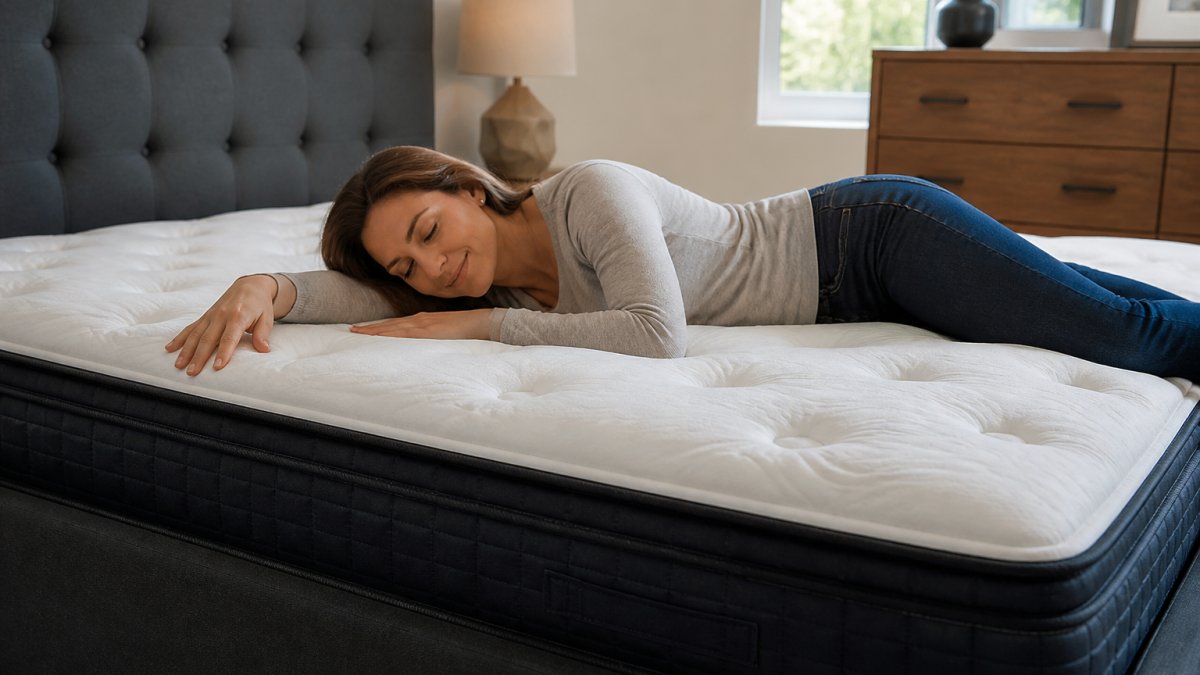
At Durable Mattress, we offer our flippable hybrid mattresses in medium, firm, and soft options. Each side maintains consistent firmness, so you're not trading comfort for durability when you flip.
How Often to Flip Mattress for Maximum Lifespan
The frequency of flipping directly impacts how long your mattress lasts. Many people assume they should flip monthly, but the optimal schedule depends on your mattress type and use patterns.
For a flippable hybrid mattress, we recommend flipping every 3 to 6 months. This rotation distributes body weight evenly across both surfaces, preventing the deep body impressions and sagging that occur when one side bears all your weight year-round. Some manufacturers suggest quarterly flipping for the first year, then semi-annual flipping thereafter.
The logic is straightforward: your body compresses the comfort layers and support core nightly. Over time, one side experiences cumulative compression. Flipping redistributes that stress, allowing compressed foam to recover and extending the mattress's effective lifespan by several years.
Set a calendar reminder for your flip schedule. Many people forget after the first few months, which defeats the purpose. Some families make it a seasonal task, flip with the time change or during spring cleaning. The consistency matters more than the exact interval.
Benefits of Double-Sided Mattresses vs. Single-Sided Designs
The practical advantage of a double-sided mattress is durability and cost-per-year of use. A single-sided mattress forces you to replace it sooner because one surface bears all compression stress. A double-sided design extends usable life significantly.
Consider the financial perspective: if a quality single-sided mattress lasts 6-7 years before noticeable sagging, and a flippable double-sided mattress of similar quality lasts 10-12 years with regular flipping, the per-year cost drops substantially. You're spreading your investment across more sleep nights.
Beyond longevity, double-sided mattresses offer flexibility. If one side develops a preference mismatch, you bought firm but realize you prefer medium, flipping to the other side gives you a different feel without replacing the entire mattress. Some families with different firmness preferences can share a flippable mattress more comfortably than a single-sided one.
The trade-off is weight and flipping effort. Flippable mattresses are heavier than single-sided designs because they require strong construction on both surfaces. Flipping a queen or king mattress requires physical effort and ideally a second person. This isn't a dealbreaker, but it's a real consideration for people with mobility limitations.
Step-by-Step: How to Buy Your Flippable Hybrid Mattress Online
Buying a mattress online without lying on it first creates legitimate anxiety. Here's how to navigate that risk systematically.
Step 1: Assess Your Sleep Needs and Body Type
Start by identifying your primary sleep position. Back sleepers typically need firm to medium-firm support. Side sleepers benefit from softer, more contouring surfaces that cushion the hip and shoulder. Stomach sleepers need firm support to prevent lower back strain. Combination sleepers need balanced firmness that doesn't penalize any position too heavily.
Next, consider your body weight. Lighter individuals (under 150 pounds) can sleep comfortably on softer mattresses. People over 200 pounds typically need firmer support to prevent excessive sinking. Average weight (150-200 pounds) has the most flexibility across firmness levels.
Finally, assess any pain patterns. Chronic back pain often improves with firmer support, though some people find medium firmness more comfortable. Neck pain, shoulder pain, and hip pain suggest you need a mattress that cushions pressure points while maintaining spinal alignment.
Document these factors before shopping. This clarity narrows your options significantly.
Step 2: Verify the Mattress Is Genuinely Flippable
Not every mattress marketed as "flippable" is truly dual-sided. Read the product description carefully. Look for these red flags:
- Descriptions that say "reversible" instead of "flippable" (reversible means end-to-end only)
- Asymmetrical construction (one side quilted, one side unquilted)
- Warnings against flipping in the care instructions
- Thin or minimal quilting on the bottom surface
Genuine flippable mattresses describe both sides explicitly. You should see layer-by-layer construction details for each side, not just one side. Hybrid construction on both sides is a strong indicator of true dual-sided design.
Step 3: Check Return Policy and Sleep Trial
Online mattress retailers typically offer 100-120 night sleep trials. This window allows you to test the mattress in your own bed with your own pillows and sleep patterns. Thirty nights is too short; ninety to one hundred twenty nights is standard and reasonable.
Understand the return logistics: Does the company pick up the mattress, or do you arrange shipping? Are there restocking fees? What condition must the mattress be in? Some companies donate returned mattresses; others recycle them. This doesn't affect your decision, but it's good to know.
A strong return policy is your insurance against online purchase risk. If the mattress doesn't work for you, a hassle-free return protects your investment.
Step 4: Review Warranty and Durability Claims
Mattress warranties typically cover manufacturing defects for 10 years. Read the fine print. Some warranties require regular flipping to remain valid, this is actually a good sign because it shows the manufacturer engineered the mattress for flipping.
Check what the warranty covers. Does it address sagging (usually defined as indentations deeper than 1.5 inches)? Does it cover foam degradation or coil breakage? Full-coverage warranties are stronger than limited ones.
Durability claims should be specific. Avoid vague language like "built to last." Look for concrete claims: "engineered for 10+ years of nightly use" or "tested for 20,000 compression cycles" (equivalent to roughly 10 years of use). These specifics suggest the manufacturer tested the design.
Step 5: Confirm Bed Frame Compatibility
Flippable mattresses are heavier than single-sided designs. Confirm your bed frame can support the weight. Most modern bed frames handle this fine, but older frames or lightweight platforms might struggle.
Check mattress dimensions against your bed frame. A queen mattress is 60 inches wide by 80 inches long. Measure your frame's interior to ensure proper fit. Undersized frames can cause edge support issues.
If you're using a platform bed, ensure slats are spaced no more than 3 inches apart. Wider spacing allows the mattress to sag between slats, defeating the durability advantage of a flippable design.
Step 6: Place Your Order and Arrange Delivery
Most online mattress retailers offer free shipping to your bedroom door. Confirm this before ordering. Some charge for white-glove delivery (assembly and old mattress removal), while others include it.
Delivery timing matters. If your current mattress is failing, order early enough that delivery overlaps. If you're replacing a functional mattress, order when you're ready to transition. Many companies deliver within 1-2 weeks of order placement.
Upon delivery, inspect the mattress for damage before signing. Open the packaging fully and check for tears, stains, or structural issues. If you notice problems, document them with photos and contact customer service immediately.
Comparing Price and Total Cost of Ownership
The sticker price of a flippable hybrid mattress often runs higher than single-sided alternatives, but the total cost of ownership, the price divided by years of useful life, often favors flippable designs.
A quality single-sided mattress might cost less upfront but require replacement every 6-8 years. A flippable mattress costs more initially but lasts 10-12 years with proper care. Spread that cost across the lifespan, and the per-year expense becomes competitive or even cheaper.
Factor in the sleep trial period. If you need to return a mattress that doesn't work, you lose the purchase price. A strong return policy and reasonable sleep trial reduce this risk. Some companies offer partial refunds if you return after the trial period, which softens the financial hit of a poor choice.
Consider financing options. Many online retailers offer payment plans, 0% interest over 12-24 months. This spreads the cost without adding interest, making a higher-quality mattress more accessible.
| Factor | Single-Sided Mattress | Flippable Hybrid Mattress |
|---|---|---|
| Typical Lifespan | 6-8 years | 10-12 years |
| Upfront Cost | Lower | Higher |
| Per-Year Cost | Higher when amortized | Lower when amortized |
| Maintenance | Minimal | Flip every 3-6 months |
| Comfort Consistency | Declines over time | Maintained longer |
Common Mistakes to Avoid When Buying Online
The biggest mistake is buying based solely on price or brand name recognition. A cheaper mattress that doesn't match your sleep needs will be uncomfortable for years.
Second mistake: ignoring the sleep trial period. Some people order, receive the mattress, sleep on it for three nights, decide it's not perfect, and return it immediately. This defeats the purpose.
Third mistake: not flipping regularly after purchase. You've invested in a flippable design; the durability benefit only materializes if you actually flip it. Set calendar reminders and commit to the schedule.
Fourth mistake: overlooking bed frame compatibility. A flippable mattress on an incompatible frame won't perform as designed. Verify frame support before ordering.
Fifth mistake: not reading return policy details. Some companies have strict conditions, the mattress must be in pristine condition, or restocking fees apply. Know the rules before you order.
Sixth mistake: confusing "flippable" with "reversible." Reversible mattresses flip end-to-end but not side-to-side. True flippable designs flip both ways.
Buying a flippable hybrid mattress online requires research, but the durability and cost-per-year value justify the effort.
Frequently Asked Questions
How often should you flip a double-sided mattress?
Most manufacturers recommend flipping your flippable hybrid mattress every 3 to 6 months to ensure even wear and extend its lifespan. Some suggest rotating it quarterly in addition to flipping. Check your mattress warranty for specific guidance, as recommendations vary by construction and materials used in the comfort and support layers.
What are the main benefits of double-sided mattresses?
Double-sided mattresses extend durability by distributing wear across both surfaces, preventing sagging in high-pressure zones. They offer flexibility, you can switch sides if one becomes less comfortable over time. Flippable designs maximize your investment's value by effectively doubling the usable surface area, making them ideal for long-term ownership and reducing replacement frequency.
Can I return a flippable hybrid mattress if it doesn't feel right?
Most online retailers offer sleep trials ranging from 30 to 120 nights, allowing you to test the mattress at home before committing. Review the return policy before purchasing, confirm whether returns are free, whether the mattress must be unused, and how pickup or shipping is handled. This protects you if the firmness level or feel doesn't match your needs.
Are flippable hybrid mattresses really more durable than one-sided mattresses?
Flippable designs can extend mattress life when used as intended, since you're distributing body weight across two surfaces rather than wearing down a single side. However, durability depends on overall construction quality, materials, and how often you actually flip it. Hybrid mattresses with quality coil support cores and foam layers generally offer better long-term durability than budget one-sided alternatives.
Table of Contents
- What Double Sided Mattresses Are and How They Work
- How Often to Flip a Mattress for Maximum Lifespan
- Even Wear and Reduced Body Impressions
- Flippable Mattress vs. One-Sided Mattress: Key Differences
- How to Flip a Mattress Safely and Effectively
- Long-Term Cost Effectiveness and Value
- Who Benefits Most From Double Sided Mattresses
- Conclusion
- Frequently Asked Questions
Last Updated: October 16, 2026
What Double Sided Mattresses Are and How They Work
A double sided mattress is a flippable bed with two distinct sleep surfaces, each built for comfort and support. Unlike one-sided mattresses, both the top and bottom of a double sided mattress are designed for sleeping, so you can flip it periodically to distribute wear evenly.
Construction typically combines foam comfort layers with innerspring or coil support systems. Flipping regularly rotates which side bears your body weight, preventing the concentrated wear that leads to permanent impressions and sagging, and extending usable lifespan versus one-sided alternatives.
At Durable Mattress, we build our flippable mattresses with this principle at the core. Our hybrid collection balances cushioning comfort with durable support in medium, firm, and soft, so you can choose the feel that suits you.
How Often to Flip a Mattress for Maximum Lifespan
Most manufacturers recommend flipping a double sided mattress every three to six months. Exact frequency depends on body weight, sleep position, and how many people share the bed.
Heavier individuals or those who sleep in the same spot nightly should flip every three months; lighter sleepers or couples who rotate positions can stretch to six months. Tying the routine to seasonal changes makes it easier to remember.
The goal is simple: prevent any single area from bearing concentrated pressure too long. Consistent flipping keeps any part from compressing permanently, separating a mattress that lasts a decade from one that sags after three years.
Mark your calendar when you flip. A consistent schedule prevents the "I think I flipped it last month" confusion that leads to skipped rotations and premature wear.
Even Wear and Reduced Body Impressions
Body impressions are permanent indentations that form where your torso, hips, and shoulders rest night after night. On a one-sided mattress, body weight compresses the foam and support layers into your shape, and over time that compression becomes permanent, costing you proper support.
A double sided mattress distributes pressure across two surfaces. Flipping every few months gives the loaded side a rest period to recover while the opposite side handles the load, dramatically reducing the depth and speed of impression formation.
The difference shows after two to three years: a one-sided mattress often has clear body-shaped depressions, while a properly maintained double sided mattress stays relatively flat on both surfaces, keeping its support structure and comfort profile. That even wear is why flippable mattresses typically outlast traditional designs by several years.
The ability to flip distributes wear across two surfaces instead of concentrating it on one. This simple mechanic is the primary reason double sided mattresses last longer and feel supportive for a decade or more.
Flippable Mattress vs. One-Sided Mattress: Key Differences
The core difference between a flippable mattress and a one-sided mattress is construction and durability strategy. A one-sided mattress has a single comfort surface over a base layer not meant for sleeping; once the top compresses, you're stuck with a degrading experience until replacement.
A flippable mattress is engineered as two complete sleep systems stacked back-to-back, both with full comfort and support layers. Each flip switches you to a genuinely fresh sleep surface, not just a worn side rotated back into use.
| Feature | Double Sided Mattress | One-Sided Mattress |
|---|---|---|
| Sleep surfaces | Two full, usable surfaces | One optimized surface |
| Flipping benefit | Extends lifespan by 40-60% | No benefit; cannot flip |
| Body impression timeline | 5-7 years to noticeable depth | 2-3 years to significant sagging |
| Long-term support | Maintains firmness across lifespan | Degrades progressively |
| Repair options | Flip to fresh surface when worn | Replace mattress |
| Best for | Long-term value seekers | Budget-conscious buyers accepting shorter lifespan |
One-sided mattresses cost less upfront because manufacturers skip half the construction. Flippable mattresses require twice the engineered layers, raising the initial investment, but cost-per-year often favors the flippable design because you replace it less often.
How to Flip a Mattress Safely and Effectively
Flipping a mattress safely takes two people and proper technique to avoid strain or damage:
First, strip all bedding and clear the floor around the bed. Remove any bed frame components in the way, and if the mattress is in a tight corner or against a wall, move it to the center of the room.
Stand on opposite sides, one person at the head and one at the foot. Bend at your knees, not your waist, and grip the edges or handles firmly. On the count of three, lift together, rotate 180 degrees so the head end becomes the foot end, then flip so the bottom faces up, rotating and flipping at once is the most efficient method.
For heavy mattresses or mobility concerns, a mattress flipper tool or furniture dolly reduces strain. Some prefer to rotate first (spin 180 degrees without flipping), then flip on a separate occasion, slower, but less physically demanding.
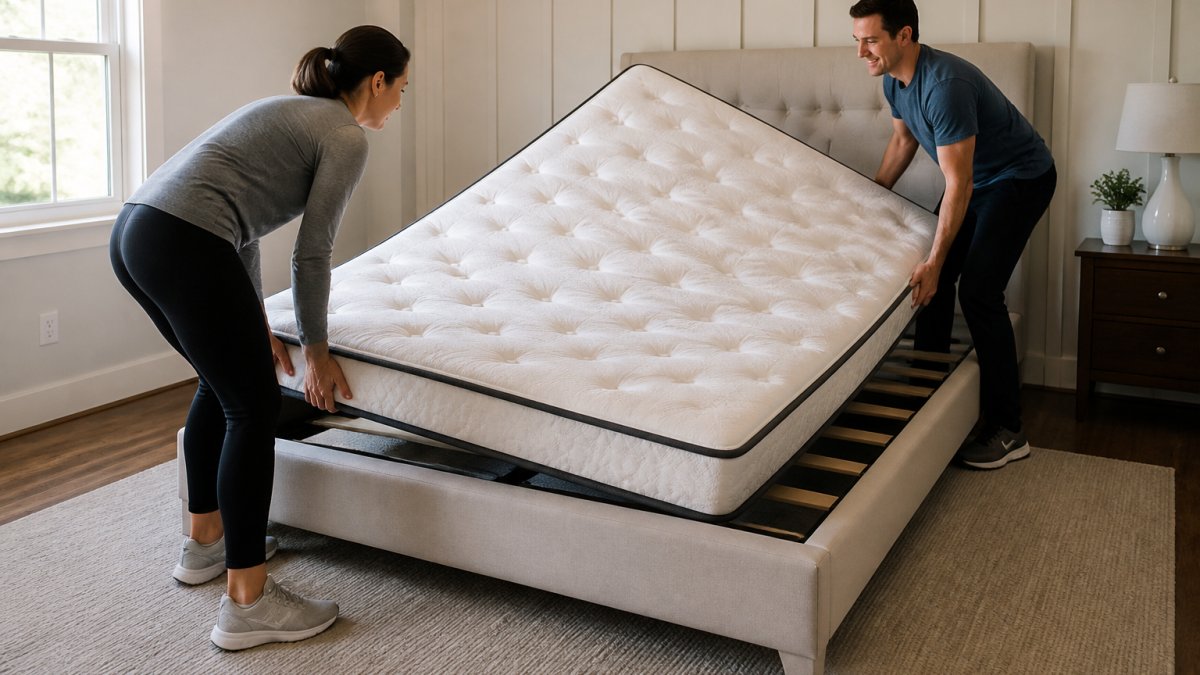
After flipping, let the mattress settle for a few hours before making the bed so compressed areas can begin recovering. If you notice odors or moisture, ventilate the room before sleeping on the newly flipped side.
Never flip a mattress alone if it weighs over 100 pounds. Attempting to lift and rotate solo significantly increases injury risk to your back, shoulders, and wrists. A second person or mechanical aid is worth the effort.
Long-Term Cost Effectiveness and Value
The usual line is that a double sided mattress costs more upfront but lasts longer, so it wins on cost per year.
The basic cost-per-year formula
Cost per year = purchase price ÷ realistic years of service. The catch is that "realistic years of service" depends far more on materials and construction than on whether the mattress flips.
The honest framing: flipping is a multiplier on good construction, not a substitute. A two-sided mattress made with low-density foam will still break down, just on a slightly longer timeline.
A transparent example
Suppose a one-sided mattress costs $1,000 and serves 6 years, about $167 per year.
The lesson: run the numbers with your own price quotes and a conservative lifespan estimate for each option. Do not accept "lasts twice as long" as a given.
What actually drives lifespan
- Support core density and gauge. Higher-density foam and heavier-gauge coils resist compression longer. This matters more than the number of sleep surfaces.
- Comfort layer quality. Low-density comfort foam is the first thing to break down, on either design.
- Foundation and frame support. A sagging or flexing foundation accelerates wear regardless of how often you flip.
- Body weight and sleep position. Higher weight and a fixed sleep position concentrate load and shorten life on any mattress.
- Rotation and flipping discipline. Consistent flipping is what unlocks the two-sided advantage. Skip it and you are paying a premium for a feature you are not using.
The non-financial value
Cost per year is not the only variable. Fewer replacement cycles mean fewer shopping trips, delivery windows, and disposal hassles, real value if you dislike the mattress-buying process, even when dollar savings are modest.
When one-sided makes more sense
Treat the value claim as a calculation, not a slogan. Compare upfront price against a conservative lifespan estimate for each specific mattress, and remember that construction quality sets the ceiling while flipping only helps you reach it.
Who Benefits Most From Double Sided Mattresses
Whether a double sided mattress is worth it depends less on the mattress than on you: sleep position, body weight, how you use the bed, and whether you'll keep up with flipping.
By sleep position
- Side sleepers concentrate pressure at the hips and shoulders, which is exactly where one-sided mattresses develop deep impressions first. A flippable design lets you move that load to a fresh surface, so side sleepers tend to see the clearest benefit. They also generally need a softer, more contouring surface to keep the spine aligned, so a soft or medium flippable model is often the better match.
- Back sleepers need even support along the spine and are usually well served by a medium to medium-firm feel. Because they tend to sleep in a consistent position, they also concentrate wear in predictable zones, another good case for flipping.
- Stomach sleepers need a firmer surface to keep the hips from sinking and the lower back from arching. They often move around more during the night, which spreads pressure and can mean slightly slower wear. The benefit of flipping is real but less dramatic for this group.
- Combination sleepers who shift positions throughout the night distribute load more evenly, so they may see a smaller durability advantage from flipping.
By body weight
Higher body weight accelerates compression on any mattress, most pronounced on lower-density comfort layers. Sleepers above roughly 200 pounds often find a one-sided mattress softens noticeably within a few years, making the dual-surface design of a flippable mattress more valuable.
Lighter sleepers put less stress on the comfort layers and may find that a well-built one-sided mattress lasts long enough that the flipping advantage is modest.
By firmness preference
Firmness is personal, but the guidance holds: softer contours more and suits side sleepers and lighter bodies; firmer supports more and suits back and stomach sleepers and heavier bodies.
Who should not flip a mattress
This is the part most benefit pages leave out. Do not flip:
- One-sided mattresses. Many modern beds have a single sleep surface and a non-sleepable base. Flipping puts you on the support core.
- Mattresses with a designated head and foot. Some two-sided models are built to be rotated end-to-end, not turned over. Check the law tag or care instructions.
- Mattresses with structural damage. A torn cover, exposed coils, or a broken edge support will not be fixed by flipping.
- Anyone unable to handle the weight safely. If lifting and turning the mattress is a strain or a fall risk, rotation-only or a professional service may be the better routine.
A quick self-check
If you sleep mainly on your side or back, weigh above roughly 200 pounds, plan to keep the mattress for years, and will commit to flipping every few months, a double sided mattress is likely a strong fit.
The benefit of a double sided mattress is conditional. It rewards sleepers who concentrate pressure in fixed spots, carry more weight, and will actually flip on schedule. For everyone else, construction quality matters more than the number of sleep surfaces.
Conclusion
Double sided mattresses address a fundamental problem with traditional design: concentrated wear in predictable locations. Distributing pressure across two sleep surfaces through regular flipping extends lifespan, maintains support, and reduces costly replacements.
The durability advantage is real: a properly maintained double sided mattress resists body impressions and sagging significantly longer than a one-sided alternative, delivering genuine long-term value for anyone wanting a decade or more of performance.
Durable Mattress engineers our flippable collection with this principle at the core. Our hybrid construction, in medium, firm, and soft, balances comfort and durability to make flipping worthwhile, an investment in years of consistent, supportive sleep rather than repeated replacements.
Consumer Reports mattress durability testing
Sleep Foundation guide to mattress lifespan and care
American Chiropractic Association recommendations on mattress support
Frequently Asked Questions
Are double sided mattresses more durable than one-sided mattresses?
Yes, double sided mattresses typically last longer because flipping distributes wear across both surfaces. One-sided mattresses concentrate all body weight and pressure on a single comfort layer, causing faster sagging and deterioration. By rotating use between two surfaces, flippable designs extend the overall lifespan and maintain consistent support longer than traditional one-sided options.
How often should you flip a double-sided mattress?
Most manufacturers recommend flipping every 3 to 6 months for optimal wear distribution. Some suggest rotating quarterly and flipping semi-annually. The exact frequency depends on your mattress construction, body weight, and sleep position. Heavier sleepers may benefit from more frequent flipping. Check your mattress care guidelines for brand-specific recommendations to maximize longevity.
What are the main benefits of a double-sided mattress?
The primary benefits include extended lifespan through even wear distribution, reduced body impressions and sagging, improved long-term comfort consistency, and better value over time. Double sided mattresses also offer flexibility if you prefer switching between firmness levels, and they reduce the need for early replacement, making them a cost-effective investment for homeowners seeking durability.
Is flipping a mattress really worth the effort?
Yes, regular flipping significantly extends mattress life and prevents premature sagging. While it requires minimal effort every few months, the payoff is substantial: you avoid replacing your mattress every 5-7 years and instead enjoy 10+ years of consistent support. For value-conscious buyers investing in quality construction, the maintenance effort is worthwhile and pays dividends in long-term comfort and cost savings.
Table of Contents
- How Often to Flip a Mattress: The Basics
- How Often to Rotate a Mattress
- Mattress Rotation vs. Flipping: What's the Difference?
- How to Flip a Mattress Safely
- Why Are Mattresses Not Flippable Anymore?
- Flipping and Rotation Schedules by Mattress Type
- What to Do When Your Mattress Already Sags
- Frequently Asked Questions
Last Updated: October 9, 2026
How Often to Flip a Mattress: The Basics
Knowing how often to flip a mattress is one of the simplest ways to extend its lifespan and prevent sagging. Most double-sided mattresses benefit from regular flipping, while modern one-sided designs require only rotation. At Durable Mattress, our 2-sided flippable mattresses are engineered to distribute wear evenly.
The general rule: flip your mattress every six months if it's designed to be flipped, giving both sides equal time supporting your body weight.
The 6-Month Rule for Double-Sided Mattresses
Double-sided mattresses are built to be flipped. Flipping every six months keeps both surfaces in good condition, like rotating tires on a car.
Some flip every three months, others stretch it to nine. The key is consistency.
Mark your calendar or set a phone reminder, many people flip when seasons change or on their birthday.
Why Frequency Matters for Mattress Lifespan
A mattress that never gets flipped will sag in the same spots where you sleep night after night, as body weight creates an indent and the support underneath weakens.
Flipping spreads that wear across both sides, so both surfaces share the load. This simple step can add years to your mattress.
Neglecting to flip is one of the biggest reasons mattresses fail early, soft spots, body-shaped impressions, and reduced support within a few years.
How Often to Rotate a Mattress
Rotation is different from flipping. When you rotate, you turn the mattress 180 degrees, moving the head end to the foot end, which addresses wear patterns along its length.
Even one-sided mattresses need rotation, which prevents the head area from wearing faster than the foot area.
Rotation Schedules by Mattress Type
One-sided mattresses should be rotated every three to six months.
Double-sided mattresses can be both flipped and rotated. Many people flip every six months and rotate every three months for maximum longevity.
Memory foam and latex mattresses often come one-sided. Rotate these every three to four months.
Innerspring and hybrid mattresses vary by design. Check your manufacturer's instructions, some can be flipped, others cannot.
Mattress Rotation vs. Flipping: What's the Difference?
These two tasks do different jobs, and confusing them can damage a modern mattress or void your warranty.
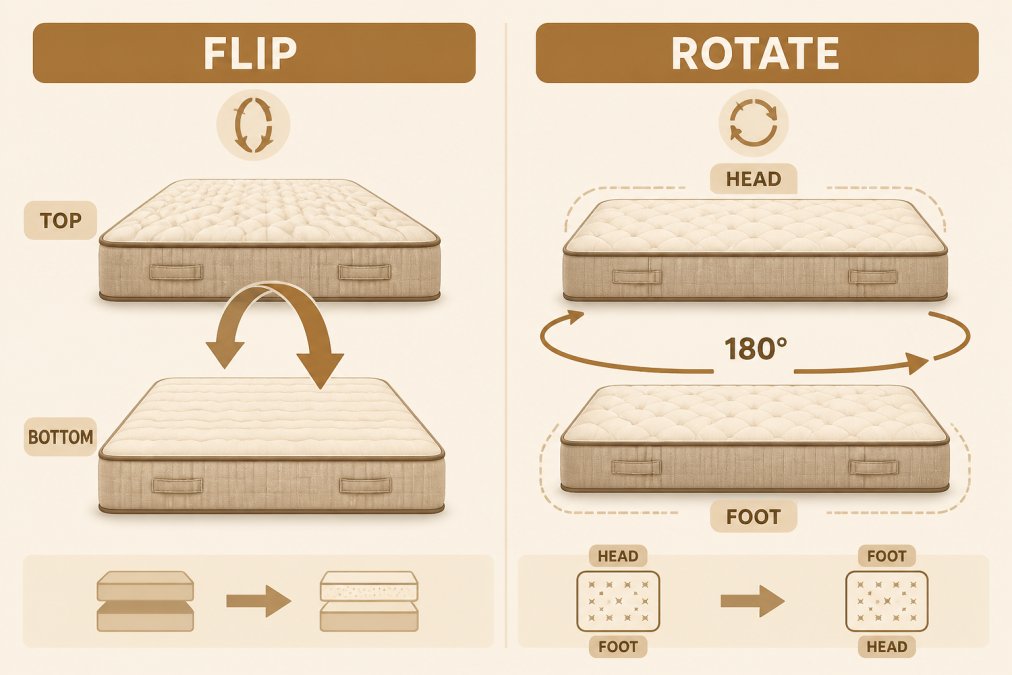
Flipping means turning the mattress over completely, so the bottom becomes the top. This works only on double-sided designs where both surfaces are equally supportive.
Rotating means turning the mattress 180 degrees along its length. The head end moves to the foot end. The top stays on top. Rotation works on all mattress types, including one-sided models.
How to Tell If Your Mattress Is Flippable
Before you flip anything, confirm your mattress is designed for it. Here is a quick identification method:
- Check the care label. Look for the sewn-in tag on the mattress edge or under the bottom. Flippable mattresses typically say "flip and rotate" or "double-sided." One-sided mattresses usually say "rotate only" or "do not flip."
- Look for a pillow-top or euro-top. If the top surface has a sewn-on extra comfort layer, it is almost certainly one-sided. Flipping would put that layer face-down against the foundation.
- Inspect the bottom surface. On a double-sided mattress, the bottom looks and feels like the top, same quilting, same fabric, same cushioning. On a one-sided mattress, the bottom is often a plain, darker fabric with no quilting.
- Check the warranty terms. Many manufacturers void coverage if a one-sided mattress is flipped. The warranty document will state whether flipping is permitted.
If you are unsure whether your mattress is flippable, rotate only. Rotating is safe for every mattress type and will not void your warranty. Flipping a one-sided mattress can expose the support core, reduce comfort, and damage the internal structure.
When to Flip vs. When to Rotate
If your mattress is double-sided and flippable, do both. Flip it every six months to use both surfaces. Rotate it every three months to prevent head-to-foot wear patterns.
If your mattress is one-sided (most modern mattresses are), rotate only. Flipping would expose the non-functional bottom layer and might void your warranty.
Always read your manufacturer's instructions before flipping. When in doubt, rotate only.
Why the Confusion Exists
The query "how often to flip mattress" is common because older mattresses, particularly innerspring models made before the 2000s, were almost all double-sided, so flipping was standard advice. Today most mattresses sold are one-sided, but the old advice persists, and many people flip mattresses that should only be rotated, causing premature wear.
How to Flip a Mattress Safely
Flipping a mattress is straightforward, but it requires the right technique to avoid injury or damage. Most full-size mattresses weigh 50-80 pounds; queen and king sizes can exceed 100 pounds.
Step-by-Step Flipping Instructions
Step 2: Get help. Never flip a mattress alone. One person on each side is the minimum.
Step 3: Position yourselves. Stand on opposite sides of the bed.
Step 5: Flip it over. Once the mattress is off the bed, flip it in one smooth motion.
Step 7: Replace bedding. Add clean sheets and make the bed as usual.
Tools and Help You'll Need
A mattress flipping tool, handles or straps that attach temporarily for better grip, isn't essential but costs $20-$50 and is worth it for heavier mattresses.
If you don't have a flipping tool, ask a friend or family member for help.
Some moving companies offer mattress flipping services, usually $30-$60 per flip, worth considering if you have mobility issues or a very large mattress.
Why Are Mattresses Not Flippable Anymore?
Modern mattress design has shifted away from double-sided, flippable models. Most new mattresses are one-sided. Understanding why helps you make better purchasing decisions.
Manufacturers discovered that customers prefer specialized comfort layers on top. Memory foam, latex, and pillow-top designs create a specific feel. Making both sides identical meant sacrificing that customization.
One-sided mattresses also cost less to produce, since manufacturers use cheaper materials on the bottom layer that won't contact your body.
One-Sided vs. Double-Sided Mattress Construction
One-sided mattresses have a comfort layer on top and a support layer on the bottom. The bottom is designed purely for structural support, so you never flip them.
Double-sided mattresses have comfort and support on both surfaces, so you can flip them without losing comfort or support.
The trade-off is clear: one-sided mattresses wear out faster, while double-sided flippable mattresses last longer because you're using both surfaces.
Flipping and Rotation Schedules by Mattress Type
Different mattress materials need different care. The schedule below is a starting point, but your manufacturer's care label and warranty always take priority.
Memory Foam Mattress Care
Memory foam mattresses are almost always one-sided. The foam top layer is what makes them comfortable, it's not designed to be flipped.
Rotate memory foam mattresses every three to four months, since the foam can develop permanent body impressions over time.
Memory foam is sensitive to heat, so keep your bedroom temperature moderate and avoid jumping on the mattress or putting excessive weight on one area.
Innerspring and Hybrid Mattress Care
Innerspring mattresses have metal coils for support and a comfort layer on top. Some older models are flippable, but most modern ones are one-sided.
Check your documentation. If your innerspring mattress is flippable, flip it every six months. If it's one-sided, rotate it every three to four months.
Hybrid mattresses combine foam and coils. Most hybrids are one-sided due to the foam layer on top. Rotate every three to four months.
Latex Mattress Care
Latex mattresses can be either one-sided or double-sided depending on the manufacturer. Many latex cores are flippable because latex is durable and symmetric. Check your care label.
If flippable, flip every six months and rotate every three months; if one-sided, rotate every three to four months. Latex resists dust mites and mold but can still develop impressions if not rotated.
Pillow-Top and Euro-Top Mattresses
Pillow-top and euro-top mattresses have a sewn-on comfort layer on one side only, so they are never flippable. Flipping would put the pillow-top face-down against the foundation, ruining the comfort layer and potentially damaging the seams.
Rotate every three to four months. Do not attempt to flip.
Adjustable Bed Mattresses
Adjustable bed mattresses are engineered for a specific orientation on a hinged or articulating frame. Never flip one, the internal structure, including any zoned support or reinforced edges, is designed for a fixed top and bottom.
Rotation depends on the frame. Some adjustable mattresses can be rotated head-to-foot; others have a tapered or split design that prevents rotation. Check your manual.
Zoned Mattresses
Zoned mattresses have different support levels along the length of the bed, typically firmer in the middle for hips and softer at the head and foot, calibrated for a specific orientation.
If your mattress is zoned, check the care label before rotating. Some allow rotation; many do not. Never flip a zoned mattress unless the label explicitly says it is double-sided.
Quick Reference Schedule
| Mattress Type | Flip? | Rotate? | Frequency |
|---|---|---|---|
| Double-sided innerspring | Yes | Yes | Flip every 6 months, rotate every 3 months |
| One-sided innerspring | No | Yes | Rotate every 3-4 months |
| Memory foam | No | Yes | Rotate every 3-4 months |
| Latex (flippable) | Yes | Yes | Flip every 6 months, rotate every 3 months |
| Latex (one-sided) | No | Yes | Rotate every 3-4 months |
| Hybrid | No | Yes | Rotate every 3-4 months |
| Pillow-top / euro-top | No | Yes | Rotate every 3-4 months |
| Adjustable bed | No | Check manual | Rotate every 4-6 months if allowed |
| Zoned | No | Check label | Follow label; often rotate only if permitted |
Set a recurring reminder on your phone or calendar for the first day of each quarter. Rotate then. If your mattress is flippable, add a flip reminder every six months, many people pair it with daylight saving time changes or their birthday.
How to Prioritize the Care Label Over Generic Advice
Every mattress ships with a care label, and many include a warranty document. These are the authoritative sources for your model.
If your care label says "rotate only," do not flip. If it says "do not rotate," follow that instruction.
Following the label protects your warranty. Many warranties require proof of proper maintenance, and flipping a one-sided mattress or rotating a zoned mattress against instructions can void coverage.
What to Do When Your Mattress Already Sags
If your mattress already has visible sagging or body impressions, flipping or rotating won't fix it, the damage is done.
A mattress topper can temporarily improve comfort.
Rotate the mattress to even out the wear.
Check your warranty. Many mattresses have a sagging guarantee: if yours sags more than 1.5 inches within the warranty period, the manufacturer may replace it.
If the mattress is beyond repair, it's time to replace it.
Frequently Asked Questions
How often should you flip a mattress?
For double-sided flippable mattresses, flip every 6 months to promote even wear and extend lifespan. For one-sided mattresses, rotate 180 degrees head-to-foot every 3 months instead. Memory foam and pillow-top mattresses should only be rotated, never flipped. Always check your mattress manufacturer's recommendations, as specific construction details affect the ideal schedule.
What is the difference between flipping and rotating a mattress?
Flipping turns your mattress over completely to use the opposite sleep surface, distributing wear across both sides. Rotating turns the mattress 180 degrees so the head end becomes the foot end, evening out pressure points without exposing the underside. Flipping works only for double-sided mattresses; rotating works for all types. Double-sided mattresses benefit from both practices.
Does flipping a mattress make it last longer?
Yes, flipping double-sided mattresses significantly extends their lifespan. Regular flipping distributes body weight and pressure more evenly across both surfaces, preventing sagging and body impressions in a single spot. This practice reduces wear and tear, helping your mattress maintain comfort and support for years.
Why are mattresses not flippable anymore?
Most modern mattresses are one-sided because manufacturers now use specialized materials like memory foam and pillow-top layers designed for the top surface only. These comfort layers perform best facing up and would feel uncomfortable or provide poor support if flipped. Double-sided flippable mattresses like hybrid designs distribute support layers more evenly, allowing safe flipping while maintaining comfort on both sides.
Premature sagging is frustrating after investing in a mattress. The good news: choosing a flippable design prevents this problem. At Durable Mattress, our 2-sided hybrid mattresses are engineered specifically for flipping, which distributes wear evenly across both surfaces and extends longevity. With multiple firmness levels, medium, firm, and soft, you get customized support that lasts. Shop our mattress collection and invest in a mattress built to last a decade or more.
Double the life of your mattress today
Our mattresses will help you get the sleep you need. Not sure which one’s right for you? Check out our firmness guide below.